The county commissioner meeting was held the second Thursday of the month in a low brick building with bad acoustics and worse coffee.
I got there early. I wore my good dress — the navy one Earl liked — and I carried a leather portfolio with the 1949 water-rights deed inside, protected in a plastic sleeve.
Tom Bricker was already there. Khaki uniform traded for a gray suit. Two lawyers beside him in better suits. They had a poster board on an easel showing the pipeline route — a clean blue line slicing across a map of the county, straight through the middle of my 480 acres.
They looked confident.
They had no idea what was in my portfolio.
The pipeline company presented first. Forty-five minutes of slides about energy independence and economic development and “minimal surface disruption.” One of the lawyers used the phrase “eminent domain authority” four times, like saying it enough would make it absolute.
Then the chairman opened the floor for public comment.
I raised my hand.
“Clara Mae Jessup,” I said when they called me. “I own the property at the center of that blue line.”
I walked to the podium. I’m seventy-one. My knees aren’t what they were. But I stood up straight the way Earl taught me and I set my portfolio on the podium and I opened it.
“The pipeline company sent me a letter saying they intend to take a corridor through my land under eminent domain,” I said. “I’m here to tell this commission, and these gentlemen, that they cannot.”
One of the lawyers smiled. The condescending kind.
“Mrs. Jessup, with respect, eminent domain is a well-established legal authority. Your objection is noted, but the law is clear—”
“The law is clear,” I agreed. “That’s exactly why I’m here.”
I pulled out the deed.
“In 1949, my husband’s father filed and recorded senior water rights to the aquifer beneath our property. It’s stamped and sealed by the Midland County Clerk. I have the original here, and a certified copy was confirmed by the clerk’s office on Tuesday.”
The lawyers stopped smiling.
“Your proposed pipeline route,” I continued, “crosses directly over my mineral and water estate. And under Texas water law — which I had a lawyer in Midland walk me through three times to be sure — a senior water rights holder’s consent is required before any easement can disturb the aquifer’s recharge zone. Eminent domain for a pipeline corridor does not override pre-existing, recorded, senior water rights on a separately deeded estate.”
The room was very quiet.
The chairman leaned forward. “Is this accurate, counsel?”
The lawyers were whispering to each other.
“We’ll need to review the filing,” one of them said.
“Take your time,” I said. “It’s been valid for seventy-five years. It’ll keep.”
The chairman tabled the pipeline approval pending legal review of my filing. Tom Bricker and his lawyers gathered their poster board and left without making eye contact.
An old rancher named Dell Hutchins caught me in the parking lot afterward. He’d been fighting the same company over an easement on his place for a year.
“Clara Mae,” he said, hat in his hands. “Where’d you learn about water rights?”
“My husband’s filing cabinet,” I said. “And a lawyer named Renata. I’ll give you her number.”
He took it. So did four other landowners along that pipeline route before I made it to my truck. By the end of the week, half the county had called Renata’s office.
Turns out I wasn’t the only one with an old deed in a drawer. I was just the first one brave enough to open it.
I’d like to tell you the whole thing ended that night. It didn’t. These things never do. There were six more weeks of letters and reviews and a hearing where the company’s lawyers tried to argue the deed was ambiguous, that the recharge zone didn’t extend to the corridor, that the 1949 filing was superseded by later statutes.
It wasn’t. My Midland lawyer — a sharp young woman named Renata who took my case for a flat fee because she said she’d “been waiting her whole career for a deed like this” — dismantled every argument.
The aquifer recharge zone did extend to the corridor. The 1949 filing was senior and valid. And the pipeline could not cross my land without my consent.
The company’s lawyers requested a private hearing before the county’s legal counsel to challenge the deed. I brought Renata. They brought three attorneys and a hydrology consultant.
The consultant testified that the aquifer recharge zone “might not extend” to the pipeline corridor. Renata had her own hydrologist — a retired professor from Texas Tech who’d studied the Midland aquifer for thirty years. He testified for forty minutes, with maps and core samples, that the recharge zone absolutely extended to the corridor, and then some.
The company’s consultant folded under cross-examination. Admitted he’d been hired two weeks earlier and hadn’t done original fieldwork.
The county counsel ruled my deed valid and senior. The eminent domain claim could not proceed over my water estate.
That’s when the lawyers’ tone changed entirely.
So they offered to buy my consent.
First number: fifty thousand. I said no.
Second number: two hundred thousand. I said no.
Third number: four hundred thousand and a re-route around the southern edge of my property where it wouldn’t touch the recharge zone.
I thought about that one for a while.
Because here’s the truth: I’m seventy-one. I don’t need four hundred thousand dollars. But I also don’t want a pipeline anywhere near Earl’s land, near the water his father protected, near the soil where I plant winter onions every October.
So I made a counter-offer.
I told them I would grant a narrow easement along the very southern fence line — the part that’s mostly caliche and rattlesnakes — in exchange for two things. One: a payment, which I directed entirely to a conservation trust. And two: a permanent conservation easement on the remaining 460 acres, legally protecting it from any future development, drilling, or pipeline, forever.
They didn’t like the second part. It meant they could never come back. Never widen. Never add a second line.
But they wanted the route. And mine was the only land that completed it.
They signed.
The pipeline runs along my southern fence now, where I never go. The other 460 acres are protected in perpetuity — Earl’s land, his father’s water, my onions — held in a conservation easement that no eminent domain authority on earth can touch.
Renata framed a copy of the 1949 deed and gave it to me as a closing gift. It hangs in the front hall now, next to a photo of Earl in his barn.
Tom Bricker sent me a card, if you can believe it. “Mrs. Jessup — you were the toughest negotiation of my career. Respect. — T.B.”
I keep it on the refrigerator.
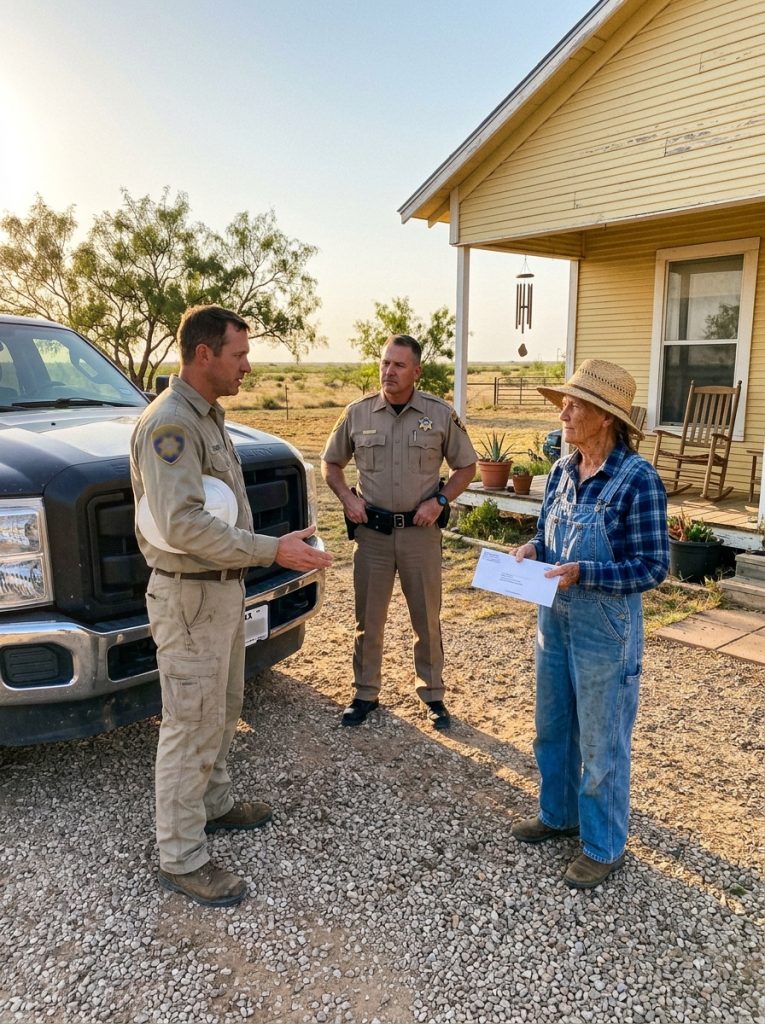
People underestimate old women in straw hats. They see the trowel and the overalls and the wind chimes on the porch and they think: easy. Sign here. Pocket change.
But Earl left me more than land.
He left me a filing cabinet I was finally brave enough to open.
And inside it was everything I needed.
DO NOT LOSE, his father had written on the envelope.
I didn’t.