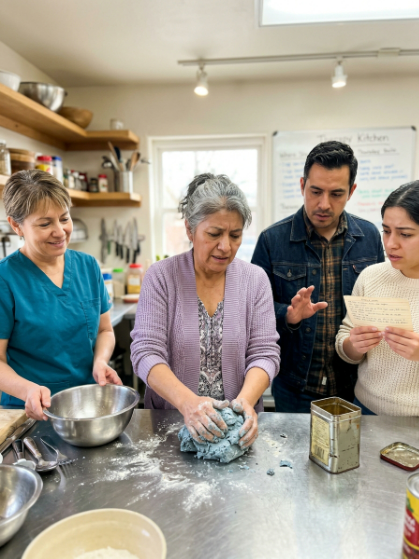
Clara did not ask me another question until my breathing slowed.
That was one of the first things I trusted about her.
Other people tried to fill every quiet place around me because my silence scared them. Clara let the quiet do its work.
The dough sat under my palms.
The torn recipe card lay between Maribel and me.
Adrian Sol stood on the other side of the counter, pale in a way that did not match the warm Santa Fe morning.
I asked him the name of the restaurant.
His throat moved before the words came out.
Sol y Maiz.
The room shifted.
Not because the name meant anything to anyone else.
Because it meant something to my body before my mind could catch up.
My left hand closed around the edge of the counter. My right hand reached for the dented spice tin without permission.
Maribel stepped closer.
Mom, she said, we can stop.
I shook my head.
I did not want to be brave. I wanted to understand why the name of a restaurant I could not remember had made my knees soften.
Adrian said his grandmother had run Sol y Maiz for thirty-one years on the south side of town. He said the restaurant closed after a kitchen fire when he was a child. He said most of her handwritten recipes were lost.
Then he looked at the card.
May I?
Maribel held it tighter.
She was not being rude. She was guarding me with the only tools she had.
Clara said, Rosa decides.
The sentence settled in me.
Rosa decides.
After months of doctors, forms, scans, schedules, and everyone telling me what was safest, those two words felt almost too large.
I nodded.
Maribel placed the torn card on the counter.
Adrian did not grab it. He turned it carefully with two fingers, like the paper might be tired.
Only half the title remained.
Blue corn.
A measurement for toasted cumin.
A note in the margin that said, not too wet, she knows by feel.
Adrian covered his mouth.
That is my grandmother’s handwriting, he said.
I stared at the card.
Nothing happened at first.
No curtain lifting.
No perfect movie memory.
Just the smell of the spice tin and the pressure of dough under my thumb.
Then I heard a spoon hit tile.
Not in the therapy kitchen.
Somewhere else.
A woman laughed and told me not to panic because every kitchen breaks something before lunch.
I closed my eyes.
The blue tiles came back sharper this time.
Not a flash.
A wall.
A sink.
A steam-clouded window with a crack near the latch.
A woman with silver hair pulled into a braid, standing beside me and tapping my wrist because I was pressing too hard.
Do not fight the dough, Rosita.
Rosita.
Nobody called me that except my father when I was small.
And her.
Estela.
I said the name aloud.
Adrian made a sound that was not quite a sob.
My daughter turned toward him.
You knew my mother?
Advertisement
Adrian shook his head, but his eyes stayed on me.
I think my grandmother did.
The memory arrived in pieces after that.
I was twenty-two.
Maybe twenty-three.
I had gone to Sol y Maiz after my first husband left and I needed work that paid cash by Friday. I was not a chef. I was a frightened young woman who could wash pans faster than anyone else because standing still made me feel poor in a way I could not bear.
Estela Sol hired me for dishes.
Within two weeks, she had me chopping onions.
Within a month, she had me arriving before sunrise to grind corn because she said my hands listened.
I had forgotten that sentence.
My hands listened.
The memory hurt, but not the way Maribel feared.
It hurt like stretching a cramped muscle.
I cried without covering my face.
Maribel put one arm around my back and did not tell me to calm down.
Adrian asked if I remembered the fire.
The therapy kitchen blurred.
For a moment I smelled smoke.
My whole body tried to back away from the counter.
Clara stepped beside me, steady and quiet.
You are here, she said. Stainless counter. Morning light. Maribel beside you.
I repeated the words.
Stainless counter.
Morning light.
Maribel beside me.
The smoke receded.
The memory did not.
The fire had started after closing.
A wire, maybe.
I remembered sirens washing the walls red. I remembered Estela crying in the alley with flour on her apron. I remembered grabbing a metal recipe box from a shelf near the office before someone pulled me back.
Not everything survived.
But some cards did.
I must have kept them.
I turned to Maribel.
Do we have a blue box at home?
She frowned through tears.
In the hall closet, she said. With Christmas lights and old insurance papers. I thought it was junk.
I laughed once.
It came out broken, but it was still a laugh.
Adrian lowered himself onto the stool near the counter as if his legs had stopped negotiating with him.
My father looked for those recipes for years, he said.
There was no accusation in his voice.
Only grief that had found a door too late and was afraid to knock.
I wanted to apologize.
For forgetting.
For keeping something that belonged to his family.
For having a brain that could remember the pressure of dough but not a man’s search for his grandmother’s handwriting.
But Clara stopped me before shame could turn into speech.
Rosa, she said, did you preserve those cards because Estela asked you to?
The question opened another small room in my mind.
Estela in the alley.
Her hands blackened with soot.
Her voice shaking.
If anything can still feed people, keep it safe.
I looked at Adrian.
She told me to keep them safe.
He pressed both hands over his eyes.
For a long moment, no one in the therapy kitchen moved.
Then Maribel did something that changed me more than the memory had.
She picked up the torn recipe card and did not treat it like evidence of my injury.
She treated it like proof of my life.
Mom, she whispered, you never told me you worked in a restaurant.
I looked at her face, my beautiful exhausted daughter who had been measuring me in appointments and pill organizers and safe shower rails.
Maybe I forgot before the accident too, I said.
That was the truth.
Not all forgetting comes from injury.
Some comes from surviving.
I had tucked those years away after I remarried, after Maribel was born, after bills and school lunches and ordinary life took over. The restaurant had burned. Estela had died. I had kept the box because I promised to, then hidden the promise so well that only my hands remembered.
Adrian asked if I could finish the dish.
Maribel stiffened.
Clara looked at me.
Again, no one answered for me.
I pressed my fingers into the dough.
This time, I was afraid.
Not of the memory.
Of failing it.
But the first piece opened correctly under my thumb. The next folded the way it should. I added the spice blend in the old order, not because I saw instructions, but because the smell changed when the balance was right.
Adrian watched like a boy hearing a bedtime story in a language he thought was gone.
When the dish was done, Clara warmed a small pan.
The therapy kitchen smelled like toasted corn and cumin and something green I could not name until I crushed it between my fingers.
Epazote.
The word came back whole.
Adrian laughed and cried at the same time.
We tasted it from paper plates because rehab centers are not built for ceremony.
He took one bite and bent forward over the counter.
That is hers, he said.
No one clapped.
That would have made it smaller.
We just stood there with the morning light and the dented spice tin, letting a lost woman, a lost restaurant, and a lost version of me sit at the table with us.
That afternoon, Maribel drove home and found the blue metal recipe box.
She brought it back wrapped in a towel.
Inside were smoke-smudged cards, folded menus, and a photograph of Estela standing beside a younger me in a flour-dusted apron.
I was smiling like I knew exactly who I was.
For a second, that hurt worse than not remembering.
Then Maribel touched the photograph.
You look happy, she said.
I was, I said.
And I am.
The next week, Adrian returned to the rehab center with a proposal, not a performance.
He did not ask to take the recipes and disappear into his restaurant with them. He asked if I would help him rebuild the dishes as part of a culinary therapy program, with my name and Estela’s name on every page.
Clara made him put it in writing.
I loved her for that.
Maribel read the agreement twice. Then she cried in the parking lot because she said she had spent months looking at me like a patient and had forgotten I was also a woman with whole rooms inside me.
I told her we both forgot things.
We could both remember differently.
The program started with six patients, one portable stove, and me sitting on a stool because my balance was still unreliable.
I could not always remember the day of the week.
I still misplaced words.
I still had mornings when my own bathroom mirror startled me.
But when blue-corn dough touched my palms, I could teach.
Not everything came back.
That was important to admit.
Memory is not a drawer you pull open to find all the missing pieces waiting politely.
Some pieces were gone.
Some returned changed.
Some, like Estela’s recipe, had been waiting in my hands for years.
Adrian reopened one family dish at a time, never calling it a comeback because that sounded too clean. He called it a continuation.
Maribel came to every session she could.
At first she watched me with worry.
Then with pride.
Then, one morning, she rolled up her sleeves and asked me to show her how to know when the dough had enough water.
I took her hands in mine.
Not too wet, I said.
She smiled through tears.
She knows by feel.
The dented spice tin stayed on my kitchen shelf, right where my hands could find it.