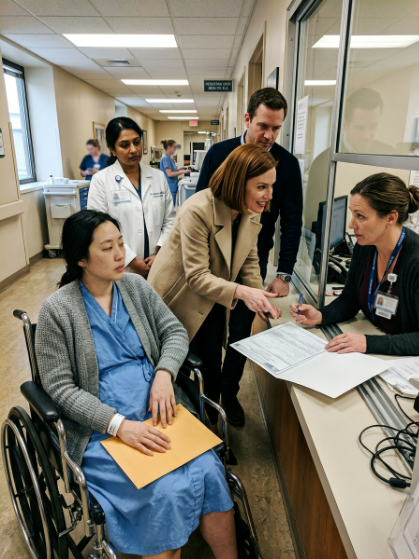
April Jensen did not pick up the birth certificate packet first.
She picked up my envelope.
That was the detail Brooke noticed before anyone else did.
Her face changed so fast it almost hurt to watch. The polite hospital smile vanished. Her lips parted. Daniel stepped forward like the counter belonged to him.
“What is that?” he asked.
My voice came out smaller than I wanted.
“An emergency petition for court review.”
Brooke laughed once.
Not because it was funny.
Because laughing made me sound unreasonable before I could explain.
“Court review of what?” she said. “You signed everything. You were compensated. You do not get to change your mind because you got emotional.”
There it was.
The word I had been afraid of.
Emotional.
As if the only reason a woman in a wheelchair might speak up beside a maternity ward was because her body had betrayed her judgment.
Dr. Holt moved closer to my chair.
She did not touch my shoulder. She did not perform comfort for the hallway. She simply stood close enough that I knew I was not alone.
April opened the envelope and read the first page.
Her eyes stopped on the time stamp.
Filed 5:42 a.m.
Before Brooke and Daniel came to the registrar window.
Before the birth certificate packet was pushed across the counter.
Before anyone could say I had created drama because I did not like being ignored.
Daniel saw the time too.
“This is absurd,” he said. “Our attorney will handle this.”
April set the birth certificate packet flat on the counter and placed my petition on top of it.
That small movement felt louder than shouting.
“Until hospital legal reviews this,” she said, “I cannot file these documents.”
Brooke turned red from the neck up.
“She has no standing.”
“I am not asking for custody,” I said.
Everyone looked at me then.
Brooke. Daniel. April. Dr. Holt.
Two nurses near the medication room who were pretending not to listen.
I forced myself to say the whole sentence.
“I am asking for a judge to review Lily’s discharge plan before anything is finalized.”
The moment I said Lily’s name, Brooke’s eyes sharpened.
“Do not call her that like she is yours.”
I almost folded.
That is the truth.
The pain in my abdomen was pulsing. My hands were cold. I had slept maybe forty minutes. My milk was coming in for a baby I was not supposed to feed, and every part of me felt like proof someone could use against me.
But Dr. Holt answered before I had to.
“The petition concerns medical follow-up,” she said. “Not parentage.”
Daniel exhaled hard.
“We have a pediatrician.”
“You declined the scheduled neonatal visit,” Dr. Holt said.
“We declined this hospital’s visit.”
“You declined the documented follow-up within the required window. You also asked about leaving Oregon before the review note was closed.”
Brooke looked at her as if betrayal had put on a white coat.
“We are allowed to take our daughter home.”
“Yes,” Dr. Holt said. “Safely.”
That word landed in me.
Safely.
It was the only word I had been carrying for eight months.
Hospital legal arrived twelve minutes later with a social worker named Marta and a phone already connected to someone from the court clerk’s office. Time became strange after that. Doors opened. People lowered their voices. Brooke made calls. Daniel paced near the vending machines, saying attorney and breach and damages like each word was a tool he could use to pry me loose from the room.
Marta asked if I understood what I had filed.
I said yes.
She asked if anyone had promised me money.
I said no.
She asked if I wanted the baby placed with me.
Advertisement
My answer came so fast it surprised her.
“No.”
Then I cried.
Not loudly.
Just enough that Brooke looked triumphant for half a second, as if tears proved her point.
Marta handed me a tissue and waited.
I wiped my face and tried again.
“I want her parents to follow the medical plan. I want someone with authority to make sure that happens. Then I want to go home.”
That was the part no one had prepared me for.
A sacrifice can look selfish from the outside.
Sometimes the right choice gives your worst critic the exact words they need to hurt you.
By noon, the judge agreed to an emergency remote review. I sat in a small family consultation room with a blanket over my knees and a paper cup of water in both hands. April was there with the unsigned packet. Dr. Holt was there with Lily’s chart. Marta was there with notes. Brooke and Daniel sat across from me with their attorney on speakerphone.
Brooke would not look at me.
Daniel looked only at the judge’s name on the tablet screen.
The judge asked me why I had filed.
For one second, every answer felt dangerous.
If I sounded too attached, they would say I had forgotten my role.
If I sounded too detached, they would ask why I cared.
So I told the truth in the plainest words I had.
“I carried her under an agreement that everyone would act in her best interest. I am not asking to be her mother. I am asking that her discharge not be rushed around a medical concern.”
The judge asked Dr. Holt to explain.
Dr. Holt did not exaggerate. That helped more than drama would have. She said Lily was stable. She said Lily could go home. Then she explained the follow-up, the concern, the declined appointment, and the request to leave the state before review.
Stable did not mean optional.
Go home did not mean disappear.
Brooke finally spoke.
“We have waited six years,” she said.
Her voice cracked on years.
For the first time all morning, I saw something behind the control.
Fear.
Not the kind that excused what she had done.
But the kind that explained why she had grabbed power like a railing.
“Every delay feels like someone is trying to take her,” Brooke said.
I looked down at my wristband.
My name. My patient number. A barcode I had stared at through contractions.
I wanted to hate her cleanly.
It would have been easier.
Daniel put his hand over hers and said the hospital was turning a normal discharge into a threat.
Then the judge asked one question.
“Will you agree to monitored discharge terms, including the scheduled neonatal follow-up and confirmation before travel?”
Brooke opened her mouth.
Daniel answered too quickly.
“We need to get home.”
The room went still.
That was the turn.
Not my petition.
Not April’s pause.
That sentence.
Because he did not say Lily needed to get home.
He said we.
The judge heard it too.
She ordered the certificate filing paused until the discharge plan was signed, the follow-up appointment confirmed, and the hospital’s neonatal review entered into the record. She did not remove Brooke and Daniel as intended parents. She did not hand me Lily. She did exactly what I had begged the system to do.
She put one locked door between a baby and a rushed decision.
Brooke cried then.
Different from me.
Angry at first. Then exhausted.
Daniel stood up and left the room before the judge finished speaking.
His attorney told him to sit down.
He did.
At 3:18 p.m., Brooke signed the monitored discharge terms with a hand that shook so hard the pen tapped against the table. Daniel signed after her. Dr. Holt entered the follow-up appointment herself. April filed the packet only after the court note attached.
I watched it happen from the same wheelchair.
No one clapped.
No one called me brave.
That is not how moments like that work.
Mostly, people are tired.
Brooke stopped beside me before they took Lily down the hall.
For a second I thought she was going to say something cruel enough to undo me.
Instead she whispered, “I thought if we left fast enough, no one could change their mind.”
I said, “I wasn’t trying to.”
She nodded, but she did not apologize.
Not then.
Maybe she could not afford to see me as human yet.
Maybe seeing me that way would make the morning too heavy to carry.
Two weeks later, I received a letter from the hospital ethics office. Not a public award. Not a headline. Just three paragraphs saying my petition had triggered a policy change for surrogacy discharges involving unresolved neonatal follow-up concerns.
The surrogate agency called too.
They said future contracts would include a clearer emergency medical review clause.
I asked if Brooke and Daniel were still Lily’s parents.
They said yes.
I asked if Lily made the follow-up.
There was a pause, then the coordinator said she was doing well.
That was all I needed.
Three months later, a plain envelope arrived with no return address except Portland. Inside was a photo of a baby’s foot in a striped sock and a note written in careful blue ink.
She is safe. I was wrong about why you spoke.
No signature.
It did not need one.
I kept the note in the same drawer as my hospital wristband. Not because Lily was mine.
Because the promise had been.
On the day I finally threw away the postpartum discharge papers, I kept the wristband and the note together.
Proof that letting go still means holding the line.