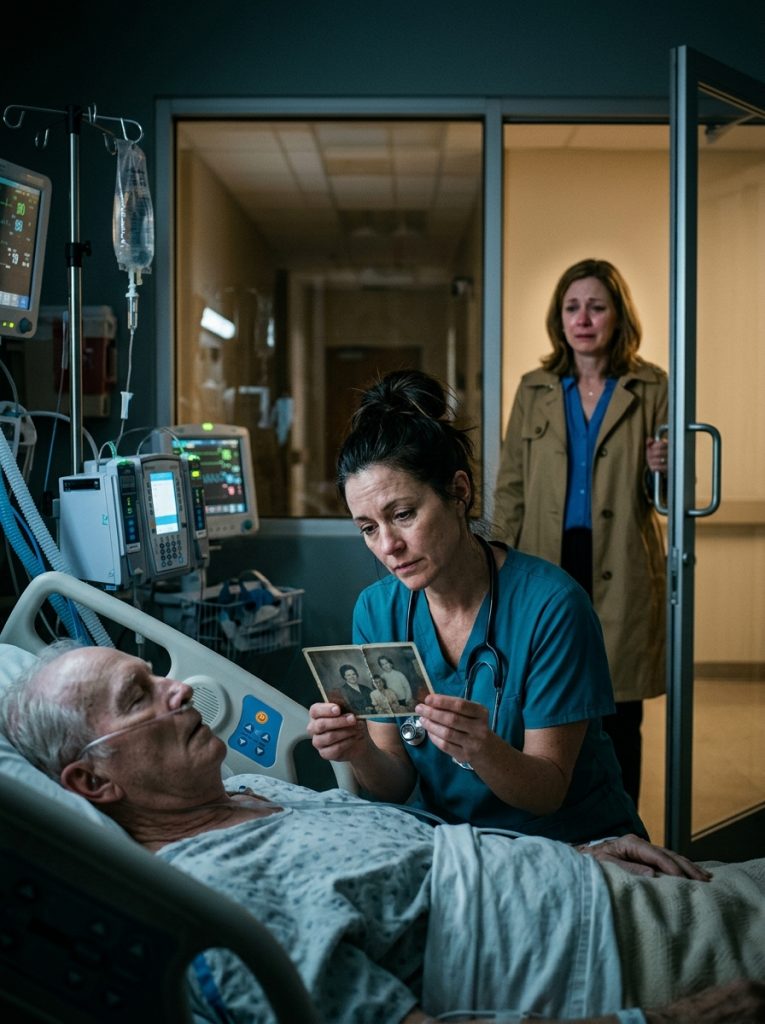
“You’re not too late,” I told her. “But you should hurry.”
It had taken me two days to find her. The folded face in every photo belonged to a woman named Ruth Whitmore — Harold’s daughter. It took one more day to convince her the call was real and not a cruel joke.
I walked her in myself, past the nurses’ station, past the son who wasn’t there at 3 a.m. because men like him are never there at 3 a.m.
Harold was sleeping the thin sleep of the very ill. His numbers were low. I’d seen enough to know we were close.
Ruth stopped at the foot of the bed. She pressed her hand over her mouth, the same place her father’s hand had been creased out of every picture.
“He doesn’t want to see me,” she whispered. “He made that very clear. Twelve years ago he told me I was dead to him.”
I’d had two days to learn the shape of it, in pieces, from a cousin and a neighbor and a Christmas card returned unopened.
When Ruth’s mother — Harold’s wife — was dying, Ruth had been the one at the bedside. There’d been a fight at the end, the kind of fight grief makes, about a decision, about a feeding tube, about who got to choose. Words were said that nobody could take back. Harold told Ruth to leave. Ruth left.
And then — this is the part that broke me — Ruth had written. For years. Birthday cards. Letters. An apology eight pages long.
The son intercepted them. Threw them out. Told his father that Ruth never reached out, never cared, had washed her hands of the family. It kept Harold’s grief pointed in a safe direction. It kept the will simple.
Harold folded Ruth out of every photo because looking at her hurt too much — not because he’d stopped loving her. A man doesn’t carry creased pictures of someone he’s done with. He carries them because he can’t put them down.
“He asked me something last night,” I told Ruth. “He asked if you ever wrote back.”
Her knees nearly went. “I wrote a hundred times.”
“I know,” I said. “I think, somewhere, he hoped you had. Go tell him.”
She went to the side of the bed. She took his hand, careful around the IV, and she said the oldest word in the world.
“Dad. It’s Ruthie. I’m here.”
His eyes opened.
I have been a nurse for twenty-two years and I will never be able to explain what happens in a dying person’s face when the thing they were grieving turns out to be alive. It’s not relief. It’s bigger than relief. It’s a man getting back something he’d already finished mourning.
“You came,” he breathed.
“I never left,” she said. “They didn’t tell you. I wrote you every year. I never stopped.”
He cried. She cried. I stepped back into the doorway and let them have the hour, because some hours don’t belong to the person standing watch.
They talked until he couldn’t anymore. She told him about her kids — his grandchildren, two of them, that he’d never met. She showed him their pictures on her phone, and he held the screen in both shaking hands like it was made of glass.
Harold passed just after the sky went gray, with his daughter’s hand in his and twelve years finally set down.
It was too late for so much. Too late for the birthdays, the grandchildren’s first steps, the dozen Christmases the lie had stolen. I won’t pretend it wasn’t.
But it was not too late for the hour. And the hour mattered.
Before Ruth left that morning, she picked up the framed photo on the tray — the one with the crease through her. She smoothed it flat against the bed rail, over and over, the way you’d press a fold out of something you finally get to keep.
It wouldn’t lie flat. Fifty years of folding doesn’t undo in one morning.
“That’s all right,” she said, mostly to herself. “I know where I belong in it now.”
She took the photo home.
I never told her son how I found her.
But I made sure, before she walked out, that Ruth had every letter she’d ever written — because the cousin had quietly saved a few, and because some truths deserve to outlive the people who tried to hide them.
Some nights, on the slow end of a shift, I still find myself checking the photos families leave on the trays. I look for the fold. You’d be surprised how often there is one — a face pressed out of the picture, someone too painful to look at and too loved to throw away.
And when I find it, I do the only thing I know how to do.
I start looking for the face.