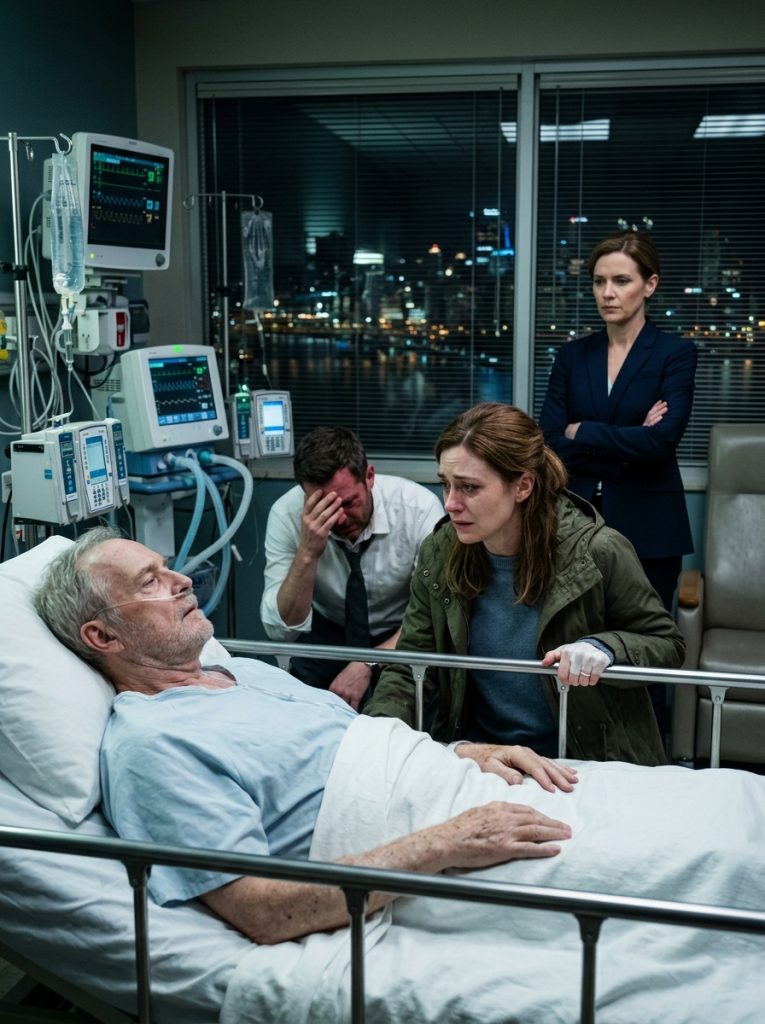
The word my father was trying to say wouldn’t come. His lips moved and nothing followed, and a nurse gently said he needed rest, and the moment slipped under like a stone in the river outside the window.
So I turned to my brother instead.
“Tell me,” I said. “All of it. Right now.”
Connor couldn’t look at me. Bridget could, and her look was a warning. He ignored it.
“After your wedding,” he said, “Dad was angry. You know that. But he got over it, Maeve. Fast. Faster than any of us expected. By that fall he wanted to call you.”
“He never called me,” I said.
“I know,” Connor said. “Because we didn’t let him.”
The ICU felt very far away.
“He’s not good with phones, with computers, any of it,” Connor said. “After the first stroke scare two years ago, he gave me his accounts to manage. His email. His phone bill. He’d dictate letters and I’d mail them.” He pressed his palms into his eyes. “I didn’t mail them, Maeve. I told him you sent them back. I told him you blocked his number.”
“What letters,” I said. My voice had gone flat and strange.
“Birthdays. Christmas. The anniversary of Mom. He wrote you on all of them.” Connor’s voice cracked. “There’s a shoebox in his closet. He kept copies. He thought you were reading them and choosing not to answer. He thought you hated him. And every year he wrote anyway, because he said a father doesn’t stop just because the kid stopped.”
I had to sit down in the vinyl recliner.
For four years I had built a whole self around the belief that my father had cut me off. I’d grieved a living man. I’d told my husband, my therapist, my own reflection: he chose them.
He’d never chosen them. He’d been writing into a silence two of his children manufactured.
“Why,” I said.
Bridget finally spoke. “The house. The land. You know what it’s worth now. If he reconciled with you, you’d have come back into the will, and we—” She stopped, because even she heard how it sounded out loud at a dying man’s bedside.
“You kept my father from me,” I said, “over an acre count.”
Nobody answered. The monitors filled the silence.
I didn’t scream. I think I was too hollowed out to scream.
I went to him instead.
I took his hand — the frail, spotted hand I’d gripped on that bed rail — and I leaned close to his ear, and I told him the truth he’d been denied.
“Dad. It’s Maeve. I never sent your letters back. I never got them. I didn’t know you were writing.” My tears were falling on the blanket. “I didn’t hate you. Not for one single day. I thought you hated me.”
His eyes opened.
I don’t know how much he understood. The doctors would later say maybe a little, maybe a lot, that the dying sometimes surface for exactly the thing they’re waiting for.
His mouth moved again. And this time the word came out, cracked and faint, but I heard it. The whole room heard it.
“Maeve.”
My name. The one he’d written on all those envelopes nobody mailed.
“I’m here,” I said. “I’m right here. I’m not leaving.”
He squeezed my hand. Once. Barely. Then his eyes closed, and his breathing went slow and even, and the nurse said he was comfortable, and that he could probably still hear me.
So I stayed. I read him the kind of things you wish you’d had years to say. I told him about my life. My husband, who turned out to be exactly the good man I’d promised he was. The job I loved. The dog. The small, ordinary, happy life he’d been told I built to spite him.
He passed just before dawn, with my hand in his and the river going gray in the window.
I found the shoebox the next week.
Forty-some letters, in his cramped careful hand. Copies of every one. He’d numbered them. “For Maeve, #1.” All the way up.
I read them in order, on the floor of his closet, the way you’d eat after a long starvation — slowly, so it wouldn’t hurt.
Connor came to the funeral and stood apart, gray and shaking, and afterward he handed me the originals he’d never mailed and said, “I’ll spend the rest of my life being sorry, and I know that’s not worth anything.”
I didn’t forgive him that day. I’m still working on it. Grief and rage can share a room a long time.
Bridget contested nothing. There was nothing to contest; the family had spent its credibility. She doesn’t call. That’s fine.
I framed letter #1. It hangs in my hallway where I see it every morning.
Some doors only open once, at the very end, just wide enough to hear your name.
I got mine.
I’ll carry the lost years forever — but I’ll carry his voice saying “Maeve” right alongside them, and on the worst days, that one cracked syllable is the thing that holds.