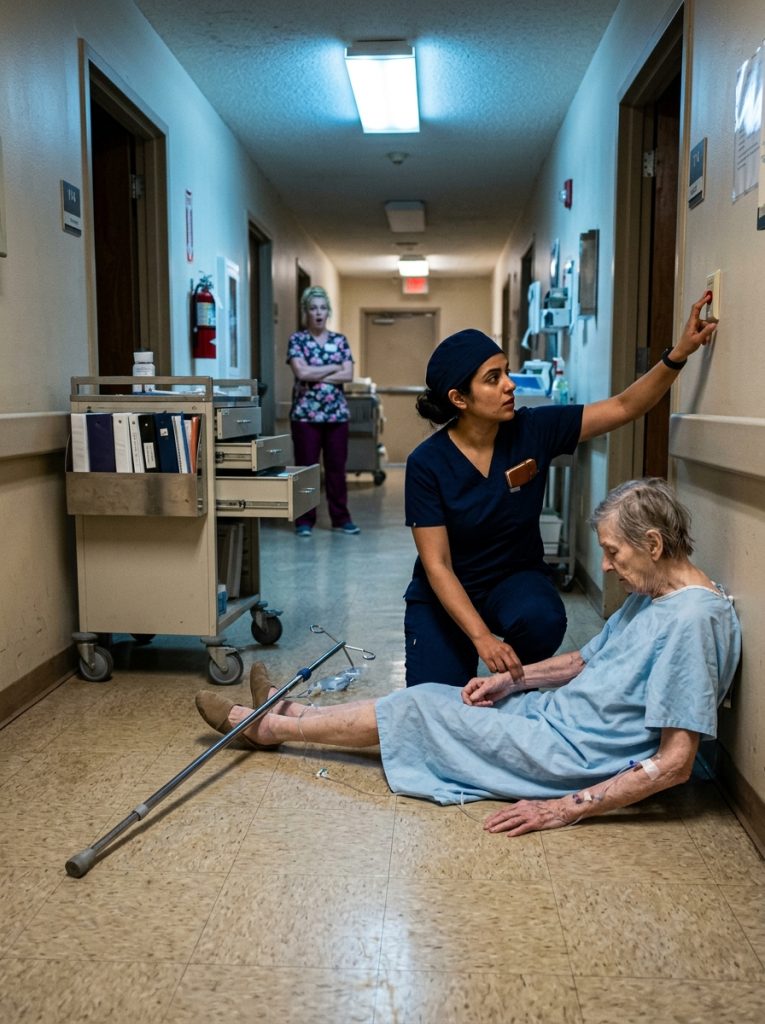
Colleen’s face went white when I said my name into the phone.
Not my cover name. Not the one on my Pinecrest badge — “Priya K., Night Aide.” My real name. My full title. My badge number with the Tennessee Department of Health.
The 911 dispatcher said, “Copy that. Ambulance en route, six minutes.”
I kept my fingers on Margaret’s wrist. Her pulse was thready but present. Her lips were cracked dry — the kind of dehydration that takes days to get this bad. Days of nobody checking her fluid intake. Days of the overnight hydration rounds being skipped because the east wing was “asleep anyway.”
She wasn’t asleep now. She was on the floor. And the only reason I found her in time was because I was restocking towels in a hallway I technically shouldn’t have been in at 2 AM on a Wednesday.
Colleen hadn’t moved from the doorway.
“You’re — you’re not an aide,” she said.
“No.”
“You’re a state inspector.”
“Yes.”
She looked at the notebook in my breast pocket. The one she’d assumed was a language diary. The one her staff had laughed about in the break room — “the foreign girl writing down English words.”
I’m from Nashville. My English is fine. Has been since birth.
“How long?” Colleen asked.
“Six weeks.”
Her arms folded across her floral scrub top. Then unfolded. Then folded again. Like her body didn’t know what posture to assume when the ground had shifted beneath it.
The ambulance arrived in five minutes. Two EMTs came through the emergency entrance with a gurney. They started an IV line immediately — Margaret’s veins were so dehydrated they had to try three times. I gave them her full medication list from memory. Her allergies. Her weight. Her baseline vitals from three weeks ago when I’d checked them myself during a shift nobody was watching.
They loaded her onto the gurney and wheeled her toward the exit.
I stood up.
My knees ached from kneeling on linoleum. My navy scrubs had a wet spot from where Margaret’s IV bag had leaked on the floor.
Colleen was still in the doorway.
“What happens now?” she asked.
“I file my report tonight. The state sends an emergency review team tomorrow morning. Every staff member currently on duty will be interviewed. Every chart will be audited. Every care log will be compared against facility records.”
Colleen’s face crumbled.
“I have a family,” she said.
I looked at her.
“So does Margaret.”
The emergency review team arrived at 8 AM Thursday. Three inspectors. Two from my office, one from the licensing board. They brought boxes for records. They brought tablets for interviews. They brought the kind of calm, thorough attention that Pinecrest hadn’t seen in eighteen months of ignored complaints.
I was there. Not in scrubs — in my Department of Health blazer with my real badge visible. The staff who’d spent six weeks calling me “the slow one” and “the quiet aide” watched me walk through the facility with a clipboard and authority they never imagined I possessed.
The orderly who skipped hydration rounds — James, twenty-four, always on his phone — saw me and dropped his coffee.
“You — you work here?”
“I did,” I said. “Not anymore.”
He was suspended by noon.
Colleen was suspended by 2 PM.
The facility administrator — a man I’d never met because he worked remotely and had never once visited the building in six weeks — was placed on administrative leave by 5 PM.
Margaret Hale was admitted to Methodist Hospital with severe dehydration, malnutrition markers, and a Stage 2 pressure ulcer on her left hip that nobody at Pinecrest had documented because nobody had turned her in three days.
Three days.
An eighty-two-year-old woman lying in the same position for three days because the night staff couldn’t be bothered to check.
Her family came to see her in the hospital. Her daughter — the same woman who’d complained about my accent, who’d asked Colleen to move me to nights, who’d said I was “too slow” — stood in the ICU hallway and cried.
She found me in the waiting room.
“You’re the aide they reassigned,” she said.
“Yes.”
“And you’re the inspector.”
“Yes.”
She sat down beside me. Her hands were shaking.
“I asked them to move you away from my mother. I complained about you.”
“I know.”
“If you’d been on day shift — if you’d been checking her — this might not have happened.”
I let that sit. Because she was right. And because I’d thought about it too.
“I documented the pattern,” I said carefully. “My presence on night shift allowed me to observe systemic failures that wouldn’t have been visible during the day. The missed rounds. The unlocked med cart. The skipped documentation.”
“But my mother—”
“Your mother is stable. She’ll recover. And the people responsible won’t be here when she comes back.”
She nodded.
She didn’t apologize for the complaint about my accent. I didn’t need her to. She was scared and hurting and her mother was in an ICU bed with an IV in each arm.
But she asked me something I didn’t expect.
“Will you be there? When she comes back?”
I shook my head.
“I’m an inspector. My job is to find the problems. Not to stay and fix them.”
She looked at the floor.
“But I’ve recommended a new care team. And I’ve flagged your mother’s chart for weekly oversight by my office.”
She nodded again. Wiped her eyes.
Advertisement
I stood up. I had reports to write. Hours of them.
But before I left, I said one more thing.
“Your mother called me by my name. My real name. Last week. She’d heard the night staff laughing about it and she asked me what it meant.”
The daughter looked up.
“I told her Priya means ‘beloved’ in Sanskrit. She said: ‘That’s a beautiful name for someone who checks on me when nobody else does.'”
The daughter’s face crumpled.
I left her in the waiting room.
I filed my report that night. Forty-seven pages. Six weeks of observations. Four hundred and twelve documented deficiencies. Thirteen recommendations for immediate corrective action.
Pinecrest Nursing Home received a conditional license — one step above revocation. They were required to hire a new administrator, retrain all staff, and submit to unannounced inspections every thirty days for a year.
Margaret came home three weeks later. New room. New care plan. New staff.
I drove past Pinecrest once, a month after. The lights were on. The parking lot was full — new hires, probably, learning a new way to do things.
I didn’t stop.
My notebook is in my desk drawer at the office now. Leather cover worn soft from six weeks in my breast pocket. Pages dense with dates and times and room numbers.
It did its job.
And so did I.
Two months later, I got a card in the mail. No return address. Handwritten on thick cream paper.
“Dear Priya — Thank you for being slow. Thank you for asking too many questions. Thank you for the notebook. Mom is doing well. She asks about you every Wednesday. — Sarah Hale.”
I put the card in my desk drawer next to the notebook.
Some weeks, when a new case lands on my desk — another facility, another pattern, another set of complaints that have been closed without action — I open that drawer and look at both of them.
The notebook reminds me why I do this.
The card reminds me who I do it for.
Margaret Hale turned eighty-three last month. Sarah sent me a photo — her mother in a wheelchair in the Pinecrest garden, blanket on her lap, sun on her face, a cup of water in her hand.
A full cup.
Someone is checking now.
Someone is always checking.
Because that’s what I built in six weeks on a linoleum floor at 2 AM under flickering fluorescent lights with a leather notebook and a scrub cap and a name nobody bothered to learn.
They know it now.
Every facility in the western Tennessee district knows my name now.
And they check the water.