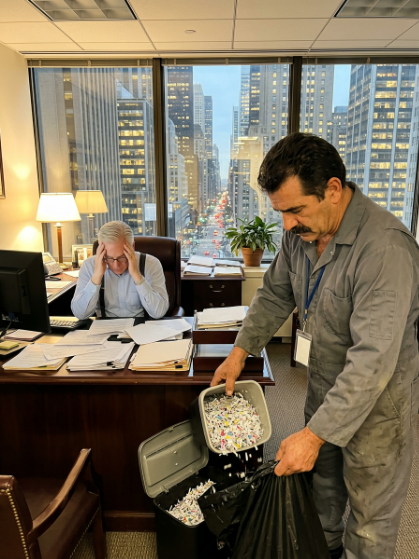
The paramedics took him at 8:02. I rode in the ambulance because he wouldn’t let go of my hand, and I am not a man who pries a frightened person’s fingers loose.
“You’re the only one who ever stayed late with me,” he’d said.
I didn’t answer him. I couldn’t. There is no honest thing a man in my position can say to that.
I sat in the hard plastic seat with the monitors beeping and Martin Keller’s hand in mine, and I thought about the badge locked in a drawer six blocks south, and the taped-together documents on my kitchen table, and the warrant that was three days from being signed.
He thought I was the janitor. He thought I was the one human being in that glass tower who’d noticed he was alone.
The terrible part is that I had noticed. That part was true. You can’t watch a man for six months — really watch him, the way I’m trained to — without learning him. I knew he ate dinner at his desk every night from the same Greek place. I knew he kept a photo of a daughter in a frame turned slightly away from the door, so visitors wouldn’t ask about a kid who, I’d learned, no longer spoke to him. I knew he stayed late not because the work required it but because the apartment he went home to didn’t have anyone in it.
I knew Martin Keller better than anyone in his life did.
And I knew he’d stolen twenty-three million dollars.
Both of those things were true at the same time, and they did not cancel out, and no one tells you, when you take this job, how heavy it is to carry two true things that hate each other.
There was one night, maybe two months in, when it nearly broke me. The office was empty and dark except for his desk lamp. He looked up from his shredding and saw me wiping down the glass, and instead of waving me off the way he usually did, he asked me if I had a family.
I said I had a daughter. It was the truth — one of the few I gave him.
He nodded slowly, and he said, “Good. Hold onto that. Don’t be a man who looks up one day and finds out he traded everyone who mattered for a number on a screen.”
Then he fed another document into the shredder.
I drove home that night and sat in my car outside my own building for twenty minutes. Because the man giving me that advice was, at that very moment, destroying the retirements of four thousand people for a number on a screen. He knew exactly what he was. He was warning me away from the cliff he’d already gone over.
You want your targets to be monsters. It makes the work clean. Martin Keller refused to be a monster. He insisted, the whole time, on being a person — a lonely, ruined, oddly kind person who happened to also be a thief.
He survived. I want to say that first, because it matters. The heart attack didn’t kill him. The doctors said the CPR I did on that office floor kept enough oxygen moving that he came back without the kind of damage that ends a person.
I saved his life on a Thursday.
I filed my case on the following Monday.
That’s the part people flinch at when I tell it, and I understand the flinch. It feels like a betrayal. He held my hand. He thanked me. He called me the only one who stayed.
But here is what I have come to understand, in the long nights since: the twenty-three million dollars he stole came from somewhere. It came from a pension fund. Meridian Capital managed the retirement savings of about four thousand people — teachers, mostly, and municipal workers, the kind of people who do unglamorous work for thirty years and trust that the number on their statement is real.
Martin Keller had been quietly making that number not real. Shell companies. Offshore transfers. A cheap shredder he trusted with the evidence because he’d decided no one was watching.
Four thousand people. Some of them were going to retire that year, and walk into an office expecting the life they’d been promised, and find a hole where it used to be.
I held the hand of the man who dug that hole. And then I did my job, because four thousand strangers needed me to more than one lonely man needed me to be his friend.
The indictment came down while he was still in the hospital. Twenty-three million in fraud, across more counts than I’ll list. He was served in his recovery room. I wasn’t there for that. I’d asked not to be.
The firm collapsed within the month, the way these things do — fast, then all at once. The honest employees lost their jobs alongside the guilty ones, which is the part of this work no one ever makes a movie about. Justice is not clean. It lands on the people standing nearest the crime, and not all of them earned it.
I went to see him once, before the trial. I told myself it was procedure — there were questions only he could answer. That was half true. The other half was that I needed to look at him without the mop in my hand.
He was thinner. The hospital had let him go home with a monitor strapped to his chest. He opened the door, saw me in a jacket instead of coveralls, and he understood before I said a single word. I watched it move across his face like weather.
“You,” he said. Quiet. Not even surprised, really, by then. “The shredder.”
“The shredder,” I agreed.
He stepped back to let me in, which I had not expected. We sat in an apartment that confirmed everything I’d guessed about him — beautiful, expensive, and empty in the way of a place no one is ever invited to. The photo of his daughter sat on a shelf, still turned slightly away.
He didn’t rage. He didn’t beg. He made me a cup of coffee with hands that shook a little, set it down in front of me, and said, “You did stay late, you know. Even now. You’re the only one who came.” Then, after a moment: “Do your job, Mr. Tavares. I’d rather it was you than someone who didn’t notice I was a person at all.”
I have prosecuted a lot of people. None of them ever made it harder than that.
I testified at his trial. Federal court, downtown, the badge out of the drawer at last and clipped to my belt where he could see it.
That was the moment. Not the CPR, not the indictment. The moment he looked across the courtroom and saw the janitor in a suit with a federal shield, and understood — finally, completely — who had been emptying his shredder every night for six months.
He didn’t look angry. I’d braced for angry. I could have handled angry.
He looked the way a man looks when the last person he trusted turns out to have been someone else the whole time.
He held my gaze for a long moment. Then he nodded, very slightly, the way you’d acknowledge a move in a game you’d already lost. And he looked back down at his hands.
I have closed a lot of cases. Most of them, I sleep fine.
This one I carry.
He recovered the savings — most of it, the forensic team clawed back the bulk from the offshore accounts. Four thousand people kept their retirements. That is the math that is supposed to make it worth it, and on paper it does. On paper I am the agent who saved a pension fund.
But I think about a man on an office floor, gray-faced, gripping the hand of the one person he believed had stayed.
And I think about how that person was me, and how I had stayed — but not for the reason he thought, and not in the way he needed.
I requested a desk assignment after that trial. Analysis. Paper. No more undercover work, no more becoming someone’s only friend so I can put them in prison. My supervisor asked if I was burned out. I told him no, that wasn’t it.
I told him the truth, which is the only thing I’ve ever been good at carrying.
I told him I’d gotten too good at being the person someone trusts.
And I’d finally learned what it costs.