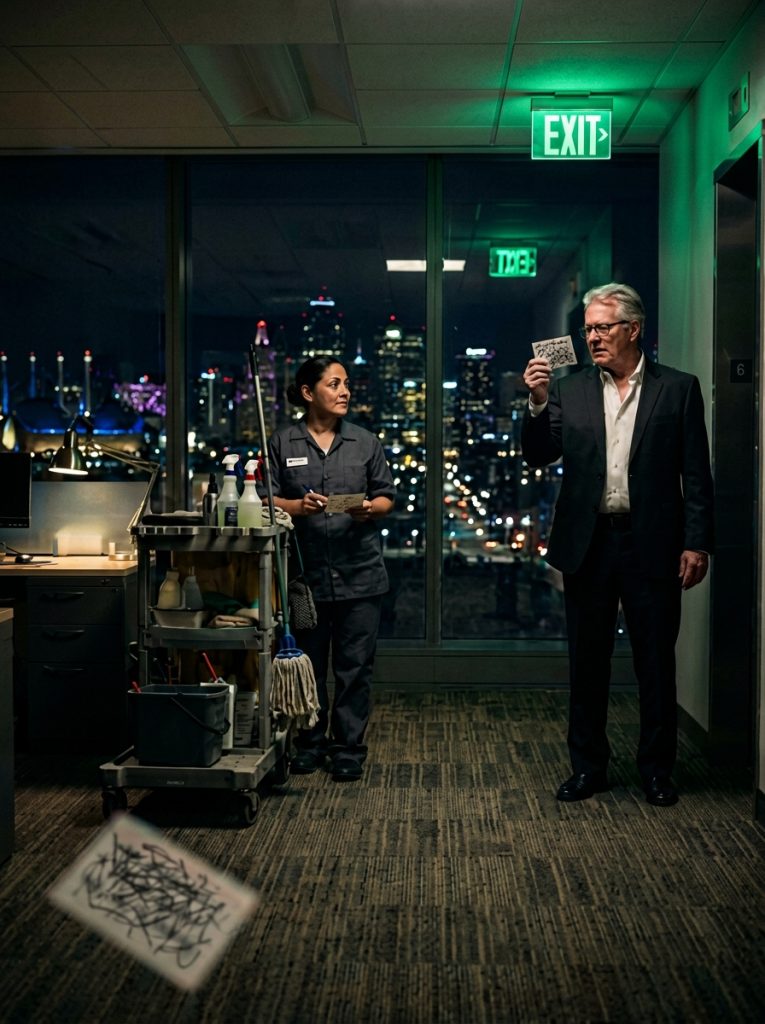
I didn’t find any of this out until later, of course. I was thirty floors down at the time, wiping the lobby glass, with no idea that the new owner of the building was standing on the thirty-first floor reading a note I’d written to my ten-year-old about how to spell “necessary.”
His name was David Halsey. The tower had his family’s name on it, which I’d always assumed was just a name, the way buildings have names. It turned out he’d bought it back — it had passed out of the family decades ago — and he had a habit the previous owners never had. He walked his buildings at night. No entourage. No announcement. Just a man in a plain dark suit, no tie, riding the elevators after midnight to see what a place was really like when it thought no one important was watching.
That’s how he came around the corner on thirty-one and found my index card on the carpet, fallen off my cart. “necessary — one C, two S’s. say it like ‘a dress’ is in the middle. you’ve got this, mija. quiz when I wake up. — Mamá.”
He told me, months later, that he stood there and read it three times. That he has two grown kids and a head full of regrets about the nights he spent in buildings like this one instead of at their kitchen tables. That something about a mother running a homework session on index cards from thirty floors up, in the middle of the night, got into him and wouldn’t leave.
So he went down to the security desk and asked the guard a simple question: who’s writing notes to her kids up there at one in the morning? He wanted to know who I was.
The guard pulled up the access logs. And the logs told a story I had never told anyone.
They showed Rosa Mendez badging onto her assigned floors, on schedule, every night. And they showed Rosa Mendez also badging onto Gladys Ruiz’s floors — twice a week, for five weeks — for hours that did not appear on any timesheet. Hours I was never paid for. Hours I’d quietly absorbed so that a sick sixty-one-year-old woman with bad sugar and worse insurance wouldn’t get her third write-up and lose everything.
David Halsey is a businessman. The first thing he saw was not a heartwarming story. The first thing he saw was a building running on unpaid labor, and a liability, and a question: if she’s covering unpaid shifts, who’s supposed to be paying for them, and where is that money going?
So he kept pulling threads. And the threads led to Brett.
Brett, my floor manager, the one who’d snatched my index card out of my hand and called my children’s homework “arts and crafts.” Brett, who’d written me up for “milking the clock.” It turned out Brett had a system. He’d been marking Gladys present on the official payroll — collecting her hours as worked, as far as corporate knew — while she was home sick and I was doing her floors for free. The labor got done. The hours got paid. Just not to the person doing them. Where exactly the difference went is a question the forensic accountants Halsey brought in spent a while answering, and it is not a flattering answer for Brett.
The man who accused me of stealing time was stealing it. Out of Gladys’s paycheck and mine, in the dark, while lecturing me about the clock.
Here is how I found out any of this had happened.
I came in for my shift on a Tuesday and there was a note in my locker asking me to come to the thirty-first-floor conference room before I started. I was sure I was being fired. I’d been written up; in my experience, conference rooms are where people like me get told there’s been a restructuring. I almost didn’t go up. I sat in the break room for ten minutes first, rehearsing how I’d tell my kids.
When I walked in, there was an older man in a plain dark suit, no tie, reading glasses pushed up on his head. He had a stack of papers in front of him, and on top of the stack, in a clear sleeve like it was something valuable, was my index card. The “necessary” one.
“Mrs. Mendez,” he said, and stood up to shake my hand, which no one in that building had ever done. “I’m David Halsey. I owe you about five weeks of back pay, and I think an apology, and I have a question about your son’s math grade that I genuinely cannot stop thinking about.”
I did not know what to say. So I said the truest thing, which was: “Is Gladys okay? Whatever this is — she was sick. It wasn’t her fault. Please don’t—”
He held up a hand, gently. “Gladys is fine. Gladys is going to be more than fine. Sit down, please. You’ve been carrying this building, and nobody told me. I’d like to fix several things at once, if you’ll let me.”
What he did, he did fast, the way people with real power can when they decide to.
He paid me every unpaid hour, with interest, in a check that made me sit down hard. He paid Gladys what Brett’s “system” had skimmed, and he put her on a medical accommodation so she could keep her coverage while she got her sugar under control. He created a night-operations supervisor position — and he gave it to me, with a raise that meant I could move my kids out of the apartment with the broken radiator, and a schedule that, for the first time in six years, let me be home some evenings to run the homework session out loud, in person, at an actual kitchen table.
And Brett. Brett was walked out by two people in better suits than his slim-fit shirt, with the forensic accountant’s report in a folder, into the kind of meeting from which you do not return to your desk. I won’t pretend I didn’t feel something watching it. I felt a lot of things. Mostly I felt the particular calm of a person who’d been told, over and over, to work faster and stop scribbling, watching the man who said it learn what the clock actually remembers.
Gladys came back to work the following month, steadier, her sugar managed, her job protected. The first night back she found me on thirty-one and didn’t say anything at all — she just hugged me, hard, the way you hug someone who covered for you in the dark without ever once making you feel like you owed them for it. “You never told me,” she said into my shoulder. “Five weeks. You never told anyone.” I said there’d been nothing to tell. She pulled back, looked at me, and said that was exactly why she was hugging me.
The part that undid me, though, wasn’t the check or the title.
It was that David Halsey kept the index card.
He had it framed. It hangs in the lobby now — anonymized, my kids’ names blurred, just the handwriting and the heart and the words “you’ve got this, mija” — under a little brass line that says something about the people who keep this building running while the city sleeps. Every tenant who walks in past the glass I used to wipe walks past my one-in-the-morning note to my daughter about how to spell “necessary.”
Mateo’s grade came up, by the way. Lucia spells “necessary” perfectly now; she’ll tell you it’s got a dress in the middle.
And I still write the notes. I don’t have to anymore — I’m home more nights than not. But some shifts I’m still up there after midnight, and old habits hold, and a card with a heart on it is still the best way I know to sit at the kitchen table with my kids even when I can’t.
People hear “janitor” and decide they already know everything about you.
One man decided to read the card instead.
It changed everything.