The woman who came in from the cold introduced herself as Dr. Renata Vos, director of admissions at the Thorne Conservatory, and she was holding a phone in one hand and a folder in the other.
“I apologize for the intrusion,” she said to the frozen room. “But when a student of this caliber goes silent on us for three weeks, and the only replies come from a parent insisting she isn’t interested, we don’t give up. We get on a plane.”
Diane found her voice first. “Lily is a child with an overactive imagination. There’s clearly been a misunderstanding —”
“There has,” Dr. Vos agreed. “But not by us.”
She set the folder on the rented grand piano, right next to where Brooke still sat frozen mid-piece.
“Three months ago we received an audition recording for Lily Marsh,” she said. “Cello. It was, frankly, the strongest first-round submission we received this year. We sent an acceptance. Then a scholarship offer. Then three follow-ups. Every reply we got declined on Lily’s behalf — from an email account we now realize Lily has never seen.”
Forty guests turned to look at my stepmother.
“I never received any acceptance,” I said. My voice was small, but it carried in the silence. “Diane told me I was rejected. She said my playing wasn’t at the level you require.”
Dr. Vos’s eyebrows rose. “We never sent a rejection. We don’t use that phrase. Ever.”
That’s when Mr. Solomon stepped forward with his laptop and did the thing that ended it.
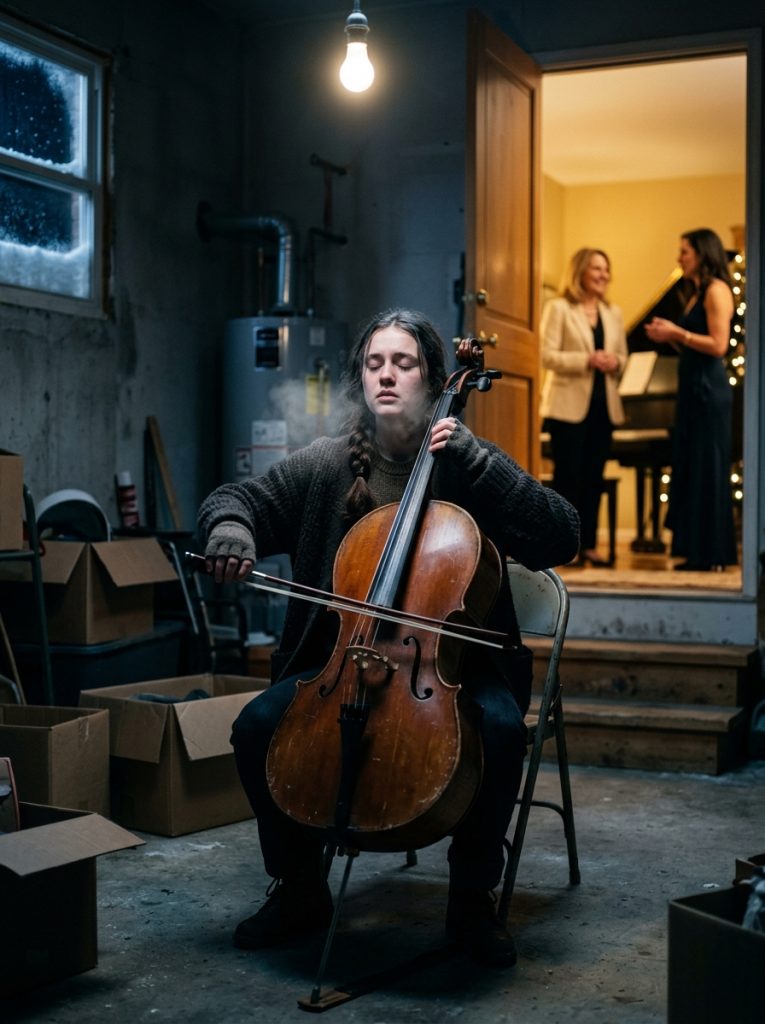
“I’m Lily’s neighbor,” he said. “I spent thirty years engineering sound in Chicago, and for two years I’ve listened to this girl practice through my bedroom wall — because her family banished her cello to an unheated garage.” He let that land. “I’m the one who recorded her. I’m the one who sent the audition. Lily didn’t even know. I did it because what I was hearing through the drywall was better than half of what I recorded in professional studios, and I couldn’t stand to let it freeze to death out there.”
He pressed a key.
And my playing filled the catered, candlelit living room — the Bach I’d practiced in fingerless gloves, my breath fogging, the cello that still smelled like my mother. It poured out of those little laptop speakers and it silenced every conversation, every clink of glass.
I watched the faces of forty important guests change.
I watched my father’s face change.
He had heard me play a thousand times through a closed door and never once walked through it. Now he was hearing it the way strangers heard it, and his eyes were wet, and I understood he was realizing exactly what he’d let happen in his own house.
When the recording ended, Dr. Vos turned to me — only me.
“Lily Marsh,” she said, “the Thorne Conservatory is offering you a full scholarship. Tuition, housing, and a place in our chamber program. The offer has been open for three weeks. I’d like to hear your answer from you, not from anyone else.”
Diane made one last attempt. She laughed the bright social laugh she used on the PTA.
“This is all very dramatic, but Lily isn’t going anywhere. She’s seventeen. I’m her guardian, and I have concerns about a strange man recording a teenage girl —”
“Avi recorded a cellist through a wall and mailed it to a conservatory,” my father said.
It was the first time in two years I’d heard him contradict her.
The room went still in a different way.
“Diane.” He stood up slowly. “Did you tell my daughter she’d been rejected from a school that accepted her? Did you intercept her mail?”
Diane’s mouth opened and closed. The bright laugh wouldn’t come this time. Forty guests were watching, and there was no version of the truth that didn’t damn her, and we all watched her realize it.
“I did it for this family,” she finally hissed. “Her scratching, her sulking, her dead mother’s cello — it was holding Brooke back. I was managing the situation.”
“You were stealing my future to decorate Brooke’s,” I said. “Those aren’t the same thing.”
It was Brooke, of all people, who broke the tableau. She stood up from the piano bench, her face blotchy, and said in a thin voice, “Mom. Stop. Everyone can hear you.” Then, to me, barely audible: “I knew the garage was wrong. I didn’t know about the letters. I swear I didn’t.” For Brooke, that was practically an act of heroism.
I turned to Dr. Vos.
“Yes,” I said. “My answer is yes. I’ve wanted to say it for three weeks.”
The party ended itself after that. You can’t serve canapés through a silence like that one. Guests found their coats and their excuses, and several of them squeezed my hand on the way out and told me they’d never heard anything so beautiful, and a few of them looked at Diane like they were seeing her clearly for the first time.
What happened in our house after the door closed took months, not minutes.
My father did not, in the movie way, throw Diane out that night. Real life is slower and sadder. But something in him had woken up, and it didn’t go back to sleep. He found the folder of intercepted letters where she’d hidden them — eleven of them, the acceptance, the scholarship, the follow-ups, all slit open and resealed. He read every one. He apologized to me in a way that cost him something, sitting on the cold garage floor where he’d never once sat with me.
“I told myself you were fine because it was easier than the truth,” he said. “The truth was I let a room go cold because I didn’t want to fight at the dinner table. That’s on me, Lil. Not Diane. Me.”
They separated that spring. I won’t pretend I was sorry. I will say Brooke and I text now, which neither of us saw coming — turns out she’d been drowning in her mother’s expectations the same way I’d been freezing under them, just in a warmer room.
I started at the Thorne Conservatory in the fall.
The first time I walked into a real practice room — heated, soundproofed, mine — I sat down and just breathed for ten minutes before I could play. Warm air. No fogging breath. No door shut against me. I cried a little, and then I worked, because that’s what the cold years taught me to do with feeling: turn it into hours.
In December, the chamber program held its first showcase.
A real stage. Real lights. A real audience, in a real hall, exactly the kind my mother promised me about when she pressed her cello into my eleven-year-old arms and told me I’d play on one someday.
My father came. He sat in the front row and wept through the whole thing, and I let him, because some tears are a man paying a debt.
Mr. Solomon came too, in his good cardigan, the man who’d heard me through a wall and refused to let the sound die. I’d saved him the best seat in the house. When I walked out to play my solo, I found his face first.
I played the Bach. The same piece from the garage. The one that had traveled, on a recording an old man made in secret, all the way to a stage my mother knew I’d reach.
When the last note faded, the hall was silent for one held breath — and then it stood.
My mother’s cello, warm at last, under bright lights, in a room full of people who finally got to hear the thing my family spent two years trying to keep in the cold.