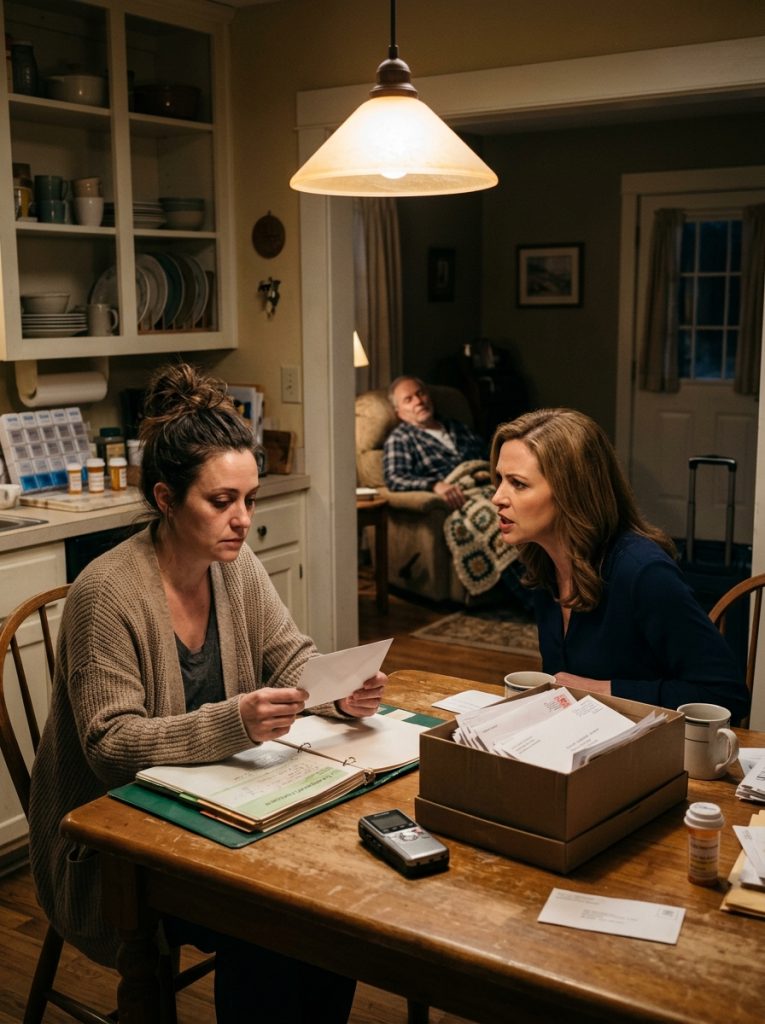
Bridget sat down. I think the shoebox did it. You can argue with a sister. It’s harder to argue with a box of letters in your father’s handwriting, all of them addressed to you, all of them sealed.
“What is this,” she said. Not a question. A flinch.
“These are the letters Dad wrote you,” I said. “Over three years. He wrote you almost every month for the first year. I mailed every one.”
She picked one up. Turned it over. Saw her own address crossed out and RETURN TO SENDER stamped across it in her own hand.
“I sent them back,” she whispered.
“You sent them back.”
She set it down like it had burned her.
“I thought—” she started, and stopped. I watched my brisk, polished, accusing sister come apart very quietly at my kitchen table. “I thought he didn’t want them read. I thought you were sending them so you’d look like the good one. I thought if I opened them they’d just be more of him telling me I’d failed.”
“Bridget. Why would you think that?”
And then, finally, after three years, she told me her side.
I’d been so deep in my own version — the sister who left, the one who couldn’t be bothered — that I had never once made room for hers.
Three years ago, when Dad had his stroke and the diagnosis started, Bridget’s whole life was on fire and I didn’t know. Her marriage was ending. Sophie was a newborn who didn’t sleep, and Bridget wasn’t sleeping either, and somewhere in those gray months she’d stopped being able to get off the bathroom floor some mornings. Postpartum, the doctors finally called it. A word she was too ashamed to say to me at the time.
She’d called Dad. Early on. Reached out, the way you reach for a parent when you’re drowning.
And Dad had been cruel to her.
“He told me not to come,” she said. “He told me he didn’t want me here. That I should stay with my baby and stop making everything about myself. He was so cold, Megan. It was the worst I’d ever heard him. And then you got the house, and the care, and the power of attorney, and I just — I decided if that’s how they wanted it, fine. I’d stop knocking.”
I felt sick. Because I remembered that phone call from the other side. I remembered Dad hanging up and going gray and shaky, and I’d thought it was the stroke.
I’d thought wrong.
“There’s a reason he did that,” I said. “He made me promise not to tell you. And I’m done keeping that promise. He recorded something. For exactly this — for the day we’d have to decide what happens to him. He said when that day came, I should play it, and not before.”
I set the little recorder on the table and pressed the button, and our father’s voice came into that kitchen — his real voice, the one from before, steady and clear, recorded in a lucid window early on when he still sounded like himself.
“Bridgie,” he said, because that’s what he called her when she was small. “If you’re hearing this, then things have gotten bad enough that your sister’s had to break a promise I had no right to make her keep. Don’t be angry at Megan. Be angry at me. I’ve got it coming.”
Bridget put her hand over her mouth.
“I pushed you away on purpose,” Dad’s voice went on. “That call where I was so hard on you — I’ve never been more ashamed of anything, and I’ve never been more sure I was right. Your sister told me how bad things were for you. The baby. The dark mornings. I could hear it in your voice before she said a word. And I knew what was coming for me. The doctors had already told me what kind of road this was going to be.”
A pause. The sound of him breathing.
“I couldn’t do it to you, sweetheart. I couldn’t let you trade saving yourself for nursing me. You only had so much left in you, and you needed every drop of it for that baby and for getting up off that floor. So I made a choice. I’d rather you hate me and live than love me and drown. I told Megan to carry it alone and to never let you see the worst of it, and God help me, I made her promise, because I knew she would. She always does. It wasn’t fair to either of you. I’m sorry. I was your father, and protecting you was the last big thing I knew how to do, so I did it the only clumsy way I had.”
The recording ended.
Nobody moved.
Then Bridget made a sound I’d never heard her make, and she reached across the table — across the box, across three years — and she grabbed my hands.
“You carried all of it,” she said. “Alone. Because he asked you to. And I spent three years thinking you took him from me.”
“I thought you abandoned us,” I said. “I thought you chose your new life over your own father.”
“I thought you’d both decided I wasn’t worth the trouble.”
We sat there in my kitchen and cried like the kids we used to be, while our father slept in the next room under a crocheted blanket, not knowing he’d just reached across his own broken brain to put his daughters back together.
The misunderstanding was never about a house, or a will, or who did more. It was two people who loved the same dying man, each one protecting the other in the dark, each one reading the other’s protection as rejection.
We opened the letters that night. All of them. Together.
They were not what Bridget feared. They were a father telling his daughter he was proud of her. That Sophie was beautiful. That he hoped someday she’d understand. That he forgave her for sending them back, because he understood exactly why she had.
One was just a single line, written on a bad day, the handwriting already starting to slip: “Bridgie, I counted the bridges between us today and there were too many. Build one from your side when you’re ready. I’ll meet you in the middle.” She read that one out loud and couldn’t finish it.
Another had a pressed flower in it — a black-eyed Susan from the backyard, the ones our mother used to grow. He’d remembered Bridget loved them. He remembered that, on a day he couldn’t remember what year it was.
He’d known she’d return them. He’d written them anyway. “So there’d be a record,” one said, “for the day you could finally read it, that I never stopped wanting to be your dad.”
We made the decision about his care together. Memory care, the good place across town, the one I’d researched alone and felt guilty about for months. Bridget walked through it with me. She asked the questions I was too tired to ask. For the first time in three years, the binder wasn’t only mine.
We moved him on a Saturday. Both of us. Sophie came too — she’s three now, and she calls him “Pop,” and he lights up at her even on the days he’s not sure who I am.
Dad doesn’t always remember the reconciliation happened. Some visits we have to find our way back to each other all over again. But Bridget comes now. Every month. She flies in and she takes the night shifts so I can sleep, and we trade off being the one who’s strong.
The estrangement didn’t end because someone won. It ended because we finally heard the truth he’d hidden inside his own stubborn love.
I keep one of the letters in my wallet now. The one where he wrote, “I’d rather you hate me and live.” I take it out on the hard days.
My father pushed his daughter off a sinking boat to save her, and let her think he’d thrown her overboard. We spent three years on separate shores because of it. But we’re rowing back now, together, while there’s still a little time — and some nights, that’s enough.