The clerk’s voice was flat and official, the way court clerks read everything, and that made it land even harder.
“Awarded to Sergeant Rachel A. Conner. The Army Commendation Medal, with valor device. For exposing herself to enemy fire to recover and treat two wounded soldiers outside Kandahar.”
Dale’s camo jacket went silent.
“The Combat Medical Badge. The Purple Heart, for wounds received in action.”
My mother had stopped dabbing her eyes.
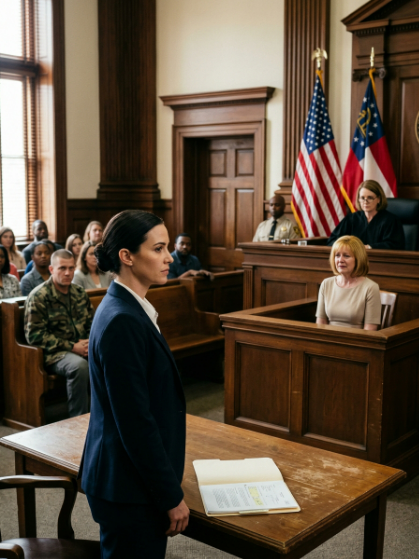
I want to tell you I felt triumphant. I didn’t. I felt the way I always feel when those words are read out loud — like they belong to someone braver than whoever is sitting in the chair. I kept my hands folded and let the clerk finish.
When she set the last page down, my attorney stood.
“Your Honor, the defense calls Sergeant First Class Marcus Bell.”
My mother’s head snapped up. Bell wasn’t on any witness list she’d seen, because she hadn’t called him. I had.
The back doors opened, and Bell came up the aisle in a pressed uniform, and behind him — two by two, quiet, filling the back three rows — came the rest of them. People from my unit. Some I hadn’t seen since the sandbox. They hadn’t told me they were coming. They’d just come.
Bell took the stand and was sworn.
“Sergeant Bell, do you know the defendant?”
“Yes, sir. She put me back together outside Kandahar in 2014.” He looked at the jury, not at me. “I’ve got three kids. They have a father because she crawled out under fire to get me. I’d know that woman in the dark. The idea that she faked it —” he shook his head, slow. “No, sir. No.”
My mother’s attorney had no questions. There was nothing to ask that wouldn’t make it worse.
Then my own lawyer did the thing I almost couldn’t watch.
He played the recording.
Three weeks before trial, at a family dinner I hadn’t attended, my mother had been bragging. To my aunt. About the farm, and the plan. And my aunt — God bless my aunt — had her phone on the table.
My mother’s own voice filled the courtroom.
“She’ll fold. She always folds. We say she’s unstable, we say she made it all up, and that farm is ours. Who’s a judge going to believe, a girl playing dress-up or her own mother?”
The recording clicked off.
The silence after it was the loudest thing in the room.
Judge Marian Sterling took off her reading glasses.
“Ms. Conner,” she said — to my mother, not to me; we have the same name, and the judge was careful with it now. “I have sat on this bench a long time. I have rarely seen a clearer case of perjury, and I have never seen one I found more distasteful.”
It came apart quickly after that.
The case was dismissed with prejudice. The farm was mine, free and clear, the way Grandpa Earl wrote it. My mother was held in contempt for the lie under oath and ordered to pay my legal fees in full. The recording was referred to the district attorney; I’m told there may be charges.
And Dale — Dale, in his costume camo, who’d discharged out of basic for stealing from other recruits and spent fifteen years pretending that never happened — Dale caught me in the hallway afterward.
“Rach. Come on. We’re family. You know I didn’t mean—”
I looked at the creases still pressed into his sleeves.
“You bought a costume to mock something men I love died wearing,” I said. “Don’t ever call me family again.”
I walked out into the Georgia heat and I didn’t look back.
There was one more thing.
After the verdict, the clerk handed me a sealed envelope the court had been holding — submitted into evidence, then returned. My grandfather’s handwriting on the front. My name.
I read it on the courthouse steps.
Rachel — if they ever try to take it, and they will, show them the truth and let it do the work. I always knew what you were. I knew the day you left for basic and didn’t ask anybody’s permission. The farm was never the inheritance. You finding out you don’t need them — that’s the inheritance. Love, Grandpa.
I sat down on the warm stone steps, in my navy blazer, with the medals still echoing in a courtroom behind me, and I finally let myself cry.
Not for the farm.
For the old man who saw me clearly, long before a clerk ever read it out loud.