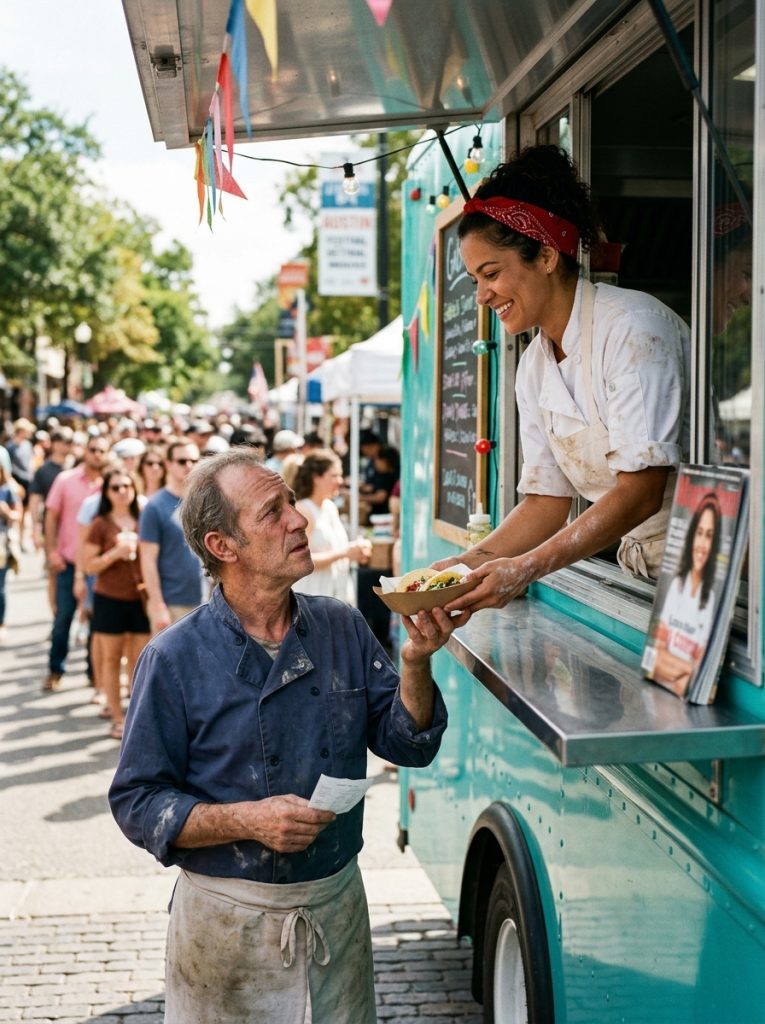
I made the short rib the way I always make it. The way she made it. The way he once said had no talent in it.
Slow-braised, pulled into long glossy strands, spooned over warm masa with a quick pickle of red onion and a scatter of cotija. I plated it like it mattered, because it does.
Then I leaned out the window and handed it down to Laurent Field myself.
“On the house,” I said. “First bite’s the important one.”
He gave me a tired smile, the smile of a man who’d forgotten what it felt like to be handed anything for free. He took a forkful right there at the window, the way hungry people do when they’ve stopped pretending they’re not hungry.
He chewed.
He stopped.
I watched it move across his face like weather — confusion, then disbelief, then something that looked an awful lot like fear.
He knew this dish. Of course he knew it. He’d been serving a version of it for eight years.
“Where,” he said hoarsely, “did you get this recipe?”
“From my grandmother,” I said. “Same place you got yours.”
The fork lowered. His eyes came up to my face, really looking now, peeling back eight years.
“Gabriela,” he whispered.
“Hello, Chef.”
Here’s the part I never put on the menu.
After Laurent fired me for “no talent,” he didn’t forget my peasant food. Six months later, his restaurant unveiled a new signature dish. Braised short rib over masa. The critics swooned. It went in his cookbook. It went on the morning shows. He called it “a refinement of rustic tradition,” and he never once said my name, or my grandmother’s.
I knew, because a line cook who’d stayed sent me the menu the day it dropped. I sat in my car and shook with a rage I had nowhere to put.
My grandmother had passed by then. She never saw the cookbook. I’m glad. I don’t think I could have stood next to her while she read a stranger’s name printed over her own recipe.
I drove to the cemetery that afternoon and sat on the grass and told her everything, the way I used to tell her everything across her kitchen counter. I told her a famous man had stolen her short rib and gotten rich off it. And then, because I could still hear her voice as clearly as the traffic, I told her what I was going to do about it.
I was going to cook.
I couldn’t afford a lawyer. You can’t copyright a grandmother. He had two restaurants and a publicist. I had a coffee can of tips and a recipe in my abuela’s handwriting.
So I did the only thing I could do.
I made it better. And I put my own name on it, out loud, every single day.
The first year of the truck nearly killed me. The transmission died in the middle of an intersection during a lunch rush, and I served forty plates anyway off a generator at the curb. I burned my forearm on the flat-top so many times the scars stopped fading. I named every special after one of my grandmother’s sayings, so her voice would be on the board even when my hands were shaking.
But every plate that went out that window had my name on the truck above it. Not his. Mine. Hers.
Now here he was, eight years later, holding the proof in his own mouth.
“I can explain,” he started, the old reflex.
“You don’t have to,” I said. “I’ve known what you did since the week you did it.”
His face crumpled. Right there in my line, with number 48 already shifting impatiently behind him, Laurent Field — who once threw a pan past my head for over-salting a sauce — put his hand over his eyes.
“Everything fell apart,” he said. “The restaurants. The marriage. I told myself it was the economy, bad partners, bad luck.” He laughed, wet and bitter. “It was none of those things, was it. I built a name on a dish I stole from a girl I told had no talent. You can’t season a thing like that out. It rots from the inside.”
I could have ended him right there.
The magazine that put me on its cover had a writer working the festival not thirty feet away. One sentence from me — that’s the famous Field short rib, and he took it from me — and it would have been everywhere by morning. The man who humiliated me, finished by a single true sentence at a food truck window.
I thought about my grandmother’s hands on my face. He doesn’t get to decide what you’re worth. You do.
And standing there with all that power finally in my hands, I realized something.
Revenge would have made the story about him again. It always had been. His kitchen, his rules, his name on my grandmother’s gift.
I was done giving him the main course.
“I’m not going to say anything to anyone,” I told him. “Not to that writer. Not on the internet. Nothing.”
He stared at me. “Why?”
“Because you already lost,” I said gently. “You lost the restaurants. You lost the name. And you’re standing in a line forty people deep to eat the one thing you were ever really good at recognizing — and you didn’t even make it. That’s not something I have to do to you. That’s just where you ended up.”
He was crying openly now. So was the woman at number 48, honestly, who had clearly worked out she was witnessing something.
“What I will do,” I said, “is feed you. Sit. Eat the whole plate. And when you’re done, this dish is going on a little card by my register tomorrow. With a name on it.”
“Mine,” he said miserably.
“Hers,” I said. “Dolores Santos. My grandmother. The woman who actually invented it. Eight years late — but she’s getting her name on it in this city, and nobody is ever taking it off again.”
Laurent Field sat down on the curb by my truck and ate every bite of that plate like a man taking communion.
When he finished, he came back to the window and set down the empty tray.
“Thank you,” he said. “Not for the food. For the —” He couldn’t find the word.
“For the chance to be a person again,” I said. “I know. My grandmother gave me that once, too.”
He asked, before he left, if there was any way he could ever make it right. I told him the truth: that you can’t give back eight years any more than you can un-ring a dinner bell.
But I also told him the soup kitchen on Fifth needed line cooks who could actually cook, and that they didn’t much care what your name used to be on a book cover.
Last I heard, he’s there three days a week. Aprons, not cameras. Feeding people who can’t pay. He’s good at it — the way he was always good at the part of this work that has nothing to do with being famous.
He sent me a letter once, care of the restaurant. No excuses in it. Just one line I’ve kept in a drawer ever since: You were the best cook I ever stood next to, and I was too small a man to say so. I never wrote back. But I never threw it away, either.
My truck did so well that autumn that I opened a brick-and-mortar in the spring.
I named it Dolores, after my grandmother. Her recipe card hangs framed by the door in her own looping hand, the short rib written at the top in pen gone a little brown with age.
There’s a line down the block most nights. People wait an hour for a dish a famous man once called peasant food.
Sometimes a young cook comes through my kitchen with shaking hands and a recipe from somebody who loved them, terrified that someone important is going to look up and tell them they have no talent.
I tell them the only thing worth telling them.
I tell them what my grandmother told me.
I think about that every time I push through the kitchen doors.
Then I tie on my apron, the way she taught me, and I go decide for myself exactly what I’m worth.