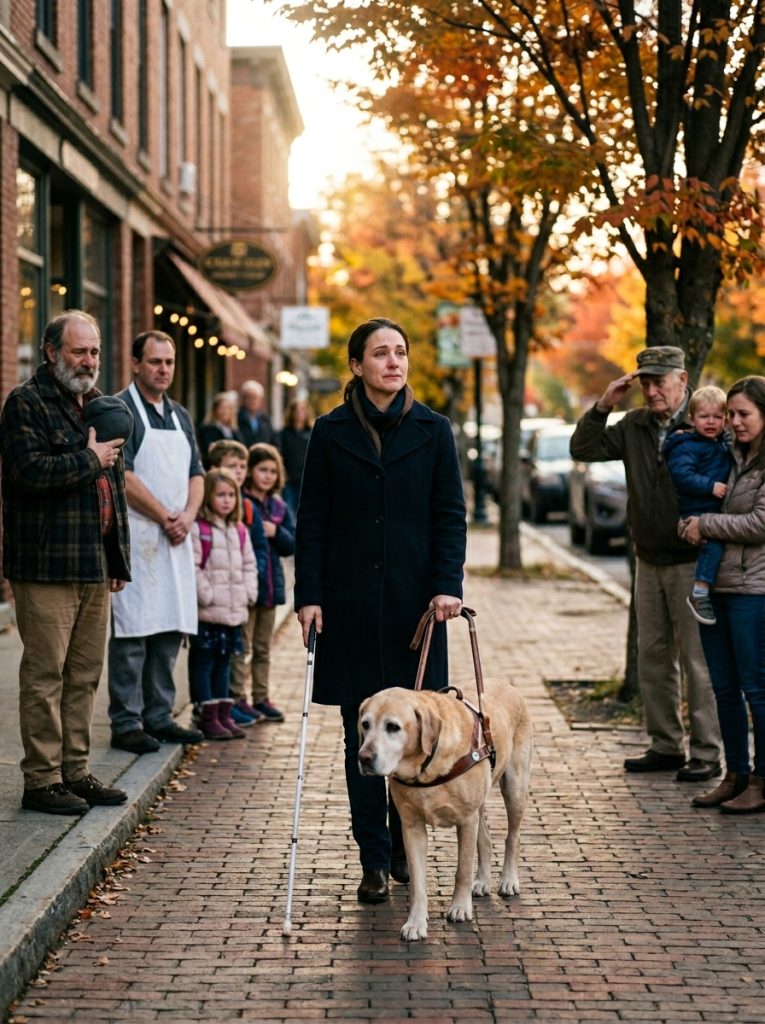
“We won’t get in your way,” Saul said, his voice thick. “We just want to walk it with you. If that’s all right.”
I couldn’t speak. I just nodded, and I felt Captain’s tail thump against my leg, and I gave him the only command that mattered.
“Forward.”
And my old dog stepped off the curb and began his last walk, the way he’d begun ten thousand others. Slow now. Careful with his back hips. But sure. He always knew the way.
I couldn’t see the faces lining that street. I want you to understand that. I have never seen a single one of them. But I have learned to read a town the way Meg’s friends read a quilt, and I read that one with my whole body.
I heard the butcher, Mr. Petrakis, set down his tray and step out onto the sidewalk in his apron. I heard the small, failed quiet of schoolchildren trying to be solemn, the teacher’s gentle “shh,” a little voice whispering “that’s the dog, that’s Captain.” I heard an old man — a veteran, someone told me later — come to attention with a creak of knees and hold a salute the whole way past.
I heard people crying. Trying not to. Crying anyway.
And I heard, under all of it, the click of Captain’s nails on the cold pavement, steady as a clock, carrying me down the middle of a street that had stopped its whole morning for a dog.
Cedar Glen is not a sentimental town. It’s flannel and pickup trucks and people who’d sooner fix your fence than tell you they care about you. I’d lived there eleven years and still felt, most days, like a guest who’d overstayed.
So I had no words for what it meant that the diner had hung a sign in its window — Closed: Walking Captain Home, somebody read it to me later. That the school had let the children out of class to stand in the cold. That an entire main street had agreed, without my ever knowing, to give my dog the kind of send-off a town saves for soldiers and firefighters.
You should know why Saul Brenner was the one who arranged it. That’s the part that undoes me.
Saul used to hate that dog.
When I first moved to Cedar Glen, blind and furious and barely a person, Saul complained about Captain constantly. The dog was too close to his sidewalk display. The dog might scare customers. Couldn’t I keep “that animal” on a shorter lead. He was not a cruel man, just a closed one, the kind who’d decided the world was a set of rules and a blind woman with a dog was an inconvenience to them.
Then came the January three years ago.
I was walking home from the school in a cold snap, and my blood sugar dropped — I’m diabetic, and I’d misjudged my insulin, and the world, which is already dark for me, started going soft and far away. I got confused. I stopped knowing where I was. I sat down on the curb outside the hardware store because my legs wouldn’t hold, and I started to drift, and in that cold, drifting is the thing that kills you.
Captain would not let me drift.
He barked. He barked like he’d never barked in his trained, gentle life — guide dogs are taught not to, and he threw that training away to save me. He barked and he pulled and when I wouldn’t get up he stood over me and turned that bark on the only door close enough to matter.
Saul’s door.
Saul Brenner came out cursing about the noise, ready to finally have it out with me and my animal — and found a woman going gray-lipped on his sidewalk in single digits, and a dog frantically trying to keep her awake.
He called the ambulance. He sat on the freezing curb and held me up and kept me talking. He told me later he kept saying “stay with me, piano lady, your dog’s not done with you yet.”
I lived because a dog wouldn’t quit and a hard man finally opened his door.
Saul was different after that. Not soft — Saul will never be soft — but different. He started leaving a bowl of water outside the hardware store. He learned Captain’s name. He learned mine. When my regulars couldn’t make a lesson, it was somehow always Saul who “happened to be driving past” the school. The dog that he’d wanted gone had pried his door open, and a whole man came out.
That’s what Captain did, over eleven years. Not just for me. For all of them.
He turned a blind stranger into a neighbor. People who’d have crossed the street to avoid the awkwardness of me instead crossed it to say hello to him — and got me in the bargain. Children who might have been frightened learned to ask, very politely, if they could say hi to the working dog, and learned my name while they were at it. He was the bridge. Every town has someone it doesn’t quite know how to look at. My dog taught Cedar Glen how to look at me.
I think of the first recital I ever put my students through, in the church hall — how I stood at the front shaking, certain everyone was staring at the blind woman and not the music. Captain lay across my feet, calm as a Sunday. And the room full of parents looked at the two of us and decided, all at once and without a word, that the piano teacher and her dog were simply part of Cedar Glen now.
He did that just by being calm. By belonging, he made me belong.
We reached the school.
Captain stopped at the bottom of the steps, the way he always did, and waited for me to find the rail. One last time. I knelt down on that cold sidewalk in front of the whole silent town and I took off his harness.
I’d dreaded that moment for weeks. I thought it would feel like an ending.
It didn’t. It felt like setting down something we’d carried together for a very long way.
“Good boy,” I whispered into his gray muzzle. “Best boy. You’re off duty. You did it. You can rest now.”
And the street — the whole, held-breath street — broke into applause. Not the loud kind. The kind that sounds like rain starting. For an old dog who’d just clocked out for the last time.
Captain’s retirement was gentle and short.
He had four good months. He slept in sunbeams. He ate things a working dog never gets to eat. He let the schoolchildren visit on Saturdays and lay in the grass like a king receiving his court. Saul built him a ramp for the porch steps and pretended it was no trouble.
People I’d never met sent cards. A class of second-graders made him a paper medal and insisted on presenting it. The vet didn’t charge me for those last months, and got gruff and changed the subject when I tried to argue.
I had spent so many years certain I was a burden this town merely tolerated. It took an old dog clocking out for the last time to show me I’d been wrong about that for longer than I knew.
He passed in the spring, at home, with his head in my lap, the way he’d lain through every bad night of the worst years of my life. I told him the same thing he’d earned a thousand times over. The route’s clear. You don’t have to hurry. You can rest.
I have a new dog now. Her name is June, and she’s young and silly and serious about her work, and I love her with my whole heart.
But I will tell you what I tell her, on our walks, when we pass the hardware store where Saul still keeps a water bowl out, where a small brass plaque now reads For Captain, who showed this town how to see.
I tell her she has big paws to fill.
And I tell her about the dog who didn’t just guide a blind woman through the dark — but walked a whole town out into the light to meet her, and then, when his work was finally done, let them line the street to walk him home.