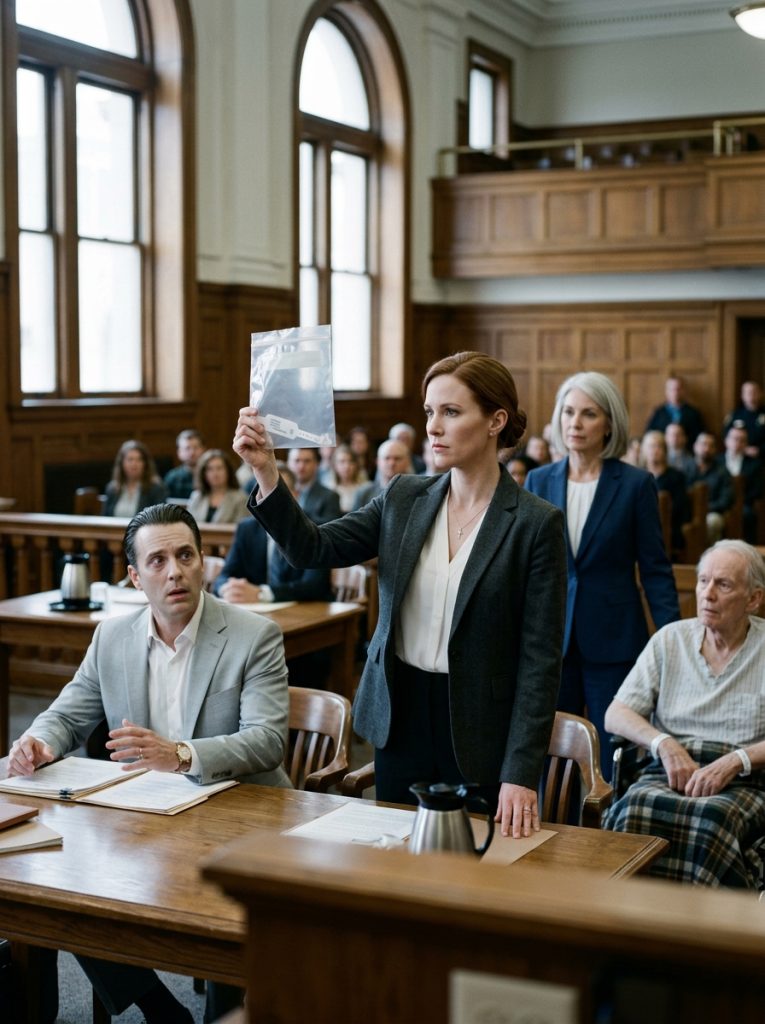
My attorney, Margaret Hale, took the wristband from my hands and entered it as the first exhibit. Then she did what I had not been able to do for eight months. She made the timeline impossible to look away from.
She put two columns on the screen.
On the left: every transfer out of my father’s accounts. The house deed. The investment accounts. The savings. Each with a date and a timestamp, pulled not from a statement Wesley could have doctored, but from the bank’s own back-end metadata — the authorization logs, the device IDs, the exact minute each one was approved.
On the right: my father’s medical record. ICU admission. Intubation. Nineteen days of sedation notes. The neurologist’s daily assessment, the same phrase repeated down the page in clinical shorthand: unresponsive, unresponsive, unresponsive.
Then Margaret lined the two columns up by date.
The first transfer — the house — was authorized at 2:14 in the afternoon on the fourth day. On the right, at that same date: a sedation log, a ventilator setting, a nurse’s initials.
The investment accounts, three days later. On the right: a note that the family had been asked to discuss end-of-life options.
The savings, the morning of day eleven. On the right: nothing but the steady, terrible record of a man who could not have lifted a pen if you’d put one in his hand.
Every single transfer. Every single one. Authorized while Harold Donnelly lay unconscious three floors up.
The “gift letter” was worse.
Wesley’s whole case rested on it — a typed page, signed in a shaky approximation of our father’s signature, notarized and dated October the fourteenth. Legal. Airtight, his lawyer had said.
Margaret pulled the notary’s own logbook.
Notaries keep journals. It’s the law. This one had dutifully recorded that on October the fourteenth, she had personally witnessed Harold Donnelly sign the document in her presence, of sound mind, willingly.
Then Margaret put up the visitor logs from the ICU for October the fourteenth.
My father had no visitors that day except me. He was on a restricted unit. No one signed him out. No one wheeled an intubated, comatose man down to a notary’s office and back without a single nurse, monitor, or door log noticing.
The notary, it turned out, had never seen my father at all. She’d notarized a signature Wesley brought to her, on his word that his father had signed it. When she realized what she’d actually attested to — that she’d sworn under her commission that an unconscious man had willingly signed away his estate — she went very pale in that courtroom, and she stopped being my brother’s witness and started being mine.
I watched Wesley the whole time.
I watched the smile I’d hated my entire life come apart at the edges, then collapse altogether. He leaned over and whispered furiously to his lawyer. The lawyer, who had called me the disappointed sister, had stopped looking at me. He was looking at the door.
The judge asked Wesley to stand.
“Mr. Donnelly,” she said, “do you have any explanation for how your father authorized six-figure transfers and signed a notarized gift letter during a period your own medical exhibits confirm he was comatose and on a ventilator?”
Wesley opened his mouth.
For the first time in his charmed, suit-wearing life, my brother had nothing. No story. No charm. No version of events that survived contact with a timestamp.
“He was going to give it to me anyway,” he finally said, and his voice cracked on the word anyway. “I just— I moved the timeline up. He always meant for me to have it.”
“He always meant,” the judge repeated quietly. “Mr. Donnelly, your father is alive. He’s in this room.”
And he was.
That’s the part I wasn’t ready for.
My father sat in his wheelchair near the front, the plaid blanket over his lap, the new hospital band on his wrist from the rehab facility. He had survived. But the man who came back from those nineteen days is not the man who went under. He speaks slowly now, and not always in order. He tires by noon. He knows my face and he knows Wesley’s, and on his clearer days he knows, in some wordless way, that something was taken.
He was listening. He understood more than people gave him credit for.
When Wesley said he always meant for me to have it, my father made a sound. Just one. A low, broken sound that I will hear for the rest of my life. Not anger. Grief. The grief of a man learning that the son he favored had stood over his hospital bed with a pen.
The judge ruled fast after that.
Every transfer was voided as fraudulent. The house, the accounts, the savings — all ordered returned to my father’s estate, with me appointed as his guardian and conservator, the role Wesley had forged his way into. The notary’s commission was referred for revocation. And the judge referred the entire matter to the county prosecutor, because moving that kind of money by forging an incapacitated person’s signature is not just a family squabble. It’s a felony, several of them, and the metadata that exonerated me is the same metadata that will follow my brother into a very different courtroom.
I should feel triumphant. People keep telling me I won.
I don’t feel like I won. I feel like I dug up something I’d have given anything not to find.
Because here’s what the money cost, and no ruling gives it back.
I have a brother, and now I don’t. Whatever Wesley was to me — and he was the golden one, the easy one, the one our parents bragged about — that person is gone, replaced by a man who could do the math on our father’s death before our father had even finished dying.
And my father knows. That’s the cruelest part. On his good days he’ll ask, in his slow new way, where Wesley is. And I have to decide, every single time, how much truth a recovering man can hold. I usually say Wesley’s busy. It’s a small lie. I’ve learned, this year, exactly how heavy small lies can get.
But the estate is his again. The house he and my mother bought as newlyweds is in his name, where it belongs, and he’ll live out his days in it with the care he earned over forty years of honest work, instead of in whatever facility Wesley’s “gift” would have left him to.
I moved in to look after him. I braid this whole life around his appointments now, the way I once braided it around that vinyl ICU chair. Some afternoons we just sit. He holds my hand the way he did when the machines were breathing for him, except now he’s the one squeezing, and I’m the one being told, without words, that I did the right thing.
I keep the wristband. The pale blue one, snapped at the clasp, that I almost threw away.
It sits in a drawer in the house that’s his again. I take it out sometimes when the doubt creeps back, when an aunt calls to say I tore the family apart, when I wonder if I should have just let it go the way everyone wanted me to.
Then I look at the date printed on it. And the date on the letter. And I remember that two dates that were never supposed to meet are the only reason my father didn’t lose everything while he was too unconscious to defend himself.
I’d do it again. Even knowing what it cost. Especially knowing what it cost.
Some things you don’t let go of. Even when the person on the other side of the table shares your last name.