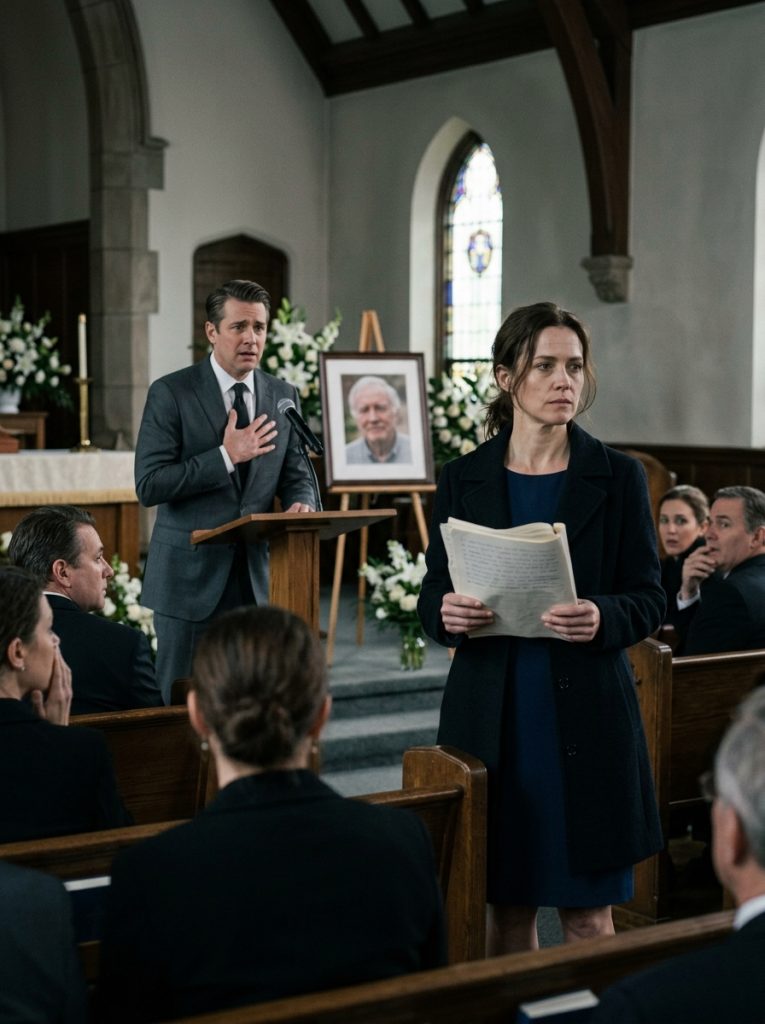
“Before you finish,” I said, “can we talk about the late nights?”
Kevin’s polished grief flickered. “Laura, this isn’t the time—”
“You said you tried every day to be the son he deserved.” I held up the stack of paper. My hands had finally stopped shaking. “These are Dad’s phone records. Eight years of them. I requested them from the carrier last month, when he went into hospice, because I had a feeling I’d need them.”
The chapel went silent. A hundred faces, half of them people who had believed Kevin’s version of our family for years.
“You live twenty minutes from him, Kevin. Twenty. Let’s go year by year.”
“Laura—”
“Year one.” I read off the top page. “Zero calls. Zero texts. Year two — zero. Year three, the year he was diagnosed — zero.” I turned the page. “Year four, when he fell and broke his hip and I slept in a hospital chair for nine nights — zero. Should I keep going? Because I printed all eight years, and every page says the same number.”
Someone near the back said, “Oh my God,” very quietly.
Kevin’s jaw worked. “I called the landline. Those records wouldn’t show—”
“Dad disconnected the landline in year two, because he kept getting scam calls and couldn’t tell the difference anymore,” I said. “Actually, I disconnected it for him. I have that bill too.”
He had nothing.
I didn’t enjoy it the way I’d thought I might. I’d imagined this moment, I’ll admit. Late at night, driving home across the state after another weekend of changing sheets and sorting pills and being the only car in his driveway, I’d pictured standing up and saying all of it.
But standing there actually doing it, with Dad’s photo on the easel watching us both, it just felt like grief. The loud kind, finally let out.
“I’m not doing this to humiliate you,” I said, and I mostly meant it. “I’m doing it because you stood up at our father’s funeral and tried to take the one thing I actually have. I gave him eight years, Kevin. Real ones. The unglamorous ones. The three-in-the-morning ones. And I will not sit here and listen to you eulogize a sacrifice you never made.”
I sat down.
The room didn’t know what to do with itself. Kevin left the podium. The minister, bless him, said a quiet prayer and moved us gently along.
Two days later we were in the lawyer’s office for the reading of the will.
Kevin walked in confident again — that’s the thing about men like my brother, the confidence regenerates overnight. He’d already mentioned, more than once, that as the son he assumed he’d be handling “the major assets.”
The lawyer, an old friend of Dad’s named Harold, pushed his glasses up his nose and said that our father had updated his will eighteen months earlier. Then he read it.
The house — paid off, the house I had driven to every weekend for eight years — went to me.
The savings, what was left after the medical bills, went to me.
Dad’s car, his tools, his fishing gear — me.
And to Kevin, our father left one item.
An envelope.
Harold slid it across the desk. Kevin opened it expecting, I think, a check. A large one. A final apology from a guilty old man.
It was a single sheet of paper, in Dad’s shaky handwriting. Kevin read it in silence, and the color drained out of his face the same way it had at the funeral, and he set it down and didn’t pick it back up.
I didn’t ask what it said. It wasn’t mine to read.
But Harold told me later, because Dad had wanted me to know.
It said: Son, I left you the only thing you ever gave me — time to think about it. Your sister gets the rest, because your sister showed up. I waited eight years for a phone call. I stopped being angry a long while ago. But I never stopped noticing. — Dad
Kevin didn’t contest the will. I think he knew those phone records made it a losing fight in any room in the state.
We don’t talk much now. We tried, once, over coffee. He apologized, in his way — a lot of words about how busy his life had been, how complicated everything was. I told him I understood. That busy is just a word we use for the choices we make about what matters.
Then I told him the thing I’d driven eight years of dark highways to finally understand:
Dad never needed a grand gesture. He never needed money, or a eulogy, or a son who tried “every single day.” He needed a phone to ring. Once. He’d have given you everything for that, Kevin. He told me so himself.
I live in Dad’s house now.
I kept his chair by the window — the one where he used to watch for my car every Saturday. Sometimes I sit in it.
The phone still rings now and then. Telemarketers, mostly.
But I always answer it.
Just in case it’s someone who needs to know that somebody, somewhere, will still pick up.