Judge Sterling opened the folder with the slow deliberation of someone who knew she was about to change lives.
The courtroom was silent — not the silence of attention but of held breath.
My mother’s hand, still resting on the Bible, began to tremble visibly.
“Exhibit A,” my attorney said, rising from his chair.
“DD-214 Certificate of Release or Discharge from Active Duty, United States Army, Nora Jean Vance.
Eight years of service. Honorable discharge. Combat medic, 3rd Infantry Division.”
He laid the document on the evidence table with theatrical precision.
“Exhibit B. Deployment orders. Afghanistan, two tours totaling twenty-two months. Iraq, one tour, eleven months.
Exhibit C. Purple Heart citation. Awarded for wounds received in action, Kandahar Province, October 14th, 2019. IED blast during medical evacuation of four wounded soldiers. Specialist Vance sustained severe shrapnel wounds to her left shoulder and upper back while shielding a patient with her own body.”
The words landed in the courtroom like mortar rounds.
I didn’t look at my mother.
I kept my eyes on Derek.
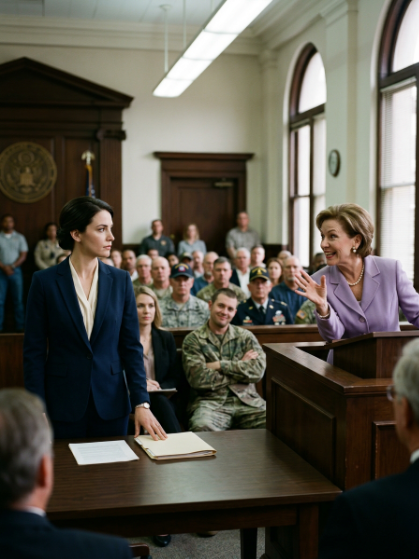
His camouflage jacket had gone completely still.
No rustling.
No grinning.
His face had turned the color of spoiled milk, and his hands — which had been crossed over his chest in defiant mockery just minutes earlier — were now gripping the wooden bench in front of him.
“All four soldiers survived,” my attorney continued.
“Two of them are present in this courtroom today.” From the back row, two men in civilian clothes rose to their feet.
One of them walked with a cane — a polished wooden cane with a 3rd Infantry emblem carved into the handle.
The other had a prosthetic right hand, the mechanical fingers gleaming under the fluorescent lights.
They didn’t speak.
They didn’t need to.
They simply stood — two men who were alive because a combat medic had put her body between them and an explosion.
The courtroom was so quiet I could hear the hum of the air conditioning.
Judge Sterling removed her glasses and set them on the bench with a sharp click.
“Mrs. Vance, you testified under oath that your daughter never served in the military.
You testified that she fabricated combat injuries.
You testified that she was living in Ohio while claiming to be deployed. Would you care to revise any of that testimony?”
My mother’s mouth opened and closed twice.
“I…
I didn’t know the details.
She never told me…”
“You didn’t ask.”
The words came from me. Quiet. Calm. Deadly.
“You never asked because you never wanted to know.
You wanted the farm.
You wanted the inheritance money.
You wanted me to be a liar so you could take everything Grandpa left me.
That was always the plan.”
“That is not—” “Exhibit D,” my attorney interrupted, holding up another sheet.
“This is a discharge document from United States Army Basic Training, Fort Jackson, South Carolina. Private Derek James Vance.
Eight weeks of training. Reason for discharge: theft of government property.”
Derek shot to his feet, his face crimson.
“That’s sealed! That’s juvenile!
You can’t use that in court!”
“Sit.
Down.”
Judge Sterling’s voice cracked like a whip.
Derek sat.
The rustling sound of his jacket was gone now — replaced by the heavy silence of absolute exposure.
“Exhibit E,” my attorney said, his voice growing colder.
“Your Honor, this is an audio recording of a phone conversation between Evelyn Vance and Derek Vance, dated three weeks ago.
In this recording, Mrs. Vance states — and I quote — ‘Nobody checks military records.
The farm is worth four hundred thousand dollars. That’s your inheritance.
We just need to make her look crazy enough that the judge believes us.'”
The courtroom erupted. Murmurs became shouts became something close to chaos.
Judge Sterling banged her gavel four times before order was restored.
She leaned forward, her eyes fixed on my mother with an expression of undisguised contempt.
“Mrs. Vance, you are looking at a perjury charge that could carry significant prison time. Do you understand the severity of your situation?”
My mother’s face had collapsed completely.
Advertisement
The lavender blazer, the pearl necklace, the practiced smile — all of it had crumbled into something small and terrified.
She looked at me for the first time that day.
Not with hatred.
Not with defiance. With something that might have been regret — or might have just been the realization that she had lost.
“Your Honor,” my attorney said, “we move for immediate dismissal of all charges with prejudice.
We also request full sanctions against the plaintiffs for filing a fraudulent lawsuit and for perjury before this court.”
“Granted.”
One word.
That was all it took.
The case was dismissed.
All charges against me were vacated.
The farm — my grandfather’s farm, three hundred acres of Texas hill country that had been in our family for four generations — remained mine.
The investment account remained mine.
And every dollar of legal fees I had spent defending myself against my own family was assigned to my mother and brother. As I walked out of the courtroom, the two veterans from my unit were waiting in the hallway.
The man with the cane — Sergeant First Class Michael Tran — caught my eye with a slight nod.
“You okay, Doc?”
That word. Doc.
I hadn’t heard it in years. Combat medics get called Doc — not a title you ask for, a title you earn by running toward fire while everyone else runs away.
“I’m okay, Sarge.”
Behind them, more veterans had gathered in the corridor. Men and women I had never met.
Some in unit patches.
Some in civilian clothes.
Some with visible scars and some with invisible ones. Word had spread through the veterans’ community — a combat medic was being called a liar in a San Antonio courtroom, and veterans don’t let that stand.
I couldn’t speak.
So I just nodded. Sometimes that’s enough.
Derek found me in the parking garage an hour later.
He wasn’t wearing the camouflage jacket anymore.
He had it balled up in his fist like a piece of garbage.
“Nora. Wait.”
I kept walking toward my car.
“Nora, please. I’m sorry.
I didn’t know about the explosion. About the IED. About any of it. Mom said you were lying.
She said you’d never left Ohio.
She said…”
He trailed off.
I turned around.
“You didn’t ask, Derek.
In eight years, you never asked me one question about where I was or what I was doing.
You never called.
You never wrote.
And when Mom told you I was a fraud, you didn’t question it for one second.”
He looked down at the crumpled jacket.
“I failed basic training. I’ve never told anyone.
I was ashamed.
And when Mom said you were faking… it made me feel better. Like I wasn’t the only one who couldn’t hack it.”
I stared at him for a long moment.
“I don’t forgive you.
Not yet. Maybe not ever.
But I understand the shame.
I carried it for years after I came home — the soldiers I couldn’t save, the faces I still see in dreams.”
I opened my car door.
“The jacket. Burn it.
And if you ever want to have a real conversation — about the military, about the family, about any of it — you know where I live.”
I drove home to the farm.
The farmhouse was dusty and needed work, but it was mine.
The will was valid.
The fraud case was dead.
On the porch, in the fading Texas light, I sat in the same rocking chair where my grandfather used to tell me stories when I was a little girl.
I touched the scar on my shoulder through my blouse.
The scar wasn’t what had won the case.
It was the folder.
The documents.
The truth that had been waiting patiently in manila envelopes and file cabinets for someone to finally speak it aloud.
My phone buzzed. A text from an unknown number: “We were there today. Whole unit heard what happened. Proud of you, Doc.”
I didn’t reply.
I just sat there in my grandfather’s chair, watching the sun set over land that no one could ever take from me.
And for the first time in four years — since the moment I woke up in a German hospital with tubes in my arm and a chaplain holding my hand — I felt something I hadn’t expected. Peace.
Not the peace of forgetting.
Not the peace of forgiving.
The peace of knowing the truth had been spoken.
And nothing — not my mother, not my brother, not a courtroom full of strangers — could ever take that away.