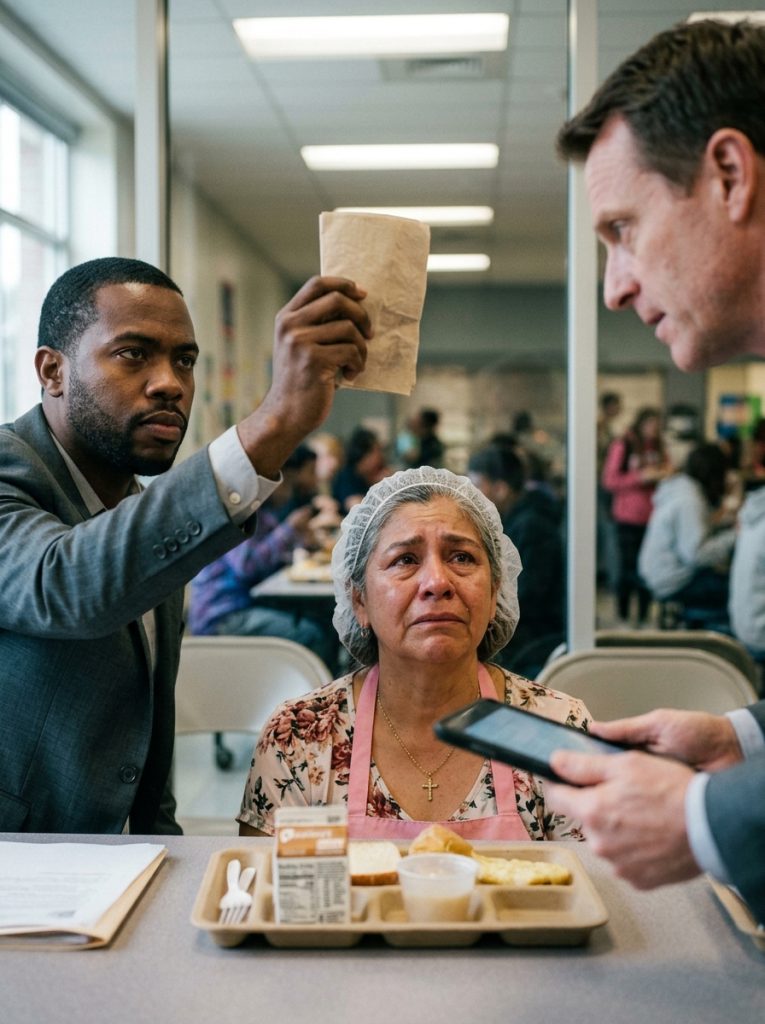
The room did not know what to do with the silence.
Mr. Hargrove recovered first, the way men like him always do. He straightened his tie and put the smile back on. It sat a little crooked now.
“And you are?” he said.
“Andre Wells.” The young man didn’t raise his voice. “I was appointed to this board in the fall. You sent me the welcome packet yourself, Mr. Hargrove.”
At the far end of the table, the board president, Dr. Bennett, sat up straight.
“Mr. Wells. We didn’t realize you’d be sitting in today.”
“That was the point,” Andre said. “I wanted to see how the school runs when nobody’s performing for the board. I’ve spent two days in that cafeteria. I’ve seen enough.”
He turned back to me and gestured, gently, at the little notebook Mr. Hargrove had been waving around like a confession.
“Mrs. Moreno. May I?”
I nodded. My voice had left me somewhere around the word “fraud.”
Andre opened the notebook. He didn’t read it to shame anyone. He held it up so the table could see the columns.
“Mr. Hargrove called these numbers irregular,” he said. “He’s right. They are. Let me tell you exactly what’s irregular about them.”
He read a line. A date. A child’s lunch number. An amount.
Two dollars and forty cents.
“That’s not money missing from the register,” Andre said. “That’s money going in. Her money. From her own paycheck. Every Friday. For nineteen years.”
He flipped a page. Another line. Another child fed.
“There’s no theft here. There’s the opposite of theft. There’s a woman who spent nineteen years quietly making sure no kid in this building ever had to do the math on whether they were allowed to eat.”
Mr. Hargrove’s jaw worked. “The counts don’t reconcile with the register totals —”
“Because she paid the difference herself,” Andre said. “You found a shortfall in the register and assumed someone was stealing. It never occurred to you that someone was giving.”
He let that sit.
Then he picked the napkin back up off the table.
“Two days ago,” he said, “I watched you deny a boy a hot lunch and stamp the back of his hand in front of his friends. And I watched Mrs. Moreno wait until you walked away, and then hand that boy her own lunch out of a container she brought from home. She didn’t know I was watching. She didn’t do it for credit. She’s never done anything for credit.”
His voice finally caught.
“I know that. Because nineteen years ago, I was that boy.”
Nobody at the table moved.
“My mother was sick for two years. Cancer. We lost the apartment, we lost the car, we lost almost everything a family can lose and still be a family. And every single school day, a woman in a pink apron made sure I had a hot tray. And she did it without ever once letting me feel like a charity case.”
He unfolded the napkin and turned it toward the board.
“She used to write little notes on a napkin and tuck them on my tray. So I’d think it was normal. So I’d think everybody got one.” He swallowed. “‘You are smart. Keep going.’ That’s what this one says. I’ve carried it in my wallet for nineteen years. It’s the reason I finished school. It’s the reason I went to college. It’s the reason I’m sitting at this table.”
I was crying now. I couldn’t help it. I had forgotten that boy’s name a long time ago. There had been so many boys. But I remembered the napkins.
Andre set it down in front of me, like he was giving it back.
“You don’t fire her,” he said quietly to the room. “You learn from her.”
Dr. Bennett asked to see the notebook. It went around the table, hand to hand, and I watched grown men and women go quiet as they turned the pages.
Then a small thing happened that I will never forget.
Doreen, who runs the dish line beside me, stood up from where she’d been waiting to give her statement against me. She walked to the front and put down her own purse.
“I want it on the record,” she said, “that some Fridays, when Lucia ran short, I covered a couple kids too. We never talked about it. We just did it. Half the staff in that kitchen has, at one time or another. She started it. We followed her.”
One by one, three more kitchen workers stood.
Mr. Hargrove watched his hearing turn into something else entirely.
Mr. Hargrove tried, for a few minutes more, to fight it.
He talked about “standards.” He talked about “liability,” about how letting staff hand out free food “sets a precedent.” He actually said the word “optics.”
Dr. Bennett took off her glasses.
“Mr. Hargrove,” she said, “a child cried in our cafeteria because you stamped his hand. Those are the optics I’m worried about.”
A parent in the back row stood up without being called on. I knew her — Tanya, whose twins came through my line every single day. She held up her phone.
“My boys told me about the stamps the first afternoon,” she said. “I’ve got forty messages in the school parent group from this week alone. You want to talk about precedent? The precedent in this building, long before you got here, was Miss Lucia. Ask any kid who ever came through that line hungry. They’ll all give you the same name.”
The room murmured. Somebody started to clap and then thought better of it, because it wasn’t that kind of room.
But I felt it anyway. The whole table tilting, like a boat finding its balance again.
The board voted that afternoon. They suspended the lunch-debt policy immediately — no more cold sandwiches, no more stamped hands, no more names taped by the register. They opened a review into Mr. Hargrove’s conduct, and within the month, he was no longer with the district.
But Andre wasn’t finished.
He stood again before the meeting closed.
“I’d like to propose a fund,” he said. “Something permanent, so this never falls on one woman’s paycheck again. We clear every child’s lunch debt in this district. We keep it cleared. And we name it after the person who’s been doing it alone for nineteen years.”
They called it Lucia’s Table.
He wrote the first check himself. By the end of the week, the local paper had the story, and the checks didn’t stop. Parents. Graduates. A trucking company two towns over. A woman who said she’d been a free-lunch kid in 1974 and never forgot it.
Lucia’s Table cleared every account in the district by spring. There was money left over. They used it to put a hot breakfast cart by the front doors, free to anyone, no questions, no list.
They asked me to cut the ribbon.
I told them I’d rather just hand out the trays. That’s what I know how to do.
So that’s what I did. I stood behind the cart in my pink apron and my hairnet, and I handed warm food to children who said good morning to me, accent and all, and meant it.
That first morning at the breakfast cart, the boy came through. The one from two days before. The one whose hand Mr. Hargrove had stamped.
He stopped in front of the cart and looked at the warm trays like he wasn’t sure they were real.
“Is it really free?” he asked.
“It’s really free,” I said. “Take two if you’re hungry.”
He took two. He came back the next morning, and the morning after that. After a week he stopped flinching when he passed the register.
Advertisement
That was the whole prize, right there. That was everything I ever wanted.
A reporter asked me later if I felt vindicated. I had to ask Andre what the word meant.
When he told me, I shook my head.
“I don’t need vindicated,” I said. “I needed the children fed. They’re fed.”
Andre comes by on the first Friday of every month now. He brings his daughter. She’s four. She likes the chocolate milk.
He still keeps the napkin in his wallet. I’ve seen it. The blue ink has nearly faded to nothing.
But I know what it says. I’m the one who wrote it.
You are smart. Keep going.
He did.