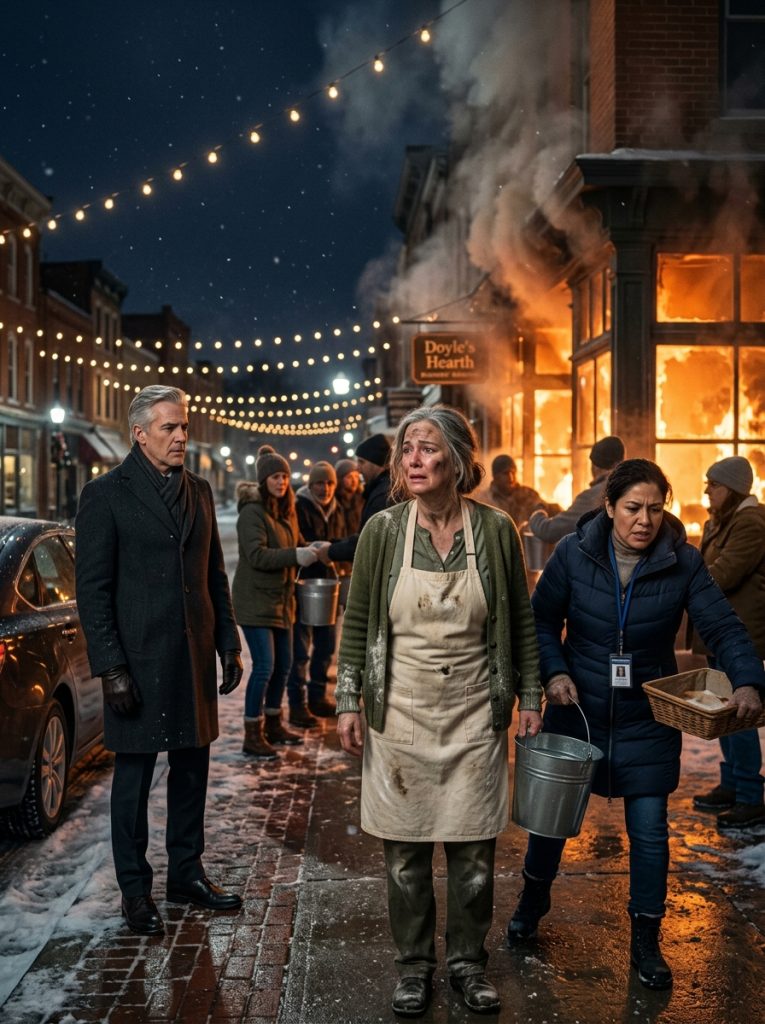
The fire trucks finally turned the corner, but by then the worst of it was already losing.
That bucket line had bought the firefighters the minutes they needed. The flames never reached the front of the shop, the part where the ovens are, the heart of the place. The back storeroom was gutted. The kitchen was black and dripping. But Doyle’s Hearth was still standing when the sun came up.
I sat on the curb in my soaked apron and watched steam rise off the brick in the cold morning light.
Ruth wrapped a shelter blanket around my shoulders. “It’s still here, Maggie,” she kept saying. “It’s still here.”
But I’d seen the numbers. I knew what I had in the bank, and I knew what a kitchen costs to rebuild, and the two of them weren’t on speaking terms.
That’s when Preston Vance crossed the street and crouched down next to me on the curb.
I almost didn’t have the energy to be angry.
“Come to make your offer while it’s cheap?” I said.
He didn’t smile. He reached into his coat and handed me a business card. Not the one he’d given me before.
This one said Heartland Main Street Foundation. Under his name it said Director.
“I owe you an apology,” he said. “And an explanation. I haven’t been entirely honest about why I’ve been sitting in your bakery.”
I just looked at him.
“There are no buyers, Maggie. There never were. My foundation puts money into towns like this one — into the businesses that actually hold a street together. But money gets wasted on the wrong people all the time. So before we write a check, I sit. I watch. I find out what a place does when it thinks no one important is looking.”
“You were rude to me on purpose,” I said.
“I pushed you on purpose,” he said. “I told you that you were drowning. I told you the bread was a waste. I wanted to see if you’d protect the smart thing or the right thing.” He looked toward the dark windows of my shop. “You told me the bread was the whole point. Three nights later, every person you’d ever fed showed up with a bucket. I’ve been doing this for twenty years. I have never seen a clearer answer.”
I started crying then. The kind you can’t stop and don’t try to.
The foundation didn’t just cover what the insurance wouldn’t.
They rebuilt the kitchen bigger than it was. They put in a second oven — a real one, the kind I’d dog-eared in catalogs for a decade and never let myself order. And they added something I never asked for: a small commercial kitchen in the back, licensed, so the shelter could bake its own bread on the mornings I couldn’t carry it over.
Preston insisted on one condition for the grant. He made me read it twice to be sure I understood.
The condition was that I had to keep giving the day-old bread away. In writing. Forever.
“That part was never charity,” he said. “That part was your collateral.”
We reopened in April.
The whole town came. People I’d handed paper bags to for twenty-six years stood in a line that wrapped past the hardware store. Ruth cut the ribbon. Half the bucket brigade showed up in the same coats they’d worn that night, and we laughed about it until we didn’t, because some things are too big to only laugh at.
Preston comes in still. He orders the same black coffee. But now he leaves a tip the size of a car payment and pretends he didn’t. He told me once that in twenty years of writing checks, the bakery on the snowy night was the easiest yes he had ever signed. Then he changed the subject, the way men like him do when the truth gets too close to the surface.
Last week I taught two teenagers from the shelter how to shape a loaf. Ruth had sent them over — said they needed somewhere to be at six in the morning that wasn’t the street.
I showed them how to fold the dough, how to feel when it’s ready, how to listen to it.
And at closing, the way I have every night for twenty-six years, I boxed up what didn’t sell.
Only this time, I didn’t carry it two blocks alone in the dark.
The two of them carried it for me, one box each, down a street where every light I passed had once come on for me.
I just walked between them, warm for the first time in months, and let the town I’d been quietly feeding finally walk me home.