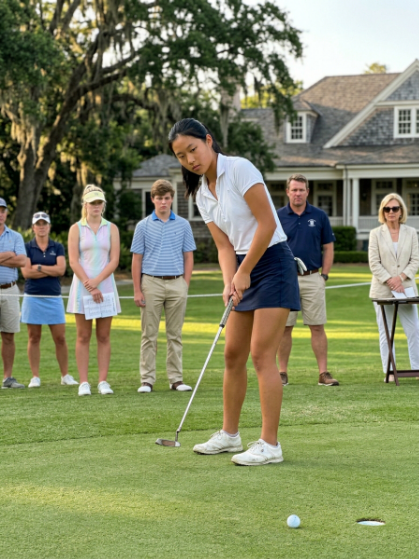
The ball did not drop right away.
It rolled like it had all the time in the world.
I could hear nothing while it moved. Not the spectators behind the rope. Not Coach Ellis shifting near the fringe. Not Madison breathing out too soon because she thought the break would miss.
Only the tiny sound of the ball crossing trimmed grass.
Then it caught the right edge.
And fell.
For one second, nobody moved.
That was the strangest part.
I had imagined cheers. Maybe anger. Maybe Madison throwing the torn team-photo schedule onto the ground like a movie villain who had lost the final scene.
Instead, the green went silent in a new way.
Not waiting.
Witnessing.
Then my mother screamed.
Not a country club cheer. Not polite clapping. A full, shocked, parking-lot-to-practice-green sound that made three legacy parents turn around at once.
I laughed before I knew I was crying.
My putter was still in my hand. My grandfather’s putter. The one Trey had joked about. The one Madison had treated like proof that I belonged somewhere cheaper.
I looked at the cup.
Then at the rope.
Then at Coach Ellis.
His face had gone pale.
He clapped twice, then stopped like he was not sure whether he had earned the right.
Patrice Donnelly stepped onto the green before anyone else did.
She did not rush me. She did not touch my shoulder for a photo. She walked to the scorer’s table, picked up the final scorecard, and asked the volunteer to read it aloud.
Madison said, “We should verify the groups.”
Patrice turned toward her.
“The scorecard is the group.”
That was the first time all day someone with power said the written rule out loud.
Trey looked at Madison’s hand.
The torn team-photo schedule was still there.
She must have forgotten she was holding it.
Patrice saw it too.
“May I have that?”
Madison’s face changed.
A flush crawled from her neck to her ears.
“It was already damaged.”
“I did not ask how it became damaged.”
Madison handed it over.
The paper looked small in Patrice’s hand. That surprised me. All day it had felt enormous, like a gate with my name folded under it. Now it was just paper. Torn paper. Evidence of a room that had trusted its own cruelty to stay casual.
Coach Ellis finally walked toward me.
“Avery,” he said.
I waited.
He looked at the putter, then at the cup, then at the spectators.
“That was an incredible putt.”
It was true.
It was also not enough.
I said, “You heard them before the round.”
The words came out before I knew I had decided to say them.
His mouth opened, then closed.
Adults hate when a kid states the thing they hoped would stay in the category of unfortunate.
I did not say it loudly. I did not need to. Patrice heard. So did my mother, who had reached the rope and was wiping her face with a napkin from the snack tent.
Coach Ellis nodded once.
“I did.”
“You did not stop it.”
He looked older in that moment.
Not ruined. Just seen.
“No,” he said. “I did not.”
Madison whispered something to Trey. He told her to stop talking.
That was new.
The trophy presentation was delayed.
Officially, it was because Patrice wanted to review the junior team selection process before announcing captaincy. Unofficially, it was because the club had to decide whether the same adults who had let the schedule be altered were going to stand in front of donors and pretend merit had always been protected.
Advertisement
We waited near the practice green.
My mother hugged me too hard and then apologized for hugging me too hard and then hugged me again. She smelled like sunscreen and car air freshener. I could see the gray sedan in the parking lot beyond the hedges.
My grandfather was not there.
He had died two years before.
But I held his putter across my knees and thought about how he used to say a clean stroke was just honesty with direction.
Madison’s parents argued near the clubhouse steps. Trey’s father paced with his phone. Coach Ellis stood with Patrice at the scorer’s table, pointing at the schedule, the scorecard, the tournament email, the folded team-photo plan.
For the first time all afternoon, adults were reviewing paper that hurt me instead of asking me to be gracious about it.
That mattered.
When Patrice called everyone back, she stood without a microphone.
Country club voices can carry when they expect to be obeyed.
She announced the tournament winner first.
My name.
Avery Chen.
I expected the applause to feel good.
It did, partly.
But what I felt more was relief that the score did not need me to explain my worth. The putt had done what speeches never could in that room.
Then Patrice held up the torn schedule.
She did not show names. She did not shame Madison like Madison had tried to shame me. She simply said the junior program had failed to enforce its own merit rules and that the board would correct it before any team photo, captain vote, or scholarship review moved forward.
Madison stared at the grass.
Trey stared at his shoes.
Coach Ellis stood beside Patrice and said, “I allowed social pressure to affect a competitive process. That was wrong.”
My mother made a sound behind me.
A small one.
The kind people make when an apology finally names the harm instead of polishing it.
I looked at Coach Ellis.
He looked back.
Not asking me to rescue him.
That helped.
A week later, the scholarship policy changed. Not in a grand way. In a useful way. Team placement tied to scorecards. Final group rules documented. Scholarship players assigned a board advocate when selection decisions involved legacy families. Complaints recorded in writing.
Rules everyone could see.
I was named junior captain at the next meeting.
Madison did not clap.
Trey did, after a delay long enough to count.
I did not need their joy.
I needed the room to stop pretending their comfort was a qualification.
The team photo was retaken on the clubhouse steps. This time my name was on the top line. Not because Patrice moved it there as a kindness, but because captains stood in front.
My mother took a picture from behind the official photographer. It was crooked. The sunlight hit half my face. My putter was visible at my side, worn grip and all.
That is the photo I like.
Not the official one.
The crooked one.
The one where you can see my mother did not care about perfect framing because her hands were shaking.
Coach Ellis changed too, slowly. He still made mistakes. Adults do. But he stopped letting jokes pass through the air unchallenged. The first time a legacy kid called a scholarship player a diversity slot, Coach Ellis ended practice and made the whole team review the selection rules.
Not a speech about kindness.
A rule.
A consequence.
A line.
That was better.
At the end of the season, I went to the final green alone after practice. The cup had been moved, of course. Grass does not preserve your victories for you. I placed a ball where I remembered standing, lined up with my grandfather’s putter, and missed by three feet.
I laughed so hard I had to sit down.
The putt that changed everything was not proof that I would never miss.
It was proof that when I earned the right to take the shot, nobody else got to move my name off the paper first.
I keep the torn team-photo schedule in a folder with the corrected captain list.
One shows what they tried to do.
The other shows where the ball went.