The compliance officer, a sharp-eyed woman named Linda, frowned as she looked at the worn leather cover of the notebook, then up at me.
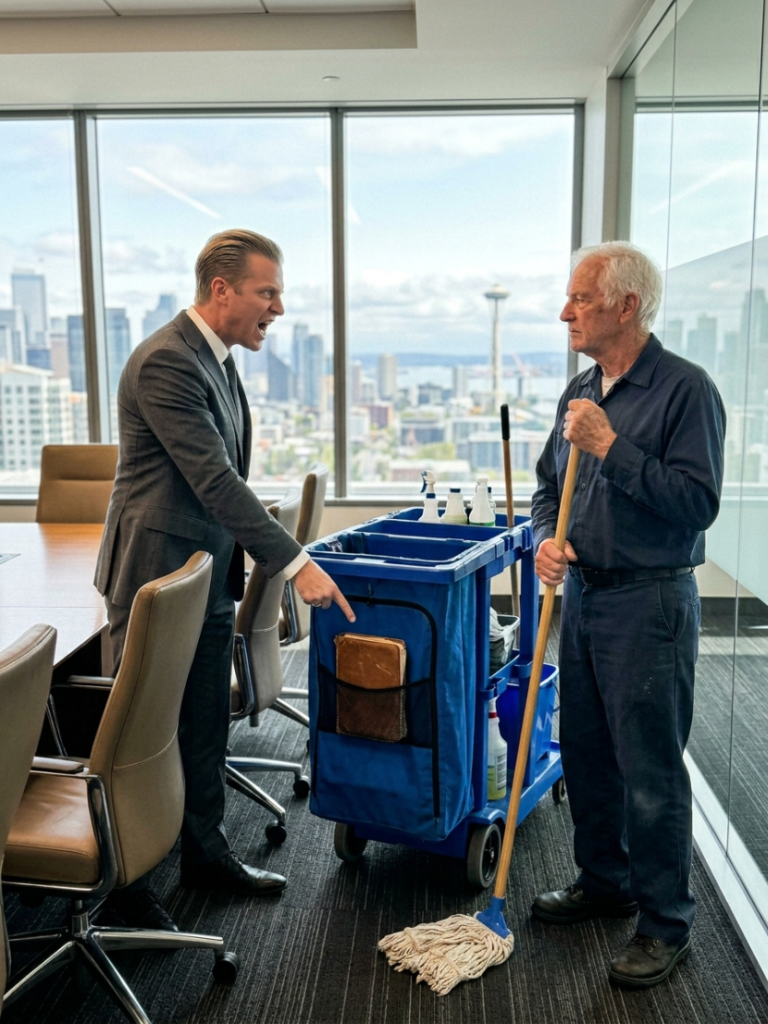
Brad Larson snorted, shaking his head as he adjusted his designer tie. “Linda, please don’t waste our time. Tom, if you don’t pick up your bucket and get out of here, I’m calling security. This is an executive board meeting, not a breakroom for the cleaning staff. Your little notepad doesn’t change the fact that we have to cut thirty percent of our workforce by Friday.”
Linda didn’t answer him. Her fingers, manicured and steady, opened the faded leather cover. She turned past the first few pages, which were filled with my sister Elena’s neat, elegant handwriting—notes about warehouse logistics, employee birthdays, and values she wanted the company to keep. Then, Linda stopped at the thick, folded document tucked into the back sleeve. She unfolded it, her eyes widening as she read the gold-embossed seal at the top.
“Brad,” Linda said, her voice dropping to a quiet, tense whisper. “You need to look at this.”
“What is it?” Brad snapped, leaning over the mahogany table, his slick blonde hair falling slightly out of place. “Elena’s old recipes? Some nostalgic family tree? We are trying to save this company from bankruptcy, and I don’t have time for—”
His voice cut off as Linda slid the document across the table. Brad’s eyes darted down the page, and the mocking sneer that had been plastered on his face for the last hour froze. The color began to drain from his cheeks, leaving him a pasty, sickly white.
“This… this is the voting trust certificate for the Sterling Family Trust,” Brad stammered, his fingers trembling as he touched the edge of the paper. “But the trust was supposed to be managed by a corporate executor. The bank said it was locked until a designated family trustee stepped forward. We’ve been trying to find them for six months to sign off on the corporate restructuring.”
“You don’t have to look any further, Brad,” I said quietly, my voice calm but carrying a weight that seemed to quiet the entire boardroom. “I am the trustee. I have been here the whole time.”
I reached up and unclipped my employee name badge, showing the gold seal engraved on the back of the metal clip—a symbol of my sister’s founding share ownership. The managers in the room stared at me in stunned silence, their jaws dropping as they looked from my worn blue janitor uniform to the documents on the table.
For the past fifteen years, I had walked these halls with a mop and a bucket, completely invisible to the executives who sat in these leather chairs. When my sister Elena founded Sterling Logistics, she wanted to create a business that treated its workers like family. She believed that the drivers, the warehouse workers, and the office staff were the real heart of the company. When she fell ill and realized her husband’s family was planning to sell the business to a private equity firm that would strip it for parts, she created the private trust, placing sixty percent of the company’s voting shares inside it.
She asked me to be the sole trustee, but she also gave me a choice.
“Tom,” she had told me from her hospital bed, her voice weak but her eyes bright. “The board will try to tell you that the only way to run a business is with cold numbers and layoffs. They will try to convince you that greed is efficiency. Don’t let them. Watch them. See who they are when they think no one is looking.”
So, I made my moral choice. I chose to stay in my janitor uniform. I chose to sweep the floors, empty the trash, and clean the restrooms of the very executives who made decisions about the employees’ lives. For fifteen years, I watched. I saw directors who walked past a cleaning man without a word, and I saw directors who stopped to ask about my day. I saw Brad Larson rise through the ranks, his ambition growing colder and more ruthless with every promotion, until he finally reached the position of Managing Director.
I watched him plan this day for months. He had ignored the warehouse safety reports, cut the drivers’ health benefits, and was now preparing to lay off fifty-two employees, including Martha, a mother of three who had spent twenty years running our logistics dispatch desk. Brad had told the board that these layoffs were “unavoidable operational adjustments,” while quietly writing a three-hundred-thousand-dollar performance bonus for himself into the quarterly budget.
“This is a joke,” Brad suddenly whispered, trying to gather his composure. He stood up, pointing an accusatory finger at me. “You’re a janitor, Tom! You clean toilets! You don’t know the first thing about running a logistics company. You can’t just walk in here in a dirty uniform and overturn an executive decision. The board of directors will never support this!”
“The board of directors is bound by the corporate charter, Brad,” Linda, the compliance officer, said firmly. She looked at Brad with a cold, professional stare. “The Sterling Family Trust holds the majority voting power. As the sole trustee, Thomas Miller has the legal authority to appoint and remove any executive officer, including the Managing Director. His signature is required for any layoffs, mergers, or structural changes. Without his approval, your layoff plan is completely void.”
The room remained absolutely silent. The managers who had previously sat in fear of Brad’s wrath now looked at me with a mixture of hope and awe. Martha, who was sitting near the end of the table, had tears streaming down her face, her hands clutched together in relief.
I walked to the head of the table, placing my weathered hands on the back of the leather chair that my sister Elena used to sit in. I looked at Brad’s sweating face.
“You’re right about one thing, Brad,” I said, my voice steady. “I don’t know how to write a spreadsheet that turns people’s lives into percentages. But I know how to run a logistics company that respects its workers. I know that the drivers who work the night shifts and the dispatchers who coordinate the deliveries are the ones who keep this business alive, not the executives who spend their days in luxury boardrooms.”
I looked at the compliance officer. “Linda, please record the trustee’s first official directive. The proposed layoff plan is canceled immediately. All affected employees will remain in their positions with full salary and benefits. We will fund our operational deficit by canceling all executive performance bonuses for the next twelve months and reducing the Managing Director’s travel and entertainment budget.”
A quiet murmur of approval rose from the managers, and some of them began to nod in agreement. Brad’s face went red with anger, his hands clenching into fists.
“You can’t do this to me, Tom!” Brad shouted, his voice cracking. “I have a contract! I have a reputation in Seattle!”
“You had a contract, Brad,” I replied calmly. “But your contract has a clause regarding professional misconduct and the ethical treatment of staff. Pointing at an employee’s mop bucket to humiliate them in front of the board is a direct violation of our corporate conduct policy. You are terminated, effective immediately. You have one hour to pack your office. Security will escort you to the lobby.”
Brad looked around the room, hoping to find someone to defend him, but the managers all looked away. They knew that the authority had shifted, and they were glad to see him go. With his head down, Brad slowly walked out of the boardroom, his designer grey suit looking suddenly small and insignificant.
I turned to the remaining managers, offering them a warm, weathered smile. “Now, let’s get back to work. I think we have some logistics networks to optimize, and we’re going to do it the right way.”
I picked up my mop handle and pushed my cart out of the boardroom, knowing my sister’s company was finally in safe hands.