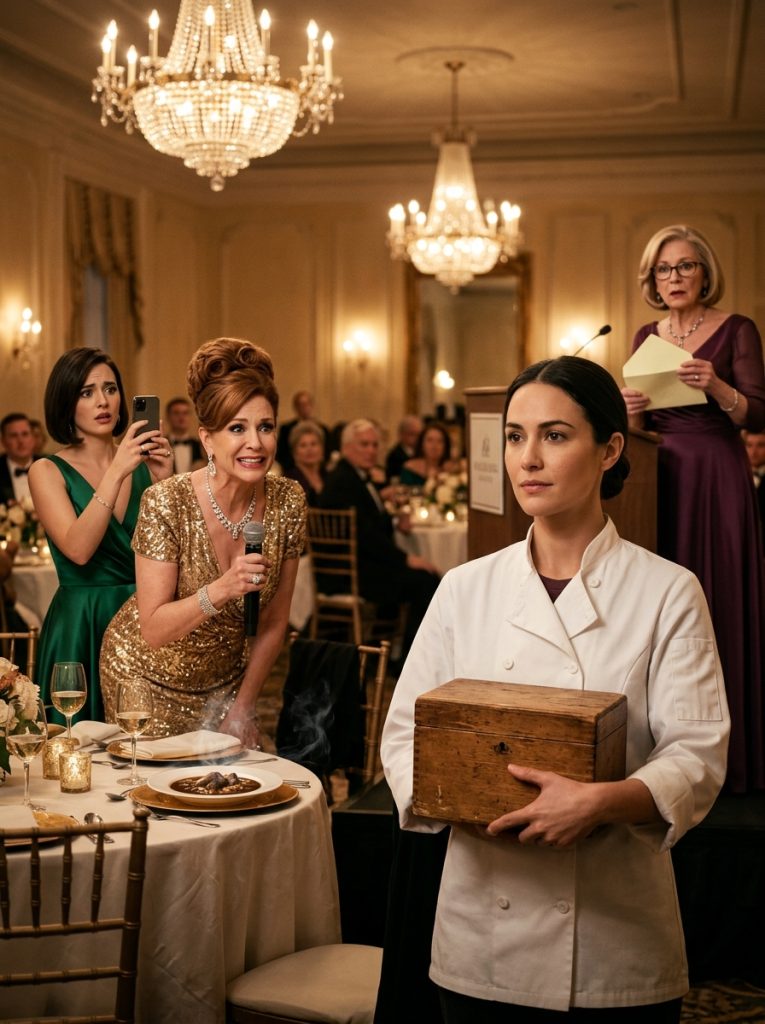
It was supposed to be my stepmother’s night.
The ballroom was packed. Her restaurant was favored to win. She had a speech ready and a microphone in her hand before they’d even opened the envelope.
Then the head judge announced the winning dish — and it was the gumbo my stepmother threw in the trash eleven years ago.
My name is Eliza Boudreaux, and I almost didn’t go to that gala at all.
My place, Rosalie’s, has twelve tables and a walk-in that leaks when it rains. I figured my nomination was a courtesy. The real story of the night, everyone agreed, was Maison Margaux — my stepmother’s gleaming temple downtown, with its valet and its chandeliers and its “house secret” gumbo that food writers crossed state lines to swoon over.
Here’s what the food writers didn’t know.
That gumbo was my mother’s.
My mother, Rosalie, died when I was twelve. She cooked at a stove that tilted to the left, in a kitchen that smelled like filé and bay leaf, and she kept every recipe in a small wooden box with a cracked lid. Index cards in her own slanting hand. Notes crowded in the margins: “More cayenne for Papa.” “Eliza’s favorite — extra okra.” “Let it sit overnight, chère, it’s always better the second day.”
When my father remarried, Margaux moved in like a renovation crew. New furniture, new china, a new set of rules. And one afternoon, a new war on “clutter.”
I came home from school and found my mother’s recipe box in the trash bin at the curb, rain already soaking through the cards, the ink blooming and bleeding.
I was thirteen. I dug it out with my bare hands and dried what I could on the kitchen radiator. But most of the cards were ruined past saving.
So I did the only thing I could. I rebuilt them from memory. Night after night, after Margaux and her daughter Camille went to bed, I cooked. I tasted from a wooden spoon and adjusted and wrote it all down again in my own messy thirteen-year-old hand. The gumbo took me two years to get exactly right — the roux the precise color of an old penny, the heat that builds slow and finishes clean.
Margaux must have salvaged a few cards before the rest hit the bin. Because a year later, “Maison Margaux’s house gumbo” appeared on her menu. My mother’s gumbo, under a stranger’s name, collecting reviews.
I never said a word. Who would believe the kid with twelve tables over the woman with the chandeliers and the publicist? I cooked my mother’s food in her honor and let the work be the truth.
Which brings me to the gala.
They served both finalist dishes to the judges blind — numbered bowls, no names. The head judge that year was an elegant woman in plum named Cornelia Vance, a James Beard committee veteran with a reputation for an unforgiving palate.
What none of us knew was that thirty years ago — before Margaux, before me — Cornelia Vance and my mother had been line cooks together at a little place on Frenchmen Street. Best friends. They’d lost touch when life pulled them in different directions, and Cornelia had never known what became of Rosalie.
She tasted Margaux’s bowl first. Polite. A nod.
Then she tasted mine.
I watched from across the room as she set down her spoon. As something moved across her face. She picked the spoon back up, tasted again, slower, and her eyes went bright and wide and wet.
Because she knew that gumbo. The exact heat. The exact finish. The “second-day” depth my mother swore by. A taste she hadn’t had in thirty years, since a cramped kitchen with a stove that tilted to the left.
When they called the winner, Margaux was already half-standing, microphone up, her gold sequins flashing, Camille’s phone raised to film the triumph.
And Cornelia said, into the room, “Before I read the name — I have to say something, because I owe it to someone who can’t be here.”
The ballroom hushed.
“Forty years ago I learned to cook beside a woman named Rosalie. The best natural cook I ever knew, and the most cheated. I never knew what happened to her. Tonight I tasted her gumbo again. Her exact gumbo — I’d know it anywhere. And it wasn’t in the bowl I expected.”
She looked at the card. “The award for Dish of the Year goes to Rosalie’s. To the chef Eliza Boudreaux.”
I don’t fully remember walking up. I remember the recipe box was in my hands — I’d brought it for luck — and the room going from confused to electric as I set it on the podium.
Margaux’s smile didn’t fall so much as freeze, like something caught in ice. The microphone was still in her hand, useless now.
I didn’t expose her with a speech. I didn’t have to. I just held up the box.
“This was my mother’s,” I said. “These are her recipes, in her handwriting, what’s left of them. The rest I rebuilt from memory after they were thrown away. That gumbo you’ve all been crossing town to eat — it was hers first. I’m just the one who remembered.”
I didn’t say Margaux’s name. I didn’t need to. Every food writer in that room had reviewed “Maison Margaux’s house secret,” and every one of them was now looking at a worn wooden box and doing the math.
Cornelia found me afterward and told me stories about my mother I’d never heard. We’ve had dinner once a month since — she’s the closest thing to my mother’s voice I have left.
Maison Margaux is quieter these days. The “house secret” came off the menu without explanation. My father called me, the first real call in years, and all he could say was “I didn’t know she threw out the box, Eliza. I swear to God I didn’t know.” Maybe that’s true. I let it be true, because I’m tired of carrying it.
The recipe box sits on a shelf at Rosalie’s now, behind glass, where the staff can see it. We still let the gumbo rest overnight. It’s always better the second day.
My mother never got to see her name win anything. But for one night, in a room full of people who’d been praising her work under someone else’s name, the truth finally got read out loud.
Comment “ROSALIE” if a stolen recipe always finds its way home. 🥘