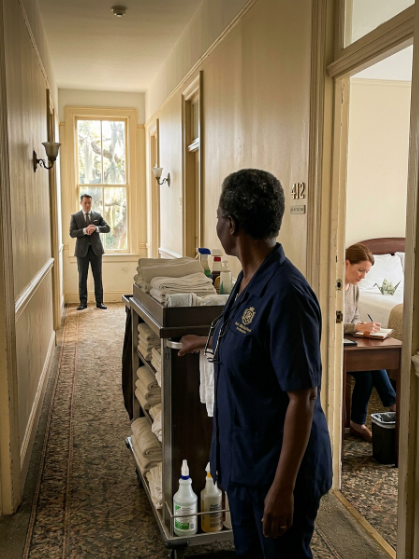
I stood in the doorway of room 412 with my cart, and I almost didn’t pick up the crane.
It felt wrong, somehow. Like taking something that wasn’t mine to take.
But she’d left it on the pillow the way she always did, square in the middle, folded with those careful hands. And tucked into the fold of its wing was a slip of paper.
I set down my dust cloth. I unfolded the crane slowly, the way you’d open a letter you weren’t sure you were allowed to read.
The note inside said: “Miriam — be in the lobby Friday at four. Wear your uniform. You’ve earned the right to be in the room. — R.C.”
I read it three times.
I didn’t understand it. But I’d spent eleven years learning that when something doesn’t make sense in a hotel, the smartest thing you can do is keep your head down and wait. So I finished my rooms. I clocked out. And on Friday at four o’clock, I came back in my navy uniform, my heart going faster than I wanted to admit, and I stood near the front desk feeling like a woman who’d wandered into the wrong party.
The quarterly ownership review was happening in the boardroom off the lobby. I knew that much. Derek Stiles had been strutting about it all week, pressing his suits, practicing his numbers. He loved those meetings. They were where he got to be a genius.
At ten past four, the boardroom doors opened, and a young man in a suit came out and said, “Mrs. Osei? They’re ready for you.”
I almost looked behind me to see who he meant.
I walked in on legs that didn’t feel like mine.
There were maybe a dozen people around a long table. Derek was at one end, mid-sentence, a slide glowing on the wall behind him full of green arrows and happy figures. He stopped when he saw me. His face did something complicated.
“This is a private meeting,” he said. “Someone get her —”
“She’s here at my request.”
The voice came from the far end of the table.
It was her. Room 412. The quiet woman with the auburn bun and the plain watch. Except now she wore a tailored blazer, and there was a thick bound report open in front of her, and every single person at that table was angled toward her like she was the sun.
“My name is Ruth Ann Calloway,” she said, to the room, but looking at me. “I’m the forensic auditor the ownership group retained ninety days ago. I’ve spent the last week as a guest in this hotel — room 412 — because the numbers Mr. Stiles has been presenting were a little too beautiful, and beautiful numbers are usually the ones somebody is painting.”
Derek’s mouth opened. Nothing came out.
“I’ll be brief, since I’ve already submitted the full report,” Ruth Ann said. She turned a page. “Over the past three years, Mr. Stiles diverted roughly one-point-two million dollars. He took the housekeeping tip pool and renamed it an administrative fee that flowed to an account he controlled. He canceled staff health insurance and continued to bill the ownership group for it. He scheduled employees off the calendar — without firing them, so they wouldn’t qualify for anything — until they quit on their own.”
She looked up at me then.
“Mrs. Osei is here because she is the reason I could prove all of it.”
I felt the whole room turn to look at me. Eleven years of being a window, and now a dozen powerful strangers were seeing me all at once.
“I asked her on my first morning whether the hotel still gave housekeeping staff insurance,” Ruth Ann said. “She told me the truth. She didn’t know who I was. She had nothing to gain and, frankly, a great deal to lose — Mr. Stiles could have ended her job that afternoon. She told me the truth anyway. No one else on staff would, because every other person I spoke to was too frightened. Her honesty is what turned a suspicion into a case.”
Derek finally found his voice. “She’s a housekeeper. She doesn’t know what she’s talking about. You can’t build a case on —”
“I didn’t build it on her word,” Ruth Ann said, and her voice didn’t rise at all, which made it worse. “I built it on your bank records. She just told me where to look.”
I won’t pretend I followed every word that came after. There was a lot about accounts and fiscal years and a phrase, “referral to the district attorney,” that made Derek sit down very suddenly.
He was gone from the hotel by Monday. Not reassigned. Gone. The kind of gone that comes with lawyers.
But that’s not the part I carry with me.
The part I carry is what Ruth Ann did after the meeting emptied out.
She asked me to sit with her at that big table. Me, in my uniform, in the chair where the genius used to sit.
She told me the ownership group was restoring the tip pool — all of it, back-paid, three years’ worth, divided among everyone he’d stolen from. She told me the health insurance was coming back, effective immediately. She told me Rosa, who’d quit when her tips vanished, was going to get a phone call offering her job back with the back pay she was owed.
I thought about Rosa when she said that. About the night Rosa cried in the linen closet because her daughter needed a prescription she couldn’t fill that week. I’d given Rosa what cash I had and told her not to pay me back. We never spoke of it again. That’s how it works downstairs — you hold each other up quietly, because no one upstairs is going to.
I had to put my hand flat on the table to steady myself.
“The others,” I said. “Marguerite, and the two new girls on six, and Tomás in maintenance — he kept fixing the broken machines on his own dime because Mr. Stiles wouldn’t authorize parts —”
“All of them,” Ruth Ann said. “Every name. That’s what the back pay is for.”
And then she told me they wanted me to be the new director of housekeeping. With a real salary. With a key to that boardroom.
I said I didn’t know if I could do that. I’d pushed a cart for eleven years.
“You ran that floor better than this hotel had any right to expect,” she said. “You did it while being treated like furniture. Imagine what you’ll do when someone finally hands you the keys.”
A week later, an envelope came to my home. Inside was a handwritten note, in that careful hand I knew from a week of paper cranes.
It said: “My mother cleaned rooms for thirty-one years. She raised me on her feet, and she died before anyone ever once said thank you to her. When I walk into a hotel now, she’s the person I look for. You reminded me of her the moment you said good morning and meant it. Your honesty saved forty-three jobs. I just wanted you to know whose daughter was listening. — Ruth Ann.”
Tucked inside the note was one last paper crane.
This one wasn’t folded from a twenty.
It was folded from a hundred.
I keep all of them now — every crane she ever left me — in a glass dish on the desk in my office. The office I never imagined I’d have.
People who visit sometimes ask me what they are. Why a director of housekeeping keeps a dish full of folded money she’ll never spend.
I tell them what my own mother used to tell me.
You do your work so well that God Himself notices, even when no one else does.
It turns out, that week, someone else was noticing too.
I just had to keep being honest long enough for her to be sure.