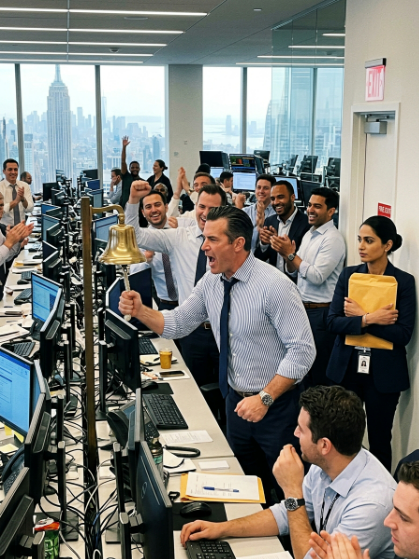
Garrett’s voice filled the trading floor.
Not loud — the floor speakers aren’t built for clarity, they’re built to blast a victory anthem at four in the afternoon. But the room had gone so silent that the muffled phone recording carried into every corner. People stopped clapping to listen. People leaned in. That’s the terrible thing about a recording: it doesn’t care about the room. It just plays.
It was the call from the night before his pharmaceutical short. The big one. I’d listened to it so many times I could have recited the other man’s lines — the executive, voice low and careful, the way people talk when they already know they shouldn’t be saying it. The trial failed. We announce Thursday. You did not hear it from me.
And then Garrett’s voice, easy, almost bored: Never do, my friend. Never do.
The playback was maybe forty seconds. It felt like an hour.
I watched Garrett the whole time. He still had the bell rope in his fist. His arm was still half-raised. And I watched the exact second the celebration drained out of his face and something older and colder moved in — the understanding that the sound coming out of the ceiling was his own voice, in this room, in front of the partners, in front of the analysts, in front of the people who’d been chanting his name nine seconds ago.
He let go of the rope.
“Turn that off,” he said. To no one. To everyone. “Turn it — who’s playing that?”
Nobody turned it off, because nobody on the floor controlled it. I’d routed it through the building’s audio system the same way the firm routes its own announcements — and the only people who could kill it were three floors up, and they were already listening too.
I started walking.
I’d rehearsed the walk more than the words. From the back wall, past the bullpen, up the center aisle to where the managing director, Howard Stein, stood frozen by the bell post. Forty feet. The whole floor watched me cross it, this compliance analyst nobody could quite place, the woman who fixed the boring problems, holding a manila envelope flat against her chest.
Garrett saw me coming. And he knew. Of course he knew. I’d put two reports on two desks in nine months and both times the message that came back was the same: drop it, or think hard about your future here.
“You,” he said. Quiet. “You did this.”
I didn’t answer him. I walked past him, to Howard, and I held out the envelope.
“Everything’s in here,” I said. “The trade timestamps. The phone logs. The pattern, going back fourteen months — it isn’t one call, it’s eleven. I flagged it in March. I flagged it again in July. Both reports are in the file, with the dates I submitted them and the names of who told me to stand down.”
That last part mattered. I want to be honest about that. I didn’t just bring the case against Garrett. I brought the record of the firm trying not to hear it. Because a place that buries a warning twice will bury the analyst the third time, and I had no intention of being buried.
Howard took the envelope. His hands weren’t quite steady. “Priya,” he said. “My office. Now.”
“Yes, sir.”
Garrett said something then. I won’t repeat all of it. The gist was that I was finished, that I’d never work in the industry again, that I had no idea what I’d just done. The thing is, I knew exactly what I’d just done. I’d done it deliberately, in public, with documentation, which is the only way a person like me ever wins against a person like him.
Security walked him off the floor before the speakers had even finished. He didn’t go quietly the way you’d hope. He went the way men like that always go — loud, certain, promising lawyers. The glass doors closed behind him and the floor stood there in a silence I’d never heard in seven years at Sterling & Cross.
The investigation took months. The SEC doesn’t move at the speed of television. But the file I built held, because I’d built it to hold — every timestamp sourced, every log authenticated, no leaps, no guesses. Eleven instances of trading ahead of material non-public information. The executive on the other end of those calls is facing his own reckoning now. The trades were unwound. The clients who got hurt are being made whole through the firm’s settlement.
I want to tell you about the nine months before, because the forty-second recording is the part people remember, but it’s not the part that was hard.
The hard part was March, when I first laid the pattern in front of my director and watched him decide not to see it. He didn’t even really argue with the numbers. He just said Garrett was “aggressive but clean” and that I should be careful, and the careful was doing a lot of work in that sentence. The hard part was July, when I came back with twice the evidence and he told me the next conversation would be about my future. The hard part was every Friday in between, watching Garrett ring that bell, watching the partners beam, watching a whole floor decide that a man who wins must be a genius and never once ask how.
I thought about quitting. More than once. There’s a particular loneliness in being the only person who can see a thing, and being told the seeing is the problem. You start to wonder if you’re the one who’s broken. I’d pull the file out at night and read it again just to confirm I wasn’t imagining it. I wasn’t. The numbers don’t imagine.
What kept me was simple, in the end. If I left, the file left with me, and Garrett kept ringing the bell. The clients he was trading against were real people — pension funds, retirement accounts, the unglamorous money of people who’d never set foot on the thirty-eighth floor. Somebody on the inside had to be unwilling to look away. It turned out the somebody was the woman they’d decided didn’t matter.
Here’s the part I didn’t expect.
A week after Garrett was walked out, Howard called me back to his office. I assumed it was for a deposition. Instead he had a different envelope, and he slid it across the desk to me.
“The board met,” he said. “We don’t have a Chief Compliance Officer. We have a guy who signs the forms and doesn’t read the trades. That’s how this happened — we built a compliance function designed not to find anything.” He tapped the envelope. “We’d like you to build a real one. Run it. Report to the board directly, not to the desk, not to the producers. You’d be the youngest CCO in the firm’s history.”
I looked at the envelope for a long moment.
“You dismissed my report twice,” I said. I wasn’t angry. I just needed it said out loud, in that office, the way I’d needed Garrett’s voice said out loud on the floor.
“I know,” Howard said. “That’s exactly why I want the person who filed it anyway.”
I took the job.
The first thing I did was build an automated surveillance layer that flags exactly the pattern Garrett ran — outsized positions preceding public disclosures, cross-referenced against call and message logs. It would have caught him in week one instead of month fourteen. The second thing I did was write a protection policy: any employee who flags a concern gets it logged, dated, and reviewed by my office, with no ability for the trading desk to make it disappear. No more reports sliding back across desks. No more futures quietly threatened.
They still don’t always notice me when I cross the floor. Navy blazer, tight bun, thin watch, badge that I still turn inward when I’m thinking. The producers are loud and I am not.
But they read my emails now. All of them. Within the hour.
Because the last person who decided the quiet woman by the back wall didn’t matter rang a bell to celebrate fourteen million dollars — and the next sound anyone heard was his own voice, telling the truth he never meant to say.