Maya Chen, the forensic intern, did not go through her supervisor first.
She told me later, sitting across a table at a coffee shop in Columbus eight months after my exoneration, that she had read enough wrongful-conviction case files in graduate school to know what happens when a fresh result with a familial connection enters a chain of command that has been comfortable with a verdict for twelve years.
“It gets buried,” she said.
“It gets reviewed for procedure.”
“It gets handed to a senior prosecutor who does not want to admit his office got it wrong.”
So Maya did the thing they tell you in the manual not to do.
She made three copies.
She gave one to her supervisor.
She gave one to a public defender named Andrea Ross who had represented me in 2014.
She gave the third copy, in a sealed envelope, to a journalist at the Columbus Dispatch who had once written a Sunday feature on cold cases nobody would reopen.
By the time her supervisor decided how to “handle” the result, three other people in three other institutions already had it in their hands.
Andrea Ross called me forty minutes later.
I was at my mother’s house in Bexley with my daughter Keyla.
It was Sunday afternoon.
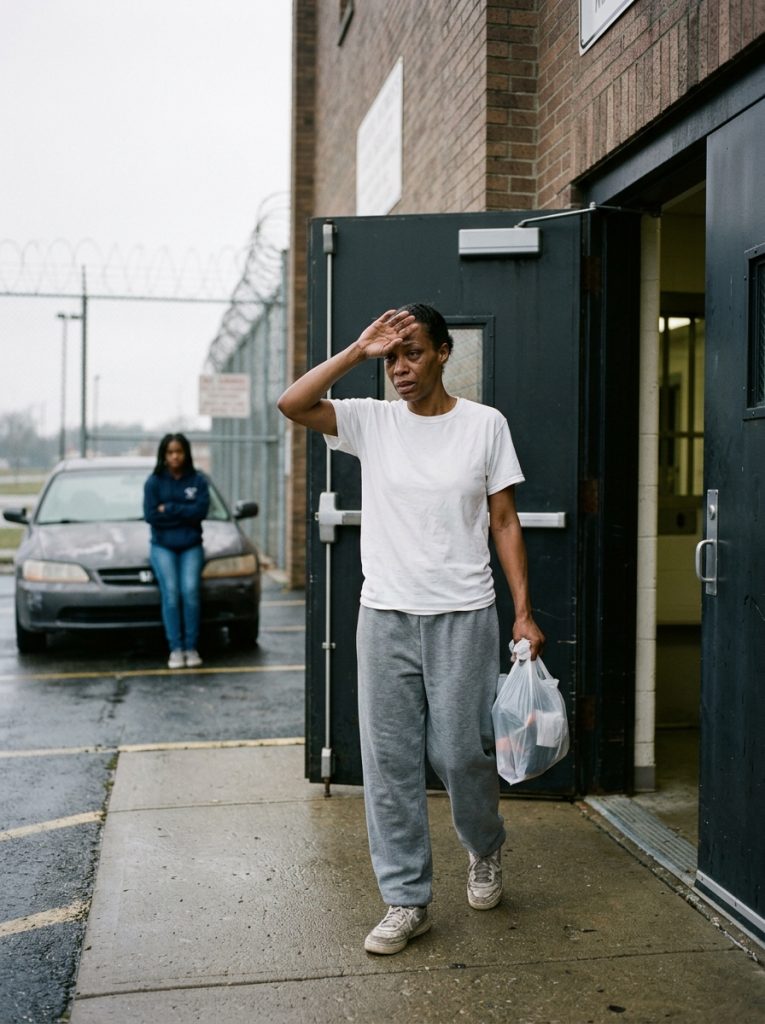
I had been out of prison for two days.
Andrea’s voice was the voice of a woman who had cried in her car before she dialed.
She told me what Maya had found.
She told me the latent print on the inside of the driver’s-side door handle of the getaway car was a sixteen-point match to my cousin Victor Holloway.
She told me the Columbus Dispatch was going to run with the story Tuesday morning whether the prosecutor’s office cooperated or not.
She told me a sheriff’s deputy who had been at my original sentencing in 2014, a man named Ray Burroughs, had quietly retired and quietly been carrying the doubt about my case in his back pocket for over a decade, and he had volunteered to drive out to Victor’s barbecue that afternoon.
She asked me if I wanted to be there.
I told her no.
I did not want to give Victor the satisfaction of seeing me on his porch.
Then I told my mother and my daughter what was about to happen.
My mother sat on her couch in her church clothes and did not say a single word for two minutes.
Then she said, “Take me to the kitchen, baby. I need to call my pastor.”
Keyla looked at me with the same careful sixteen-year-old face she had worn in the prison parking lot.
She said, “Mom, are they actually gonna arrest him?”
I told her yes.
She nodded once.
Then she said, “Good.”
She did not smile.
That afternoon, two unmarked sheriff’s department vehicles pulled up to the curb of 4127 Brandymore Drive in Reynoldsburg, Ohio.
The house had been mine for sixteen years before they took me away.
I had paid it off in 2012 with my mother’s help.
Victor had inherited it through a probate court he had paid a lawyer to expedite while I was being processed at intake.
He had repainted it.
He had put in a pool.
He had a new gas grill on the back deck and a banner across the carport that said HOLLOWAY FAMILY HOUSEWARMING in foil letters.
There were forty people in the backyard.
Two of them were Victor’s parents, my Aunt Della and Uncle Tyrone, who had testified for the prosecution in 2014.
The deputy in charge, Ray Burroughs, did not lead with sirens.
He walked through the side gate, asked for Victor by name, and showed him a piece of paper.
Victor read it.
Victor looked at his mother.
Victor’s smile, the one that never reached his eyes, did its slow collapse on a Sunday afternoon in front of forty witnesses with their phones already out.
He did not run.
He did try to argue.
He told Ray Burroughs that the print was contaminated.
He told Ray Burroughs that he had been at his own grandmother’s house the night of the robbery.
He told Ray Burroughs the print could have come from anywhere — he had touched a thousand cars in his life.
Ray Burroughs did not respond.
He simply turned Victor around, cuffed him in his own backyard, and walked him through the gate to the curb in front of his entire neighborhood.
The Tuesday morning headline of the Columbus Dispatch read: TWELVE YEARS IN, PRINTS REOPEN OHIO ROBBERY CASE — RELATIVE OF EXONERATED WOMAN ARRESTED.
Below the headline was a photograph of my cousin Victor in handcuffs by his own pool.
Below that was a photograph of me from 2013, taken by a friend at a barbecue I myself had hosted in the same backyard, smiling in a yellow dress.
The dress my mother had finally given to Goodwill in 2018 because she could not look at it anymore.
The exoneration hearing was held three weeks later in Franklin County Court of Common Pleas.
Same building.
Same courtroom.
Advertisement
Different judge.
The original judge had retired.
The new one, Judge Helen Adisa, was Black, fifty-four, and had served as a public defender for fifteen years before taking the bench.
She read the procedural motion herself.
The state of Ohio was vacating my conviction.
The state of Ohio was issuing a formal apology.
The state of Ohio was scheduling a separate hearing for civil compensation under the wrongful-conviction statute.
When she got to the section about the official letter of exoneration, Judge Adisa paused.
She looked up.
She said, “It is the practice of this court to read this letter aloud. Mrs. Holloway, would you like to read it yourself, or would you like me to?”
I stood up.
I did not have the strength.
I shook my head.
Then I felt a small hand take mine from the row behind me.
Keyla had stood up.
Box braids.
A school blazer she had bought herself with her cafeteria-job money for this exact day.
Sixteen years old, the same age I had been when I learned my own mother’s hands could shake.
She squeezed my fingers.
She said, very quietly, “Mom. I want to do it.”
The bailiff brought the letter to her.
Keyla walked to the podium with the steady gait of a girl who had already lost twelve years of childhood and was not going to give up another minute.
She unfolded the page.
She read every word.
She read my full name.
She read the docket number.
She read the formal acknowledgment that the state of Ohio had wrongfully imprisoned Nadia Marie Holloway from August of 2014 to September of 2026.
She read the apology of Franklin County, signed by the prosecutor.
When she got to the last sentence, she paused.
The last sentence was a standard line.
“This court hereby restores all rights, privileges, and standing to Nadia Marie Holloway, effective immediately and without restriction.”
Keyla read it once.
Then she lowered the paper, looked up at the judge, looked over at me, and read it one more time.
She did not look away from the bench.
She said, “Effective twelve years too late.”
The courtroom stayed silent for a long beat.
Judge Adisa nodded once.
She said, “Acknowledged.”
Victor’s trial took fourteen months.
The fingerprint analysis was upheld.
A second piece of evidence emerged — a deposit slip, found in the attic of my old house when the receivers cleared it for the deed reversal, made out to Victor in February of 2015 from the same insurance company that had paid the false claim on the necklace.
He pled guilty to robbery, perjury, fraud, and obstruction of justice.
He was sentenced to twenty-two years.
The same prison system.
A different facility.
I do not visit.
The deed to 4127 Brandymore Drive was returned to my name in November of 2026.
I sold it.
I did not want to sleep in any room Victor had slept in.
The state’s wrongful-conviction settlement, plus the sale of the house, gave me enough to buy a small two-bedroom in a quiet neighborhood in Westerville.
Keyla decorated her own room.
She picked the paint.
She picked the bed frame.
She picked the small framed letter she hung above her desk.
It is a copy of the page she read in court.
She circled, in red pen, the line about effective immediately.
Underneath, in her own handwriting, she wrote: “It’s not. But we are.”
I read it every morning when I walk her to the door for school.
She is a junior now.
She wants to study forensic science.
She has Maya Chen’s email address pinned to her corkboard.