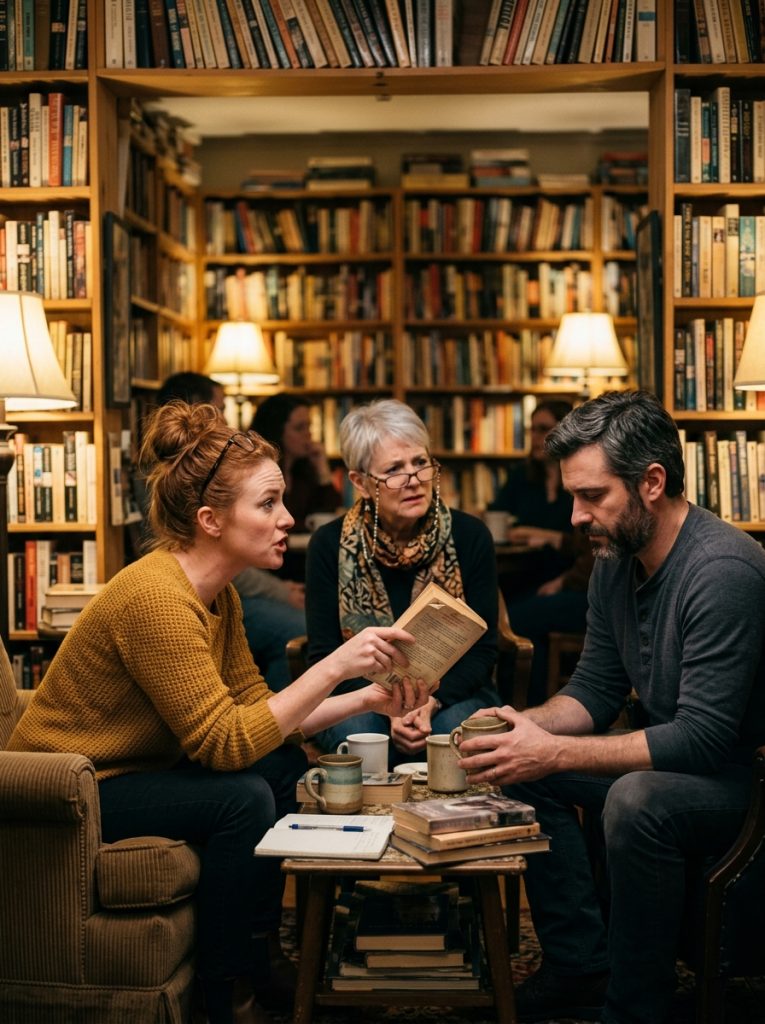
Here’s the thing nobody warns you about getting caught: your mouth keeps going for a second after your brain stops.
“That’s ridiculous,” I heard myself say. “Hale would never come to a—”
And then I stopped. Because Elliot had finally looked up from his coffee cup, and he was looking right at me, and there was no anger in his face at all. That was the worst part. If he’d been angry I could have argued. Instead he looked the way you look when someone steps on a bruise without knowing it’s there.
“You’re him,” I said. It wasn’t a question.
Margot, mercifully, jumped in. “I’m so sorry, Elliot, I didn’t— Jo, I should have told you, I just thought it would be a lovely surprise, the two of you—” She trailed off, because there is no graceful way to finish the sentence I set you up on a date with the author you spent an hour calling a coward.
The room had gone the specific kind of quiet where everyone is suddenly very interested in their own shoes.
I wanted to disappear. I wanted the bookshelves to fall on me. Instead I did the only thing left to do, which was the thing I’m worst at.
“I owe you an apology,” I said. “A real one. Not a polite one.” I put the book down on my knees, cover up, like setting down a weapon. “I called you a coward. To your face, for an hour. I don’t— Elliot, I don’t actually think that. I was performing. I do that. I lead with the meanest version of my opinion because it gets a laugh, and I forget there’s a person attached to the thing I’m being clever about.”
He turned the coffee cup a slow quarter-turn. The same gesture from the start of the night. I understood now it wasn’t boredom. It was how he held himself together.
“You said the death was emotional manipulation,” he said quietly. “The sister.”
“I did.”
“Her name was Claire.” He said it carefully, like the name had weight. “My sister. She died the year I was writing the book. She was thirty-four.” He looked at the cup, not at me. “We were eleven months apart. People used to think we were twins. She was the one who told me to send the manuscript out in the first place — she read every draft, she circled the lazy sentences, she was a better editor than anyone they ever assigned me.” He almost smiled. “She never got to read the finished copy. It came in the mail the week after the funeral. I have a box of them in a closet. I’ve never opened it.”
“When you lose someone like that,” he went on, “the people around you want a funeral scene. They want the casserole and the eulogy and the part where everyone cries and then, somehow, it resolves. They want grief to have a third act.”
Nobody in the room moved.
“It doesn’t,” he said. “That’s the only true thing I know about it. One day the person is in the next chapter of your life and then they just — aren’t. There’s no scene. There’s no resolution. You cut away and the rest of the book has to go on without them, with this hole in it shaped exactly like a person. So that’s how I wrote it. Not because I couldn’t stick the landing. Because the landing you wanted is the lie, and I couldn’t make myself tell it. Not about her.”
I have never in my life wanted so badly to take words back.
“And the anonymity,” I started.
“You said it was ego. That I was too precious to face my readers.” A small, sad smile. “It’s the opposite. I couldn’t put my name on a story that was really about Claire and then go sit on a stage and let strangers ask me which parts were ‘inspired by real events.’ I couldn’t turn her into an author photo and a publicity tour. The initials weren’t me hiding from readers. They were me protecting her. The one piece of her I had left.”
The book was still on my knees. The book I’d read twice. The book that had gotten me through my own hard week — the second read, the one I never told anyone about, when I was the one with a hole shaped like a person in my life and a novel was the only thing that seemed to understand it.
That’s when it hit me, all the way through.
“I read it twice,” I said. My voice came out wrong. “The second time was after my dad died. I didn’t tell anyone that. I came in here tonight and tore your book apart, and the truth is it’s the only thing that made me feel less insane that whole spring. The ending I called a cop-out—” I had to stop and breathe. “It’s the only ending anyone ever wrote that felt true to me. Everything else lies. You said it. The casserole and the third act. Your book was the only one that didn’t lie to me, and I walked in here and called you a coward for it because being honest in a room full of people is harder than being clever.”
For a long moment Elliot didn’t say anything.
Then he said, “What was his name? Your father.”
And just like that, the whole thing turned over. It stopped being an author and a critic, a reveal and a humiliation. It became two people in a back room full of books who had each lost somebody and each found the same novel on the other side of it, coming at it from opposite directions and meeting, ridiculously, in the middle.
“Tom,” I said. “His name was Tom.”
“Tell me about Tom,” said the most private man in American letters, to a woman who had spent an hour insulting him.
So I did. And he told me about Claire. And Margot, bless her, quietly herded the rest of the book club toward the coffee and the front of the store, and the two of us sat in the circle of mismatched armchairs until the bookstore lights started clicking off, talking about the two people who weren’t in our next chapters.
I’d like to tell you it became a great romance. The truth is gentler and stranger than that.
We didn’t fall in love that night. You don’t, not really, not when you’ve just exposed the ugliest reflex in your personality to a grieving stranger. What happened was both smaller and bigger. We became friends. The kind you make once a decade if you’re lucky, forged in the specific intimacy of having been completely, embarrassingly honest with each other inside the first three hours.
He let me read the book he was working on. I gave him notes — real ones, kind ones, the meanest version of my opinion finally retired. He told me I was the first person in years he’d trusted with pages, precisely because I’d been incapable of flattering him; I’d already shown him my whole hand.
We have dinner most weeks now. Sometimes it feels like more than friendship and sometimes it just feels like the most comfortable thing in my life, and we’ve both agreed to stop trying to name it and just let it be in the next chapter, unresolved, the way the truest things are.
I still have my opinions. I still have too many of them. But I lead with them differently now.
Because I learned something in that back room that I’m not proud it took me thirty-six years and a public humiliation to learn: there is always a person attached to the thing you’re being clever about. The author you’re calling a coward might be three feet away, holding his sister’s name in a coffee cup. The “cop-out ending” might be the only honest thing someone could manage to say about the worst year of their life.
Be careful what you tear apart in a room full of strangers.
One of them wrote it. And he probably had a reason that would break your heart if you’d only stopped performing long enough to ask.