The attorney’s name was Renee Okonkwo, and she did not flinch once while I laid eleven days of my marriage across her desk.
The photographs of the documents. The power of attorney. The two transfers I’d already signed. The folder Eleanor’s sister had kept. The recording of my two-hour phone call with Eleanor, made with her full permission.
Renee listened, took notes, and at the end she folded her hands and said the sentence that finally let me breathe.
“Cora, you didn’t walk in here a victim. You walked in here with a case.”
Then she told me how bad it would have gotten if I hadn’t.
The two documents I’d signed on the honeymoon weren’t about the mortgage. One added Preston as a joint owner with right of survivorship to the house my grandmother left me. The other was a broad financial power of attorney that would have let him move my accounts without asking. In another two weeks, Renee said, he’d likely have had me sign a third — and after that, unwinding it would have taken years and a fortune I no longer had.
“He moves fast in the first month,” I said. “Eleanor warned me. She said that’s his window.”
“Then let’s close his window,” Renee said.
We worked quietly for four days.
Renee filed to revoke the power of attorney before it could be used — a single notarized document that slammed the door Preston thought he’d propped open. She put a hold on the joint-ownership filing on the grounds that it had been procured by fraud. She drafted a petition for annulment built not on heartbreak but on documents: the misrepresentations he’d made, the assets he’d targeted, the pattern.
And the pattern was the thing.
Because Eleanor wasn’t the only one.
When Renee’s paralegal ran Preston’s history, two other names surfaced — two women in two states, each married to Preston for under a year, each of whom had quietly signed over property before the marriage dissolved and Preston moved on. None of them had called it fraud. Each had called it the worst year of her life and tried to forget.
Margot’s note hadn’t just warned me. It had handed me the loose thread that unraveled all of it.
I called Eleanor to tell her. She was quiet for a long moment.
“He told everyone I was crazy,” she finally said. “For years. It’s the part that almost killed me — not losing the house, but everyone believing I’d imagined the man who took it.” Her voice steadied. “If you do this with the records, Cora — if there are documents — then it’s not my word against his anymore. It’s a pattern on paper.”
“It’s a pattern on paper,” I promised her. “And you’re not crazy. You’re the reason I got out in eleven days instead of eleven months.”
That night I sat alone in my grandmother’s house and let myself feel all of it for the first time — the humiliation of having been chosen as a mark, the grief for the marriage I’d thought I had, the cold fear of how close I’d come. I’d spent eleven days performing happiness so well that I’d half-convinced myself. Now the performance was over, and the shaking finally came. I let it. Then I wiped my face, opened my laptop, and kept building the case. Feeling it and fighting it, I was learning, are not opposites.
Preston found out the way men like him always find out — when the control stops working.
He went to move money between our accounts and discovered the power of attorney had been revoked. He came home that night wearing the warm, easy smile I’d once mistaken for love, and he tapped his watch the way he did when he was about to lie.
“Sweetheart,” he said, “the bank flagged some kind of paperwork mix-up. Probably that idiot notary. Let’s sit down this weekend and just re-sign everything, clean it all up.”
A month earlier, I’d have signed. I’d have wanted to make the discomfort go away.
Instead I said, “I don’t think so, Preston.”
The smile flickered.
“I had my flowers preserved,” I said. “There was a note in the box. From Margot. About her sister.”
For one second — just one — I watched the charming man disappear and something flat and cold look out through his eyes. Then the charm snapped back on, and he started to talk, fast and smooth, about misunderstandings and Eleanor’s instability and how Margot had always been jealous.
I let him finish. Then I slid a single sheet across the table: Renee’s letter, informing him that annulment proceedings had begun, that the fraudulent filings were being unwound, and that copies of the relevant records had been provided to counsel for two other women and, where appropriate, to the authorities.
He read it. The watch-tapping stopped.
“You think you understand what you’re doing,” he said quietly. “You don’t.”
“I understand all of it,” I said. “That’s the problem for you. I’m not the first woman you did this to. I’m just the first one who opened the box in time.”
Preston moved out that night. He took his tailored suits and his face-down phone and left behind the wedding photos and a marriage eleven days old.
He fought the annulment at first, through a lawyer who stopped returning calls once Renee sent over the documents. A man can bluff a frightened wife. He cannot bluff three women’s signatures on three suspiciously similar property transfers, lined up side by side in a courtroom.
The annulment was granted on grounds of fraud. My grandmother’s house came back to me, clean, my name and only my name on the deed. The accounts he’d “simplified” were unwound. It took months and more legal fees than I want to admit, but I lost nothing that mattered, because a frightened bridesmaid had slipped a note under a ribbon.
The two other women joined Eleanor. With a pattern on paper, the conversation finally moved out of the realm of “his word against hers.” I’ll let the lawyers and the authorities tell the rest of that story; it’s not only mine to tell. I’ll say this much: Preston is not charming his way to a fourth wedding any time soon.
I drove to see Eleanor when it was over.
She’s doing better now — clear-eyed, steady, rebuilding. We sat in the garden of her recovery residence and she held my hands and cried, not from sadness, but from the specific relief of a woman who’d been called crazy for years and was finally, officially, believed.
“He took my house,” she said. “But he didn’t get yours. That’s the first time the story ended differently. Thank you for being the one who broke the pattern.”
“Thank your sister,” I said. “Margot’s the one who was brave at the right moment.”
Margot and I are friends now — the strange, fierce kind of friendship forged by the same fire. She still apologizes sometimes for not saying something at the wedding, out loud, in front of everyone. I tell her the same thing every time: she said exactly what needed saying, in exactly the way that worked. A whisper under a ribbon, where I’d be sure to find it alone, with time to think instead of react.
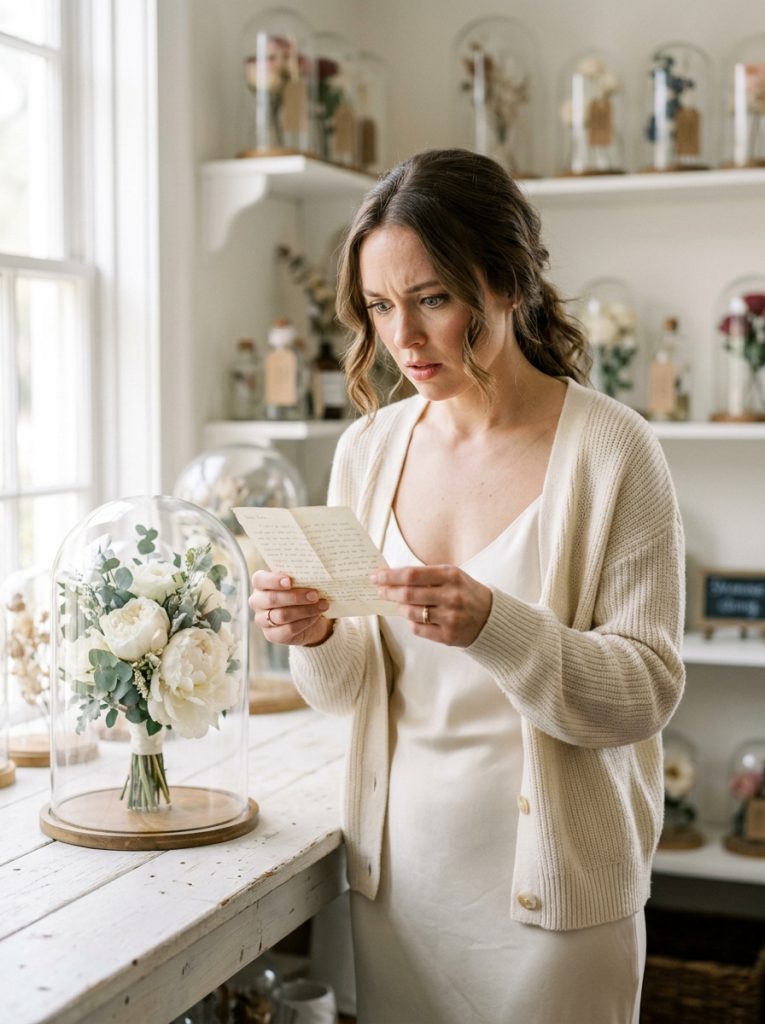
I had the bouquet preserved after all.
The same white peonies, pressed under glass, sitting on my mantel in the house that is mine again.
People assume I’d want to forget that wedding. I don’t. I keep the flowers where I can see them — not as a monument to the man, but to the morning I opened the box, found the note, and chose to read carefully instead of love blindly.
The peonies are beautiful, still. And tucked behind them, where no one sees it but me, is Margot’s folded note — three sentences that cost her everything to write, and gave me back my whole life.