They let me see Frank first. They had to half-carry me, because somewhere in the last ten minutes my legs had decided they were done.
He was behind the curtain in Bay 4, gray and small and wired to a machine that breathed for him, and he was the most beautiful thing I have ever seen. I put my forehead against his and felt the warm air move in and out of him, and I think I said thank you about four hundred times to a God I’d been furious at ninety seconds earlier.
Imani, the nurse, stood in the doorway and let me have my minute. When I finally turned around, her face was doing something complicated.
“Mrs. Calloway,” she said. “I owe you the whole truth. The mix-up wasn’t nothing. A patient did pass tonight. We did tell a family. We just told the wrong one. For about three minutes, the worst news in this building had your name on it by mistake.”
“Whose was it, really?” I asked.
She hesitated. “A Mr. Callahan. Wallace Callahan. Bay 6.”
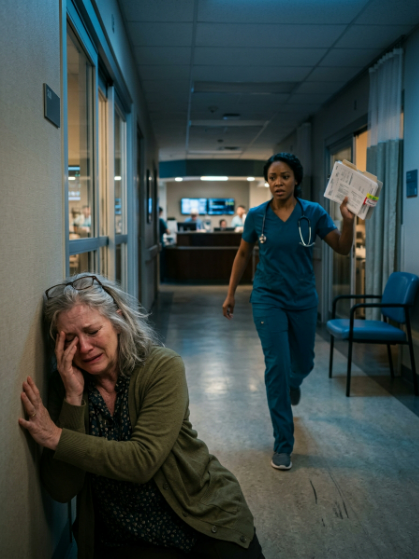
“Is his family with him?”
And Imani’s face just folded.
“There’s no one,” she said. “We’ve been trying since he came in two days ago. There’s no one to call.”
I don’t know what made me do it. Shock, maybe. Or maybe just the animal knowledge that I had been standing on the exact spot where his news belonged — that the universe had handed me his grief by accident and then taken it back — and it felt wrong to set it down on no one and walk away.
I asked if I could sit with him.
Imani looked at me a long moment. Then she walked me to Bay 6.
Wallace Callahan was sixty-two. He looked older. He’d died about twenty minutes before — the death that, for three minutes, they’d thought was Frank’s. There was an empty vinyl chair beside the bed. It had clearly been empty the whole time.
I sat down in it.
I didn’t know him. I won’t pretend I felt some cosmic connection to a stranger. I felt sad, and strange, and guilty in a way I couldn’t name — guilty for the violent relief still ringing in my chest, in a room where the news had actually been true.
A man had died ten feet from my living husband, and the only reason I knew his name was a clerical error.
So I sat with him a while. It seemed like the least a person could do.
Over the next few days — Frank stabilized, then woke, then started complaining about the food, which is how I knew he’d really come back — I couldn’t stop seeing that empty chair.
The hospital social worker wasn’t supposed to tell me much, but she told me Wallace had been a long-haul trucker. That an old file listed two grown kids in another state, no current numbers. That no one was coming.
There’s a particular math that runs in your head when you almost lose everything and don’t. You start counting what you have, and it feels obscene to count it next to a man who had nothing.
So I did the only thing I could think of.
I made calls. It took a week, a lot of nerve, and one very kind clerk in a trucking company’s old records office. I found his daughter.
She cried on the phone. Not the easy way you cry for someone you loved simply — the complicated way, for a father who was hard to love and harder to forgive, who’d missed the birthdays and broken the promises. They’d been estranged eleven years.
“I always thought there’d be time,” she said. “I thought one day he’d just show up, older and softer, and we’d figure it out.”
That’s the thing about “one day.” It isn’t a real day. It never lands on the calendar.
She couldn’t afford to travel right away, so Frank and I talked it over one long night, holding hands across the bed rails, and we did something.
We paid for a small service. Nothing fancy — we’re not fancy people. But a man shouldn’t leave the world with an empty chair beside him, and I had been handed a second chance with my husband by sheer accident, in the same hour Wallace lost his last chance at a first hello from his kids.
His daughter came. She stood at the front, lost, and I stood close so she wouldn’t be the only one, and afterward she gripped my hands and asked, “Why are you doing this? You didn’t even know him.”
I thought about how to say it.
“For three minutes,” I said, “I was you. They told me my husband was gone, and I felt exactly what you’re feeling — except I got to give mine back. You didn’t. So this is me giving some of that relief somewhere it can do some good. I couldn’t keep it. It was too heavy to keep when it wasn’t really mine.”
Frank’s home now. He walks slower. He naps in the afternoon, which a year ago he’d have called lazy. We don’t say “one day” anymore. We say “this weekend.” We say “tonight.”
And on Wallace Callahan’s birthday, every year now, his daughter calls me. We don’t talk long. We just check on each other — two women joined by a wristband, a clerical error, and three minutes of borrowed grief.
I never met him.
But I learned his name by accident, and I decided that was reason enough to make sure somebody said it with love before it was gone.
It was too late for him. It’s almost always too late by the time we figure out what matters.
But it is never too late to sit in the empty chair.
There’s always one somewhere. Go sit in it.