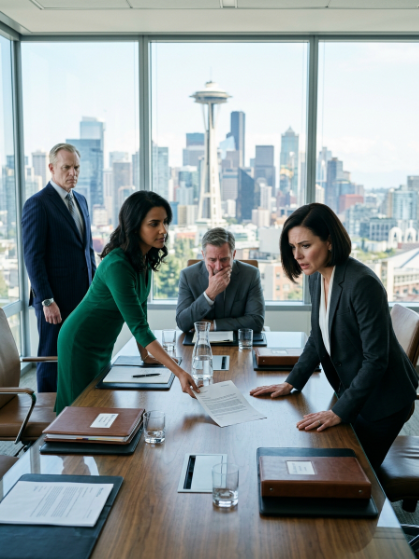
I read the whole chain twice before I trusted my own eyes.
The email was Mark’s, sent at 11:48 the night the board “restructured” me out. It was addressed to all five directors. The subject line was my name.
“If you dilute Dana’s shares, I walk too,” he’d written. “She built the optics platform. Half of everything Kepler sells exists because of her. Touch her stake and I will burn this deal to the ground and take the engineering team with me.”
He hadn’t stayed silent.
He’d threatened to blow up the company to protect me.
I looked up at my brother across that long table. He was watching me read it, and his eyes were wet, and his mouth was pressed shut like a man bracing for a blow.
“I never sent you anything that night,” I said. My voice didn’t sound like mine. “You never called. You never fought for me. I waited by the phone for two days, Mark.”
“I called you eleven times,” he said quietly. “From the office line. I emailed you twice. You never answered. And then I got your reply.”
“I never got a single call.”
Priya, the woman from Hollis, slid a second page across the table.
It was an email. Supposedly from me, to Mark, dated the morning after.
“Don’t ever contact me again. You chose the company. We’re done.”
I had never written it.
“I didn’t send that,” I said.
“I know that now,” Mark said. “I didn’t then.”
We both turned at the same time toward the window.
Garrett Vance had gone the gray of old paper.
Garrett, our COO. The man who’d “managed communications” during the restructuring. The man who, nine years later, somehow still sat in the second chair while two founders who built the place from nothing stopped speaking and let him run it.
Priya folded her hands. “When my team ran technical diligence on your archive,” she said, “we pulled the mail server logs. The originals. Both of these messages were routed through an administrator account and altered before delivery. The administrator credentials belonged to Mr. Vance.”
The room was very quiet.
“He intercepted Mark’s calls to you,” she went on. “He deleted the voicemails. He fabricated the reply that ended your relationship. He turned two founders against each other so that neither of you would ever compare notes — because the day you did, you’d realize you still controlled the company together.”
Garrett finally spoke. “This is absurd. Those logs can be misread — “
“They were read by three forensic accountants,” Priya said. “They are not misread.”
I have been angry for nine years. I know the shape of my own anger by heart.
What I felt then wasn’t that.
It was grief. Nine Thanksgivings. My mother’s hospital room, where Mark and I had stood on opposite sides of her bed and not spoken, while she begged us with her eyes. The birthdays. The silence I’d defended like it was a fortress.
All of it built on two sentences a man forged to keep his job.
“Why?” I asked Garrett. “Why us?”
He didn’t answer. He didn’t have to. Priya did it for him.
“Because divided founders are easy to buy out,” she said. “He’s been positioning Kepler for a fire sale for years. Frankly, it’s why my firm could afford to make the offer we made this morning. A company at war with itself sells cheap.”
She closed her folder.
“For what it’s worth,” she said, “I don’t think you should take our offer.”
Mark let out a sound that was half a laugh and half something breaking.
I looked at my brother. Really looked at him. The gray in his hair. The lines that nine years had put there, same as mine.
“You’d have burned it down for me?” I said.
“I’d still burn it down for you,” he said. “It’s just a company, Dana. You’re my sister.”
We didn’t sign with Hollis.
We did something better.
Together — because together we still held more than half — we voted Garrett Vance out of Kepler Instruments before the end of the day. No package. No quiet exit. We read the server logs into the board minutes first, so the record would always say exactly what he did.
He left through the same lobby he’d walked through for fifteen years, carrying a single box, while the engineering team he’d tried to sell watched from the glass.
Mark and I rebuilt the second chair the way we should have built it the first time. Side by side.
It doesn’t give the nine years back.
I want to be honest about that. Some nights it sits on my chest — the calls I didn’t get, the brother I grieved while he was still alive, two desks and a soldering iron and all the time a liar stole from us.
But last Sunday, Mark came to dinner.
He sat at my table and argued with me about a circuit board until midnight, the way we used to in our father’s garage.
And when he left, he hugged me at the door and said, “Same time next week?”
Nine years of silence, undone by one buried email and a stranger honest enough to slide it across a table.
We answer the phone now. Both of us. On the first ring.
We learned the hard way what it costs not to.