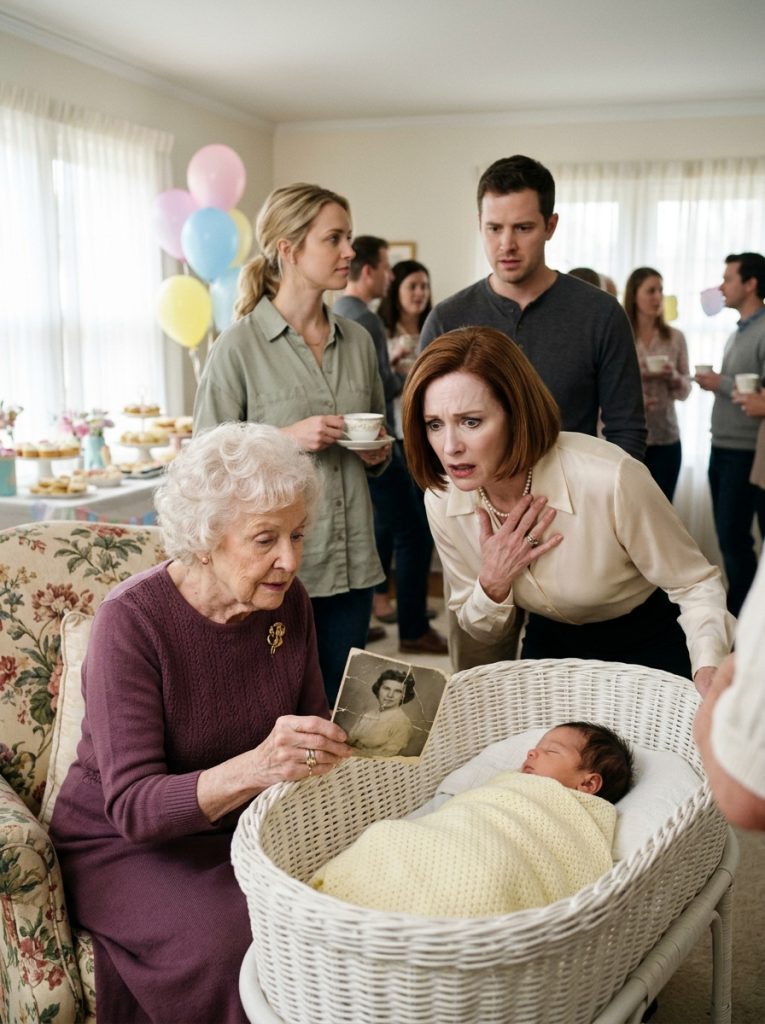
The party didn’t end so much as drain.
Nana Vivian’s photograph did something a hundred polite conversations never could. People saw it. People did the math. And one by one they remembered somewhere else they needed to be, the way guests do when a room has filled up with something they don’t want to be standing in.
Diane stood by the dessert table the whole time, saying goodbye in a bright cracked voice, pressing leftover cake on people who didn’t want it. Performing normal. She is very good at performing normal.
Jordan was the last to understand, because love makes you slow about your own mother. He kept holding the old photo of his grandfather next to Theo and marveling, and it wasn’t until the house was nearly empty that he noticed his mother hadn’t come near the bassinet again, and that I had gone very quiet, and that the air had a charge to it.
“Okay,” he said, when the door closed on the last guest. “Somebody tell me what just happened. Because that was weird, and you both know it was weird.”
I looked at Diane. I gave her the chance. That mattered to me later — that I gave her the chance to say it herself.
She didn’t take it. She busied herself with foil over the cake and said, “I don’t know what you mean. It was a lovely party.”
So I told my husband the truth.
I told him calmly, in our living room, with our eight-day-old son asleep between us, exactly what his mother had been saying for months. That the baby “came too fast.” That Theo “doesn’t look like a Ward.” What those phrases meant, stripped of the soft voice. That she had been telling the family — his aunts, his cousins, the people who’d just stood in our living room — that their grandchild might not be their grandchild. That she had been quietly suggesting his wife was a liar and his son was another man’s.
Jordan turned to his mother. “Mom. Tell me she’s wrong.”
And Diane — cornered, the cake foil crinkling in her hands — made the worst possible choice. She defended it.
“I never said anything to her face,” she said. “I was protecting you, Jordan. A mother notices things. He came three weeks early and he didn’t look like—”
“He looks exactly like Grandpa.” Jordan’s voice was shaking now. “Nana Vivian put the picture right there. The whole room saw it. He looks more like Dad’s side than I do.”
“That photograph proves nothing,” Diane snapped, and there it was — the real woman, the one under the pearls. “Babies change. You can’t tell anything from a baby.”
I want to tell you what broke the moment open. It wasn’t me. I’d said my piece and gone quiet, the way I’d promised myself I would.
It was Nana Vivian.
She was still there. Eighty-seven, in the armchair, where everyone had forgotten her in the chaos. And she spoke up in the small iron voice of a woman who has watched four generations of this family make fools of themselves.
“Diane Marie,” she said. “I held your husband the day he was born, and I held that baby an hour ago, and they are the same child sixty years apart. I have been quiet in this family for a long time. I am done being quiet. You owe this girl an apology, and you owe your son one, and if you’ve got any sense left you’ll give them before that baby is old enough to understand what his grandmother said about him.”
The room was so silent I could hear Theo breathing.
Diane started to cry. Not the soft kind. The kind that comes when the story you’ve told yourself collapses and you’re standing in the rubble of it. She said she was sorry. She said it badly, defensively, with too many excuses braided through it — but she said it.
I didn’t accept it that night. I want to be honest about that, because the internet loves a clean hug at the end and this wasn’t one. Forgiveness you hand over too fast isn’t forgiveness; it’s just keeping the peace, and I’d kept the peace with this woman for six years and it had cost me my reputation in my own husband’s family.
Here is what actually happened, in the weeks after.
Jordan did the thing I most needed him to do and least expected. He called every relative his mother had whispered to. One by one. And he told them, plainly, that the things they’d heard were false, that he had no doubt his son was his son, and that anyone who wanted a relationship with Theo could start by apologizing to Theo’s mother. He didn’t ask me to be in the room. He just did it, because — his words — “she spent months building a story about you, and I’m going to spend as long as it takes tearing it down.”
Some of those calls were harder than others. His aunt Renee had not only believed Diane, she’d repeated it, embroidered it, added her own little flourishes. She’d been one of the people standing in my living room doing the math when the photo came out, and she’d left without saying goodbye. A week later she showed up at our door with a casserole and a face full of shame. She’d been the one, it turned out, who couldn’t keep the secret — the cousin who finally told me what Diane was saying had heard it from Renee. She apologized to me on my own porch, crying, saying she’d gotten swept up in Diane’s certainty and never once stopped to think about what it would do to me. I took the casserole. I told her thank you. I did not tell her it was fine, because it wasn’t, and I’m done saying fine when I mean wounded. But I let her hold Theo before she left, and her hands shook the whole time.
Diane offered, through tears, to take a DNA test “to put it to rest.” Jordan refused on my behalf before I could even answer. “We’re not doing that,” he said. “We don’t have to prove anything to you. A grandmother’s job was to love him on sight. You didn’t. That’s the only test that happened here, and you failed it.”
We set terms. Real ones. Diane could be in Theo’s life, but supervised, and only after she apologized to me — really apologized, not the cake-foil version. It took her two months to do it. When she finally did, she came to our house without her armor on, no pearls, no performance, and she sat at our kitchen table and she said the true thing: that she’d decided she didn’t like me before she knew me, and she’d let that ugliness grow into something that nearly cost her a grandson, and she was ashamed.
It’s not fixed. I don’t know if it ever fully will be. But it’s honest now, and honest is a thing we can build on. She holds Theo carefully these days, like a woman who knows she almost didn’t get to.
That first night, after everyone had gone and Theo was finally down, Jordan sat on the edge of our bed for a long time with his head in his hands. “I should have seen it,” he kept saying. “She’s my mother. I should have caught it months ago.” I told him the truth — that you don’t go looking for cruelty in the people who are supposed to love you, and that’s not a flaw, it’s just what trust costs. We stayed up past two. It was the first real conversation of our marriage where he chose me out loud, without flinching, and I think Theo’s whole childhood will rest on that quiet night neither of us planned.
Nana Vivian gave me the cracked 1962 photograph in a little frame. “So you’ve always got the proof,” she said, with a wink, “though you never needed it.”
It sits on Theo’s dresser. Two babies, sixty years apart, the same funny dimpled chin.
Some nights I stand over the crib and look from the photo to my sleeping son and back again, and I think about how the truth was sitting in an old woman’s purse the whole time, just waiting for someone brave enough to set it down on the table.