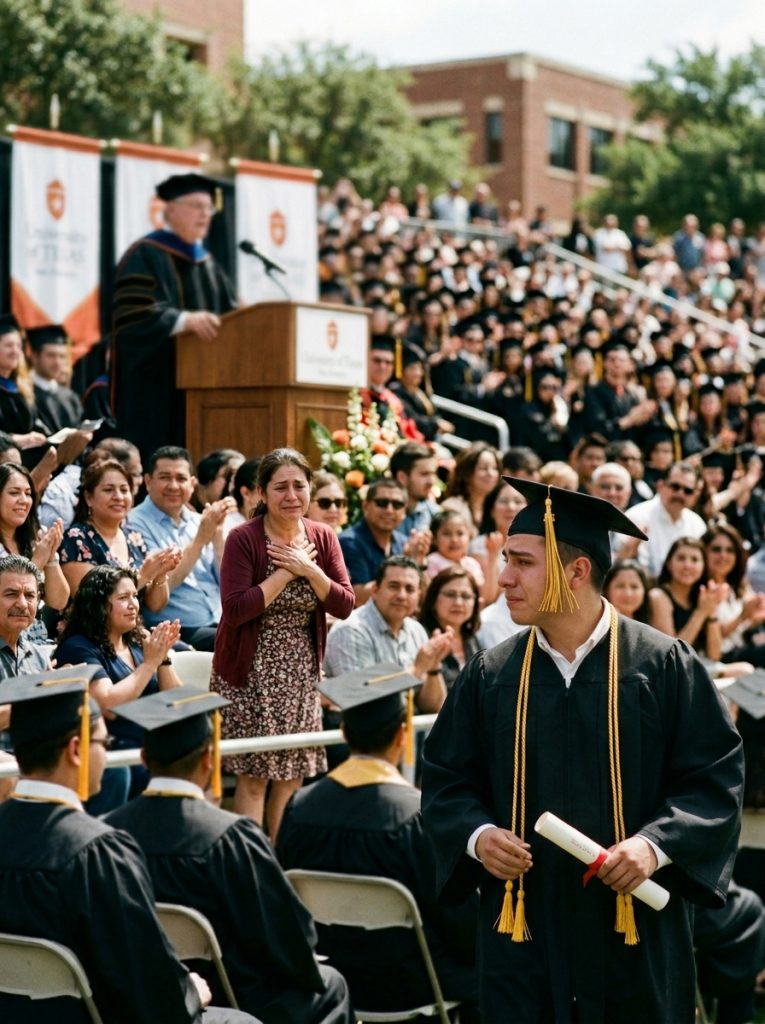
The dean asked the named donors to please stand and be recognized.
All across the lawn, people rose. A man in a good suit. A silver-haired couple. The kind of people you picture when you hear the word “donor.”
And in the family section, my Aunt Rosa stayed glued to her folding chair, shaking her head, trying to make herself smaller, mortified that her name had been read at all.
I was already on my feet, turned all the way around, staring at her.
Because the math was finishing itself in my head, four years too late.
The “anonymous foundation.” The donor who “wished to remain unnamed.” Rosa Vargas. My aunt, who cleaned houses, then cleaned offices, who said “we’ll see” about everything that cost money, who I’d never once suspected could fund a vending machine, let alone a full ride.
After the ceremony I found her in the crowd and I didn’t even say congratulations. I said, “How.”
She tried to wave it off. “Mija, it’s your day, don’t—”
“Rosa. How.”
And finally, because I wasn’t going to let it go, she told me.
For nine years — since I was thirteen — my aunt had worked a second job. After the office-cleaning shifts I knew about, three nights a week and Sunday mornings, she worked at a commercial laundry across town. The kind of place with industrial machines and no air conditioning, folding hospital linens until her hands cracked. That’s where the rough hands came from. That’s where the tiredness came from. That’s where the money came from.
She didn’t put it in a bank for herself. She set up a tiny scholarship fund through a community foundation — a real one, with a real, boring name — and she fed it, dollar by folded-sheet dollar, for years. Then she made sure I “won” it.
She knew me. She knew if she ever offered to pay for college herself, I’d have refused. I’d have gotten a job, or two, and I’d have told her she’d done enough raising me, which she had. The only way to get me to accept the gift was to disguise it as a stranger’s kindness. So she became the stranger. She gave anonymously to her own nephew and let me spend four years thanking the universe for a generosity that was sleeping down the hall the entire time.
“You wanted to be a writer,” she said, like that explained everything. To her, it did. “Your mother left you a note and an empty closet. I wasn’t going to let the world hand you another reason to think you didn’t get to want things.”
My mother, for the record, did come to the graduation. She found me on the lawn in a dress that cost more than Rosa’s car, with a man I’d never met, and she wanted a photo “with the graduate” for her own page. Four years of silence and then a hand on my shoulder and a camera.
I took the photo. I’m not cruel. But I took it standing next to Rosa, and when my mother said something light about how “we always knew he’d make it,” I said, clearly enough for the people around us to hear, “Rosa made it. I just did the homework.”
My mother didn’t stay long after that.
Here is what I did with the rest of that day.
I took the cap off my own head, and I put it on Rosa’s. The tassel hung down by her ear and she laughed and tried to give it back and I wouldn’t take it.
“You earned this more than I did,” I told her. “You just did it three nights a week where I couldn’t see.”
I start my job next month. A real one, with my degree, the degree she folded ten thousand hospital sheets to buy. The first thing I did with my first real paycheck wasn’t for me.
I called the commercial laundry across town, and I told them my aunt was putting in her notice.
She argued, of course. She likes to be the one who gives. But I told her the thing she’d taught me without ever once saying it out loud: that love is what you do quietly, for years, with your hands, when you think no one’s keeping count.
That night I drove her back to the apartment where the thermostat had never once been nudged past sixty-two in the dead of winter, and I turned it up to seventy-two and told her to leave it there for good. She cried at a number on a little plastic dial. I understood completely. It was never about the degrees. It was about a woman finally being allowed to stop saving every dollar for somebody else and let herself be warm.
Somebody was keeping count, Rosa.
It just took me until graduation to learn how to read the receipts.