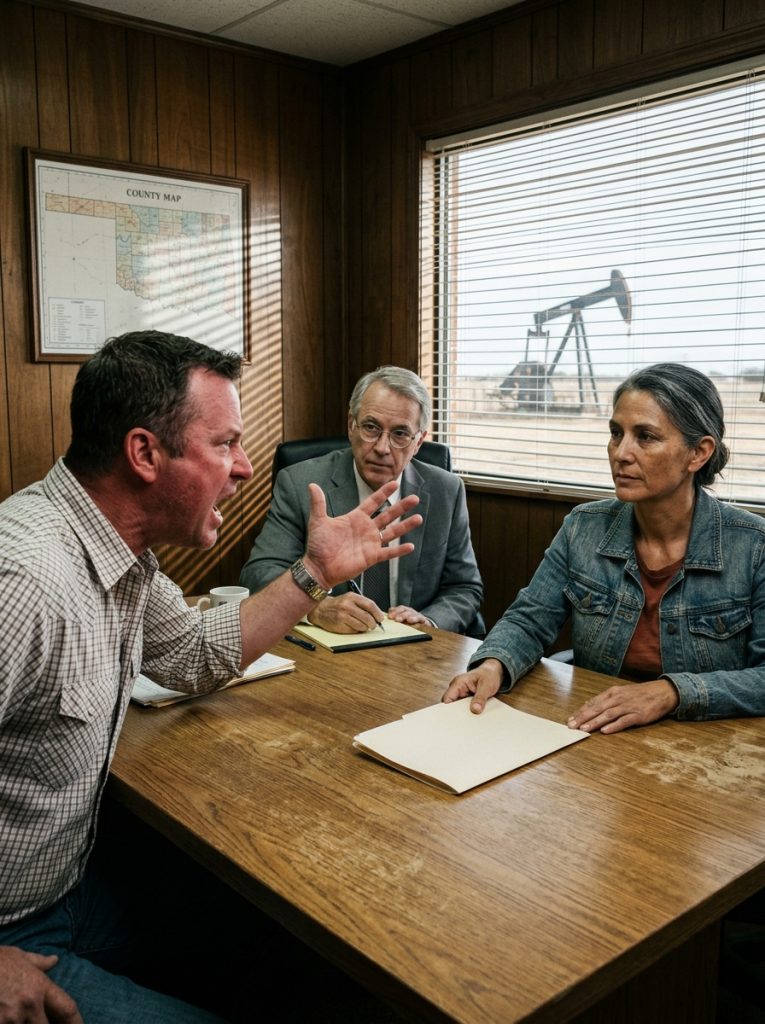
Cole stopped talking. The office got so quiet I could hear the pumpjack outside, rocking on its slow steady hinge.
“I’m finished,” he said warily. “Say whatever you came to say.”
So I opened the folder.
“Page one,” I said, sliding it toward Mr. Pruitt. “The quitclaim deed. Signed by Cole Hargrove, witnessed and notarized, the Thursday after we buried our father. That’s his signature. He’ll tell you it’s his signature, because he was very proud of it at the time.”
Mr. Pruitt put on his half-moon glasses and read.
“Page two. The canceled check. Forty-one thousand dollars, made out to my brother, cashed the same week at a bank in Tulsa. Memo line, in my handwriting: full and final purchase of his half.”
Cole shifted in his seat.
“Page three through nineteen,” I said. “Eleven years of property tax receipts. All paid by me. The loan I took against my truck to cover his buyout, with the payoff statement. The vet bills. The fence invoices. The new well pump in ‘sixteen. Every dollar that land ate for eleven years, while my brother was — where were you, Cole? Remind the room.”
He didn’t answer.
“Las Vegas, mostly, from the postcards,” I said. “Then Reno.”
“That’s not relevant,” Cole snapped.
“It’s about to be,” I said. “Page twenty.”
Page twenty was the screenshots.
I’d thought about leaving them out. They were the cruelest thing in the folder, and the truest. In the end I put them in, because a man who comes for your home with a lie should have to sit in his own words.
“These are text messages from my brother,” I told Mr. Pruitt. “Sent to me over the years. I’ll read a few. The dates are on them.”
I read them flat, no drama. Drama was Cole’s department.
“‘Enjoy the dust pile, sis. Bought myself a boat.'”
“‘Best decision I ever made getting out of that worthless dirt clean. You always were the sucker.'”
“‘Dad left us a money pit and you’re dumb enough to keep feeding it. lol.'”
Each one landed in that little office like a stone in a still pond.
There was one more I didn’t read aloud. I just slid it across to Mr. Pruitt and let him read that one to himself.
It was from the week our mother died. I’d texted Cole that she was failing, that she was asking for him, that he ought to come. His reply was three words long.
Can’t. Send money.
Mr. Pruitt read it, and something in his lawyer’s face went very still, and he set the page down more gently than the others.
Cole had gone the color of putty.
“There’s no oil in those texts,” I said quietly. “No scheming sister. Just a man who took his money, called me a sucker for staying, and ran. For eleven years the land was ‘worthless dirt’ to you, Cole. It only became ‘the family land’ the week a company offered to pay for what’s under it.”
Mr. Pruitt set the pages down and folded his hands.
“Mr. Hargrove,” he said to Cole, “I’m going to be plain with you, as I’d want someone to be plain with me. You don’t have a case. You have a notarized quitclaim, a cashed check, and a written record of your own that contradicts every word of your complaint. If you proceed, opposing counsel will enter these exhibits, and I expect the court will not look kindly on it. My advice is to withdraw. Today.”
The young lawyer beside Cole leaned over and murmured something in his ear. Whatever it was, Cole’s face told me it was the same advice, in fewer words and with a good deal less mercy.
Cole’s lawyer — a young man he’d clearly found in a hurry — was already gathering his legal pad.
And there it was. The thing I’d waited eleven years and one folder to watch happen.
My brother had nothing.
He looked at me across that table, and the bluster drained out of him all at once, and underneath it was just Cole. The boy who used to ride on the back of my bike. The boy who cried at Dad’s funeral and then cashed the check before the flowers wilted.
“So that’s it,” he said bitterly. “You win. You always land on your feet, Della. Must be nice.”
I could have let him walk out on that. Lord knows he’d earned it.
But our mother raised me, even if she didn’t manage to raise him, and I’d been turning a thing over in my mind for eight months, ever since that company first knocked.
“Sit down, Cole,” I said. “I’m not done. The rest of this isn’t for Mr. Pruitt.”
He sat, suspicious.
“You’re in trouble,” I said. It wasn’t a question. “The boat’s gone. The money’s gone. You don’t sue your own sister over land you called a dust pile unless you’re drowning. How much?”
His jaw worked. For once, no performance came out. Just a number, small and ashamed.
I thought about all the things that number stood for. The boat, sold at a loss. Whatever came after the boat. The particular math of a man who keeps betting that the next thing will fix the last thing, until there’s nothing left to put on the table but his own sister’s good name.
It was a number I could cover. That was the strange part. The thing under that worthless dirt had made it so I could write a check for the wreck my brother had made of his life and barely feel the ink.
“Here’s what’s going to happen,” I said. “You’re going to withdraw this lawsuit today, like the man said. And then I’m going to set up an account. Not a windfall. A monthly draw, modest, from the royalty. Enough to keep your head above water.”
Cole blinked. “Why would you—”
“Because Mom asked me to look after you, the last thing she ever said, and I told her I would, and I don’t break my word the way some people sign theirs away.” I leaned in. “There are conditions. You get clean. You go to the meetings — gambling, whatever you need. You miss them, the draw stops. And you don’t ever again tell anyone I cheated you. Because we both know who signed what.”
He stared at the table for a long time.
“You’re doing this to rub my nose in it,” he said.
“I’m doing it because you’re my brother,” I said. “You can decide for yourself which it feels like. That part was always up to you.”
He withdrew the suit that afternoon.
I’d love to tell you Cole changed. That he hugged me in the parking lot and we drove off into a reconciliation as wide as the Oklahoma sky.
He didn’t. He took the deal grudging and grumbling, and he’s been to some of the meetings and skipped others, and the draw has stopped twice and started again. He still hasn’t said thank you. He may never.
But last Christmas he called. Sober, that day at least. He didn’t apologize — Cole doesn’t have that in him — but he asked how the cattle were, and he stayed on the line twenty minutes, and at the end he said, “Dad would’ve liked that you kept the place.”
It wasn’t much. From Cole, it was a cathedral.
I framed nothing from that day. I didn’t need to. The folder went back in the drawer where I keep the deed and the brand papers and the only photograph I have of Mom and Dad and the two of us as kids, squinting into the sun on the porch of a house that’s still standing because one of us refused to let it fall.
Some nights I take that picture out and look at the four of us and wonder where it went sideways for Cole. I never find the spot. Maybe there isn’t one. Maybe some people are just built to leave, and some are built to stay.
I still pay the taxes every year. The pumpjack out back rocks day and night now, turning that worthless dirt into something that pays for fence wire and meetings and, once in a while, a long quiet phone call from Reno.
I didn’t win, exactly. You don’t win against family. You just decide what kind of person you’re going to be while you lose some of them and carry the rest.
I decided a long time ago.
I’m the one who stays.