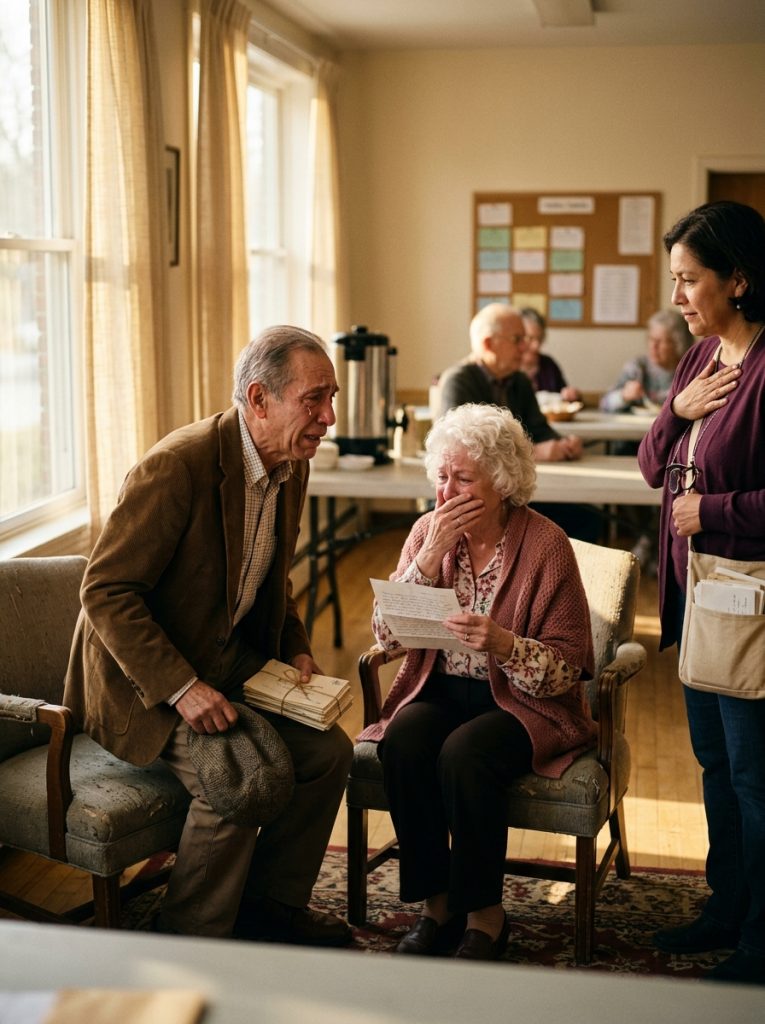
For a moment, neither of them moved.
Frank stood there with his cap in one hand and his year of letters in the other. Arlene stood by the window with Marigold’s whole correspondence pressed against her heart. And I stood off to the side, where I always stand, and held my breath.
“Arlene?” he said. Like a question. Like a prayer.
“Frankie,” she said. Not a question at all.
Fifty-six years. That’s how long it had been since Frank Delgado and Arlene Whitcomb had stood in the same room. They’d been twenty-three and twenty-one, in a college town, the autumn of 1968.
I got the whole story later, in pieces, over weeks of coffee in the common room. This is how it broke.
He’d asked her to wait for him while he took a job two states away for the summer. He wrote her a letter the first week — a real letter, the kind a nervous young man writes when he’s decided he’s going to marry a girl. He mailed it to her dormitory.
It came back. Return to sender. The dorm had reassigned rooms over the summer and the new mail clerk didn’t recognize the name.
Frank, being twenty-three and proud and terrified, decided the returned letter was her answer. She hadn’t moved far — just across town to a new boarding house — but he never knew that. He stopped writing. She waited for a letter that, as far as she knew, he’d simply never bothered to send.
Each of them spent that winter believing the other had let go first.
They married other people. Good people, as it happened. Frank’s wife passed four years ago. Arlene’s husband, six. They’d each had children, grandchildren, whole long lives — and underneath all of it, a small autumn ache that never fully closed.
And then two lonely widowed strangers signed up for a pen-pal program at a senior center, picked pen names off the top of their heads, and a fifty-eight-year-old volunteer with a tote bag put them together by accident.
Except I don’t believe in accidents anymore. Not after that Thursday.
They sat in the two chairs I’d set by the window. They didn’t stop talking for three hours. I refilled the coffee urn twice and otherwise made myself invisible, which is the entire skill of my job.
At one point I heard Arlene laugh — really laugh — and ask him why on earth he’d picked “Compass” for a pen name. He said it was because he’d spent his whole life feeling like he’d lost his true north somewhere in the autumn of 1968, and this little program was the first time in decades he’d let himself go looking for it. She put her hand over her mouth. She’d chosen “Marigold” because of the flowers he used to pick for her on the walk to class, the wild ones that grew by the science building. Neither of them had known. For a whole year, without the faintest idea, they’d been signing their letters with each other.
Here’s the part I have to tell you honestly, because this isn’t a fairy tale and Arlene would scold me for pretending it was.
They didn’t get fifty-six years back. You don’t. Time doesn’t return what it takes; it only, sometimes, offers a little at the end as if to say it’s sorry.
What they got was fourteen months.
Fourteen months of Sunday drives and shared crossword puzzles and Frank learning to like her terrible casseroles. Fourteen months of holding hands at the window like teenagers who’d finally gotten the timing right. He asked her to marry him at Christmas. She said the yes she’d been holding since 1968.
Frank passed in his sleep last spring. Quietly. Arlene was beside him.
She told me, after, that she wasn’t angry about the years they lost. “I spent fifty-six years thinking he forgot me,” she said, dry-eyed, steady. “Now I know he didn’t. That’s the gift, Edith. Not the time. The truth.”
I still run the program. I still match them by hand. I still read every letter and stay out of the way.
But I keep Frank and Arlene’s letters in a separate box now, the whole year of Compass and Marigold, tied with the same string he used.
And every time a new pair starts writing, every time I drop two strangers into the same envelope and step back, I think about that Thursday by the window.
I just carry the letters.
Sometimes, if you carry them long enough, they find their way home.