Vanessa’s mouth opened, but nothing came out. Jonathan Hale wasn’t waiting for an answer anyway.
He had already crouched down to the level of the potted plant.
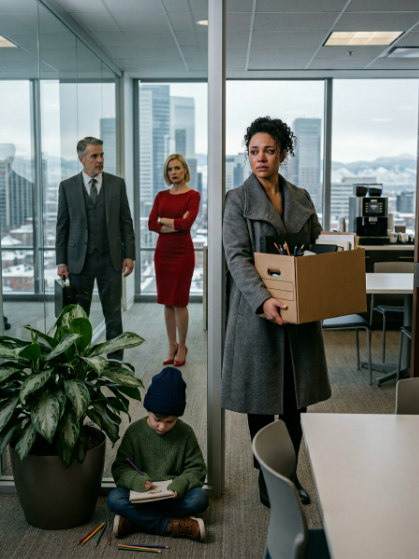
Theo had gone very still back there, sketchbook hugged to his chest, doing the thing he does where he tries to become furniture.
“That is a serious fort,” Hale said. “Best one I’ve seen on this floor, and I own the floor. Would you show me what you’re drawing?”
Theo studied him for a long second. Then, slowly, he turned the sketchbook around.
It was the break room. The potted plant. A small boy behind it. And in the doorway, a woman in a gray coat holding a box — and all around her, drawn small and gray, the backs of people at their desks. Everyone facing away.
He’d drawn the morning exactly as it happened.
Hale looked at that picture for a long time.
Then he stood up, and his voice changed.
“Get me her personnel file,” he told the nearest manager. “Now. And nobody touches that elevator.”
It came up fast. Hale read it standing in the break-room doorway while the whole floor pretended very hard to be busy.
“Maya Brooks,” he said. “Fifteen years. Last three performance reviews: exceptional, exceptional, exceptional.” He turned a page. “Recommended for senior coordinator nine months ago by two directors.” He looked at Vanessa. “The promotion paperwork is in this file. Unsubmitted. Signed by you, on hold, with a sticky note that says ‘not a culture fit.'”
Vanessa lifted her chin. “I manage this floor. Those are my calls. And frankly, Mr. Hale, you should know my uncle—”
“I know exactly whose niece you are,” Hale said. “I don’t care.”
He turned to me. “Ms. Brooks. Walk me through this morning.”
So I told him. The 5 a.m. call. The hospital. The three people I’d phoned. I told him I’d hidden my son behind a plant because the alternative was losing the job that barely covers a one-bedroom in a city that gets more expensive every month.
“My lease is up in three weeks,” I heard myself say. “The new rent is four hundred dollars more. I came in today because I can’t afford not to.”
Hale’s jaw tightened. He turned back to the file, flipped to the very back, and went still.
“Ms. Brooks. Were you ever told this company has an employee hardship and housing-assistance fund?”
I stared at him. “A what?”
“It’s been in the benefits package for six years. Emergency housing support. Childcare reimbursement for exactly the morning you just had.” He looked up, and he was not looking at me. He was looking at Vanessa. “It’s administered at the floor-supervisor level. Which means someone decided who got told it exists.”
The silence on that floor could have held weight.
“I didn’t think people on her band needed to know,” Vanessa said. “It would have been abused.”
“By single mothers,” Hale said. “Trying to keep their kids housed.”
He didn’t raise his voice. He didn’t have to.
“Security will walk you out while we review every file you’ve sat on,” he told her. “You’re suspended, effective now. Pack a box.” A pause. “I hear that’s the policy on this floor.”
It moved quickly after that.
My firing was reversed before lunch — not just reversed, erased, like it never happened, with an apology in writing. The senior-coordinator promotion that had been sitting in a drawer for nine months went through that afternoon, with nine months of back pay attached.
And the housing fund — the one I was never told about — covered the gap on my lease, then helped me move somewhere with a bedroom door Theo could close and a window he could see the mountains from.
Hale didn’t stop there. By the next quarter the company had a posted, plain-language list of every benefit, sent to every employee on every band. A childcare room went in on the fourth floor — couches, books, a quiet corner. And the rule that fired me got rewritten into one sentence that’s now framed by the elevators:
No one at this company will ever apologize for being a mother, a father, or a caregiver.
Vanessa’s review turned up eleven other people she’d quietly buried. None of them work under her anymore, because she doesn’t work here anymore. Uncle or no uncle.
Theo’s drawing — the one with everybody facing away — hangs in Jonathan Hale’s office now. He asked if he could keep it. He says it reminds him to walk the floors himself.
My son still draws every day.
But these days, when he draws the office, the people in it are facing the right way.
And there’s a door on the room where the kids wait.