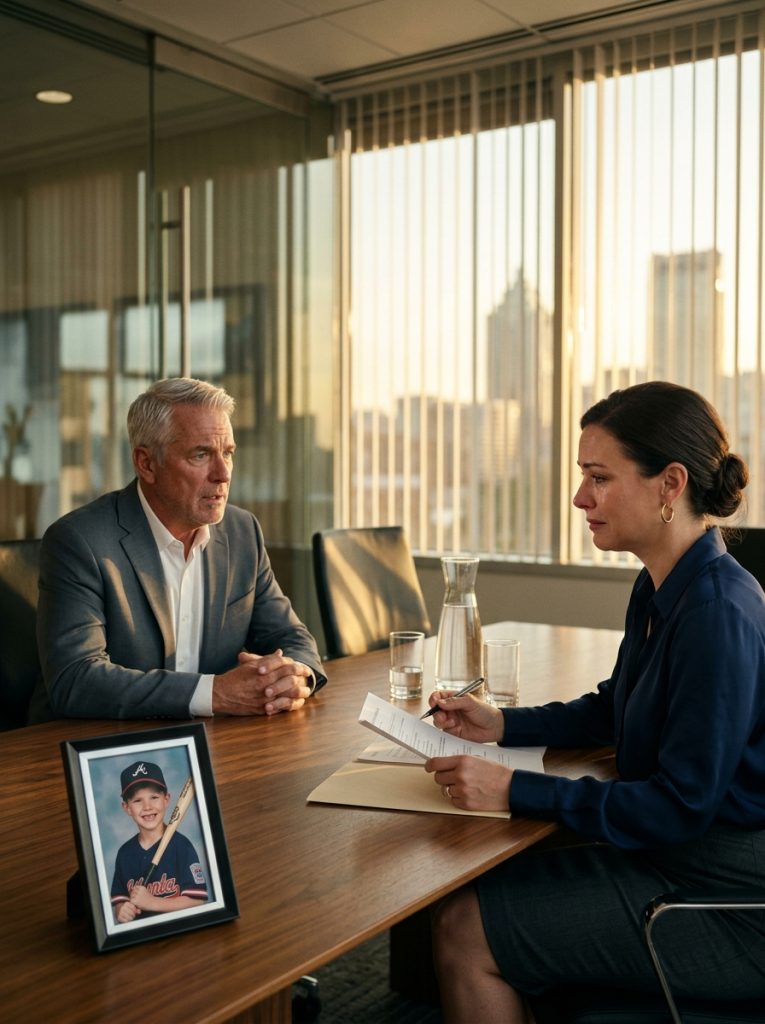
I walked Daniel Thorpe to the elevator at four twenty-eight.
I did not say goodbye in any way that meant anything. I shook his hand. I told him our committee would be in touch within forty-eight hours. He nodded. The elevator door closed. He looked at me through the gap right before it shut and his face did the thing it had done in the conference room — equal parts professional and gutted.
I went back to my office and shut the door.
I had two minutes to walk down the hall to the COO’s standing four-thirty.
I sat down at my desk instead.
I picked up the framed 4×6 photograph of Wyatt — gap-toothed grin, Atlanta youth-league cap, Little League bat — and I held it in both hands for thirty seconds while I made one decision.
The decision was the easy part.
The decision was: I am going to recuse myself in writing right now, before I walk down the hall, before I let anyone in this building, including me, talk me into thinking I can be objective about a candidate I share a thumb with.
I opened a new email. I wrote the recusal in seven sentences. Subject: Conflict of interest — Logistics Manager search, third candidate. Body: I have just discovered that the third candidate of today’s panel is my biological father, with whom I have had no contact since age six. I have not disclosed this to him in the room. He recognized me at the conclusion of the interview. I am formally recusing myself from any decision regarding his candidacy and from any further communication with him in a professional capacity until and unless this committee makes its hire. Please disregard any feedback I may have entered on his rubric. — Ken.
I sent it to the COO and the chair of the search committee, copy to legal.
I shut the laptop.
I walked down the hall and I told the COO, in person, in three sentences, the same thing.
He said, “Ken. I’m sorry. Are you okay?”
I said, “I’ll be okay tomorrow.”
He said, “Take the rest of today.”
I did.
I drove home.
I did not, in the parking-deck elevator or on the highway or in my own driveway, allow myself to think about anything other than the road.
I made it to the kitchen.
I sat down at my own kitchen table and I cried with my hand pressed flat over my mouth the way Wyatt does when he is trying not to wake the baby.
We do not have a baby. I just remembered, the way you remember strange things, that he had cried that way the day his hamster died.
I cried for thirty-five minutes.
Then I put my face under cold water. I made myself a sandwich. I ate it.
The committee hired Daniel Thorpe the next morning.
They did not tell me. The COO sent the offer letter under the regular review process. My deputy ran the onboarding kickoff. Daniel signed at three thirty p.m.
He texted me at four eleven from a number I did not recognize.
The message said: “Kennedy. I accepted. I will not be in the room with you in any capacity I can avoid. If you would prefer I withdraw, I will. Please tell me. — D.”
I read the message four times.
I drove out to the parking lot of his hotel that evening.
I did not call ahead. I am not sure why. I think I was afraid that if I gave myself any time to script it, I would script the wrong version.
I texted from the lot: “I’m in the parking lot. Come down if you can.”
He came down in the same slate-gray suit, no tie, no jacket, sleeves rolled.
He sat in my passenger seat.
I had thought I would talk first.
I did not.
He said, “Kennedy. I am going to say what I came here to say, and you are going to interrupt me anywhere you need to. Okay?”
I said, “Okay.”
He said, “I left when you were six because I was sick and I did not know I was sick. I had not been diagnosed yet. I had been awake for nine days. I had cashed my paycheck and bought a one-way bus ticket because the voice in my head had told me I was about to ruin you and your mother and that the kindest thing I could do was disappear. The voice in my head was wrong. It was a symptom. I did not know that. I did not get a name for it for another eleven years.”
He looked at his hands on his knees.
“I was diagnosed bipolar at thirty-eight. I have been on medication for twenty-three years. I have been sober for seventeen. I attend a Saturday morning men’s group at a church in Decatur every week. I have a sponsor. I have written you and your mother forty-one letters and never mailed any of them because every time I sat down to mail one I could hear my sponsor say, ‘Daniel. Are you doing this for them or for you,’ and I always answered honestly. So they sit in a shoebox at my apartment.”
He said, “I tried, in 2009, to find your mother. I learned at that point that she had passed. I am sorry. I am very sorry. I should have been there. I would have been there. I was not.”
He stopped.
He said, “I did not know about you. I mean, I knew about you. I did not know what your name was, or what you did, or where you were. I did not know about the boy in the photograph until ten minutes into the interview. I am sorry I sat down across from you without preparing you. I would have spent thirty years preparing you, if I had known.”
He waited.
I said, “Okay.”
He said, “I am going to take this job because I need this job and because, also, the truth is, I came down here last month for an interview at a different company and they did not bite, and your firm called me on a Friday and I thought maybe — maybe the universe had pointed me here for some other reason. I did not know it was you. I should have known it could be you.”
He said, “If you want me to withdraw, Kennedy, I will withdraw.”
I sat for a long time.
I am thirty-nine. I am married. I have a son. I have a stepfather who taught me how to ride a bike and walked me down the aisle. I do not need a father.
But Wyatt has one grandfather, and that grandfather lives in Knoxville and visits twice a year, and Wyatt has been asking, lately, in the careful way of a kid who has overheard adults, why his other grandparents on his mom’s side are not around.
I had been planning to lie about that for the rest of my life.
I said, “Daniel. I’m not going to forgive you. Not today. I might never get there. I can promise you I will not stand in your way.”
He nodded.
I said, “I’m not going to ask you to withdraw. I am going to ask you to do one thing.”
“Anything.”
“Show up. Saturdays. For Wyatt. Not for me. Saturdays. Saturday morning park. Saturday afternoon Little League. Whatever I tell you. You show up early. You leave when I tell you to. You do not ask for time you have not earned.”
He said, “Yes.”
I said, “I will tell him you are my father, when I am ready. Not yet.”
“Yes.”
“You will not ask when.”
Advertisement
“Yes.”
He said, “Kennedy. Thank you.”
I said, “Don’t thank me. Show up.”
He has.
He has shown up every Saturday for fourteen weeks. He arrives at the park at nine. He sits on a bench with a thermos of coffee and a paperback. He throws balls Wyatt asks him to throw and he stops throwing the second I say practice is over. He has not once tried to hold his hand. He has not once asked Wyatt for a hug. He drives his quiet sedan home at noon and he does not contact me for another seven days.
He does his job in the building. He runs his routes. He is, the COO told me on month two, the best hire in the department in five years.
We do not have lunch.
We do not have coffee.
We have Saturdays.
I told Wyatt last weekend that the man who throws him balls on the bench is my dad. He looked at me with his gap-toothed grin and said, “Mom. I know. He has your nose.”
I had not noticed.
I drive to the Saturday park now with my husband in the passenger seat and our son in the back seat in his Little League cap and a navy blouse on me that has nothing to do with HR, and I park where I always park, and I get out, and I walk Wyatt to the bench where his grandfather is already waiting with a thermos and a paperback.
He stands up when he sees us coming.
He puts the paperback down.
He says, “Hi, buddy.”
He looks at me last. He says, very quietly, every Saturday, the same thing.
He says, “Thanks for letting me show up.”
I say, every Saturday, the same thing back.
I say, “Don’t thank me. Show up.”
I am beginning to believe he will keep doing it.
I am beginning to be okay with beginning to believe it.
That is enough, for now, for a man who left a six-year-old on a Tuesday and is finally walking back through her door on Saturday mornings, one bench at a time.