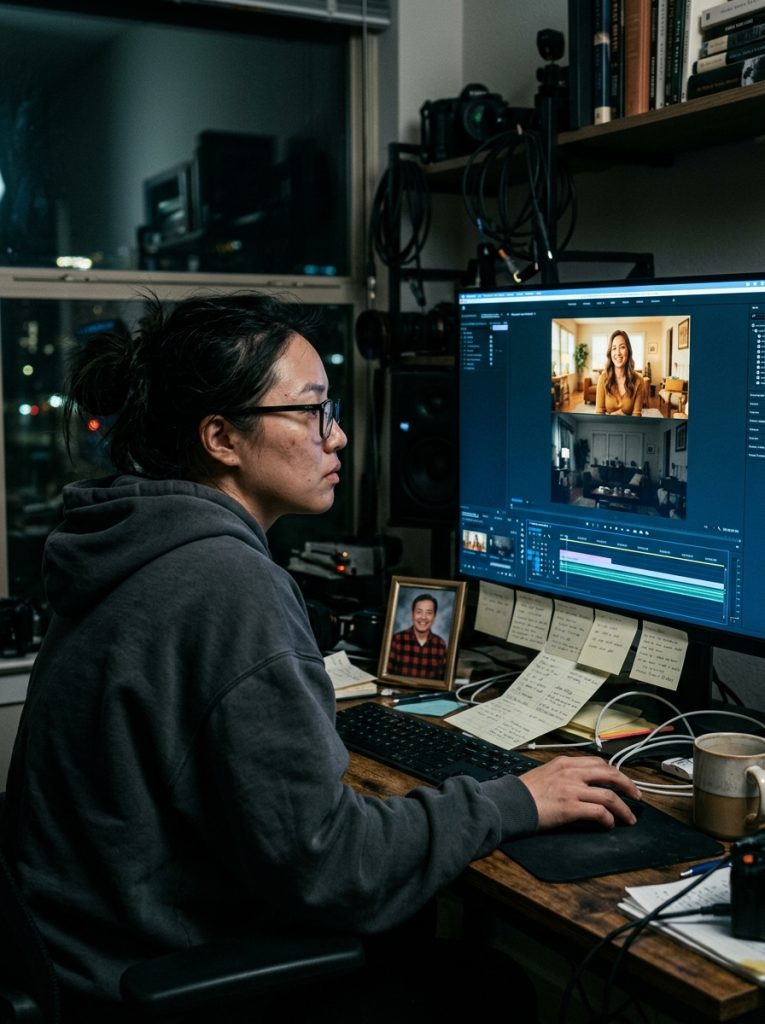
I posted it at 2:48 a.m. and fell asleep certain that two hundred people would see it and nothing would happen.
By the time I woke up, the post had been shared eleven thousand times.
It wasn’t the side-by-side that did it, not really. It was the four sentences under it. I’d written that I was Sloane Avery’s editor, that I was resigning, that everything in her feed was staged, and that I could live with the staging — but not with what I’d watched happen to a real family during a “charity” shoot.
I named no addresses. I posted no private messages. I shared one image I’d composed myself and one honest paragraph.
That was enough.
Because I wasn’t the only one who’d been waiting to exhale.
By noon, the comments had filled with other people: a former assistant named Hannah, who’d left in tears and an NDA two years before me. A florist who’d never been paid. A photographer Sloane had publicly humiliated. None of them shared secrets either. They just stopped staying quiet, all at once, the way a dam doesn’t break in one place but everywhere.
Hannah messaged me privately that afternoon.
“I almost did what you did, two years ago,” she wrote. “Then they put a contract in front of me and I got scared and signed it and convinced myself I’d imagined how bad it was. Watching you post that today — I cried. Not because it’s about her. Because somebody finally said the thing out loud, and now I know I didn’t imagine it.”
I read that message four times.
Because that had been my exact fear at 2:48 a.m. — that I was overreacting, that it was just content, that I’d built a monster out of an ordinary demanding boss. Hannah’s message was the first proof that I hadn’t. There had been a girl before me, scared into silence by the same machine. I’d nearly become her. Instead, by accident, I’d become the person who told her she’d been right the whole time.
That’s the thing nobody warns you about staying silent: it doesn’t just cost you. It teaches the next person that silence is the only option.
Sloane’s team came at me by 3 p.m.
Marcus called first, all false warmth, then ice. “You signed a contract, June. You’re going to want to take that down before our lawyers wake up. This is theft of proprietary content. We will bury you.”
I’d been afraid of exactly this for hours. So I’d already done the one smart thing I’ve ever done at 6 a.m. on no sleep: I’d talked to a lawyer of my own, a tired kind woman at a media-rights clinic who answered her phone early.
“The frame you composed and the honest description of your own experience are yours to speak about,” she’d told me. “Don’t post their unreleased footage. Don’t post anything private. Tell the truth about what you saw and did, in your own words. That’s not theft. That’s a witness.”
So when Marcus threatened to bury me, I said, “I took down nothing of yours. I posted one image I made and one true thing I lived. If you’d like to sue me for describing my own job, please put it in writing. I’ll forward it to the eleven thousand people currently asking what happened to that family.”
He hung up.
Sloane went a different route. She posted a teary video — beautifully lit, I noted, by the ring lights I knew the exact placement of — calling me a “disgruntled former contractor” spreading “lies,” insisting the charity campaign had been “100% real.”
It was a good performance. I’d graded enough of them to know.
It would have worked, too.
Except for the family.
The mother of the family from the fire saw the post.
She didn’t know me. She’d had no idea the gifts were props until a van took them away “for insurance reasons” and her kids cried themselves to sleep. She’d assumed they’d done something wrong. For months she’d carried that quiet shame.
She made her own video. Just her, at her kitchen table, no ring light, telling exactly what had happened: the eleven takes of the hug, the youngest told to smile bigger, the van pulling away full of Christmas. She held up the one thing they’d been allowed to keep — a single donated blanket — and said, “We were grateful for the help. We just didn’t know the help was a costume.”
That was the end of Sloane Avery’s golden life.
You can survive an angry ex-employee. You cannot survive a grieving mother with nothing to gain and a kitchen table for a stage.
The sponsor of the “giving back” campaign launched an audit within forty-eight hours. The brand that owned the farmhouse aesthetic — an actual furniture company — discovered their “authentic farmhouse partner” had been renting the property four days a month and quietly ended the deal. One by one, the sponsorships went dark. Marcus stopped representing her. The husband she’d kept in old footage filed quietly and was, I heard, glad to finally exist as himself.
I did not celebrate the way I thought I would. There’s no champagne in watching something rotten finally fall over. Mostly I just slept, for about fourteen hours, for the first time in three years.
Here’s what I did with the noise while it lasted.
People kept asking how they could help the family from the fire. So I did the only honest thing I could think of: I put them in touch with a vetted local relief fund, posted the link, and stepped out of the way. No staging. No camera in their faces. The fund raised enough to actually matter — real furniture, real Christmas, no van coming to take it back. I never filmed a second of it. That was the whole point.
The sponsor, scrambling to save face, made its own restitution to the family. I don’t care why they did it. The kids got their Christmas. Sometimes a good outcome doesn’t need clean motives.
My own life got quieter and, for the first time, honest.
I expected to be unhireable — the editor who turned on her client. Instead, my inbox filled with messages from creators I actually respected. People who make documentaries. A nonprofit that needed someone who could cut footage without lying with it. One of them wrote a line I taped to my monitor: “We want the editor who knew where the line was and walked off the job rather than cross it.”
I took the nonprofit work. It pays less than Sloane did. I sleep fine now, which turns out to be worth a lot of money.
And I paid off my dad’s pharmacy bill — the number I couldn’t look at directly, the reason I took the golden job in the first place — with my last honest paycheck plus the freelance work that came after. I drove home to tell him in person.
He didn’t fully understand the influencer drama. He’s a flannel-shirt, fix-the-truck kind of man. But he understood the shape of it.
“So you spent three years making something fake look real,” he said. “And then you quit by making the real thing look real for once.”
“Pretty much.”
He nodded slowly. “That’s the right way around, June. Took you a minute, but that’s the right way around.”
I still edit for a living. I still make rooms look beautiful and moments land. The craft was never the sin — the lie was.
These days, when I color-grade a shot, I think about that family’s kitchen table, lit by nothing but a window, the most convincing thing I’ve ever seen on a screen.
Turns out the truth has its own light. You just have to stop cropping it out.