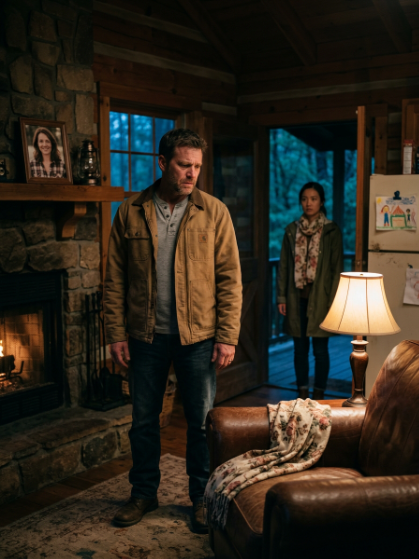
“Helen was my mother.”
The words didn’t fit in the room. Helen and I had tried for years to have children. We’d grieved that together, or I thought we had. I stood there holding a stranger’s scarf, certain this girl was confused, or lying, or cruel.
“My wife couldn’t have children,” I said. “We tried. Whoever told you—”
“Nineteen ninety-nine,” the young woman said quietly. “She was eighteen. Before she met you. She gave me up in Knoxville. Her parents made her.” She swallowed. “Her name was Helen Marsh then. She had a freckle right here.” She touched the corner of her own mouth.
Helen had a freckle right there. I used to kiss it.
I sat down. I had to.
Her name was Grace. She’d found Helen four years ago, through one of those DNA sites. She had a folder in her car — letters, in Helen’s handwriting, dozens of them. The last one was dated eight months before my wife died.
Helen had been driving up to this cabin to meet Grace. While I thought she was on “research trips” for her work. The two of them had spent two years here, learning each other, in the one place Helen felt safe enough to be the version of herself she’d hidden from everyone, including me.
Including me.
“She was going to tell you,” Grace said. “She told me that, the last time. She said, ‘After the holidays. Sam will understand. He’s a good man, he’ll just be hurt I waited.'” Grace’s eyes filled. “Then she got sick so fast. And after she was gone, I didn’t know how to walk up to a grieving husband and tell him his wife had a whole daughter he never knew about. So I just… kept coming up here. To be near her. I’m sorry. I should have written. I kept the lamp on like she used to.”
I looked at the scarf in my hands. Helen had given it to her. I could see that now. It was exactly the kind of soft, impractical, beautiful thing my wife loved and I always teased her about.
Here is the part that I will carry the rest of my life.
I wasn’t angry at Grace.
I was angry at the wiring of the whole thing — at a nineteen-year-old’s parents who decided shame was cheaper than truth, at the decades that taught my wife to keep the biggest part of her heart in a cabin instead of in our marriage. She was so afraid I’d think less of her. As if anything could have made me love her less. As if a child she’d grieved at eighteen was a stain instead of the bravest thing about her.
She ran out of time to find out she was wrong about me. That’s the cruelty I can’t fix. I never got to say, “Helen, you should have told me the day we met. I’d have driven you to Knoxville myself.”
I never got to meet my wife all the way.
Grace stayed that night. We sat by the stove and she showed me the letters, and I learned things about Helen I’d never known — that she’d kept Grace’s hospital bracelet sewn into the lining of her winter coat for nineteen years. That she cried every September. I’d always thought September made her quiet because of the season changing.
It was never the season.
I read those letters until I had them nearly memorized. Helen, writing to a daughter she’d given away, apologizing across two decades, signing each one “your mother, even if I never earned the word.” She had earned it. She’d earned it a hundred times over, and never once let herself believe it.
Grace is twenty-five. She has Helen’s freckle and Helen’s terrible sense of direction and Helen’s habit of holding a coffee mug with both hands. Watching her is like watching a window into a room I wasn’t allowed in.
I gave her the cabin. Helen’s letter had left it to her anyway — the letter I never opened, filed with the lawyer under “to be read by Sam,” which I couldn’t do for three years. Grace tried to refuse. I told her Helen wanted her to have the one place she’d been her whole self.
We keep it together now. I drive up some weekends. Grace calls me Sam, not anything more, and that’s right; I’m not her father. But I was her mother’s husband, and that turns out to be its own kind of family.
We scattered the rest of Helen’s ashes on the hidden trail behind the cabin. Grace knew the path. Of course she did. Helen had walked it with her a hundred times.
I keep the floral scarf on the reading chair.
Some doors you don’t get to open in time. The least I can do is stop closing the one she left ajar.