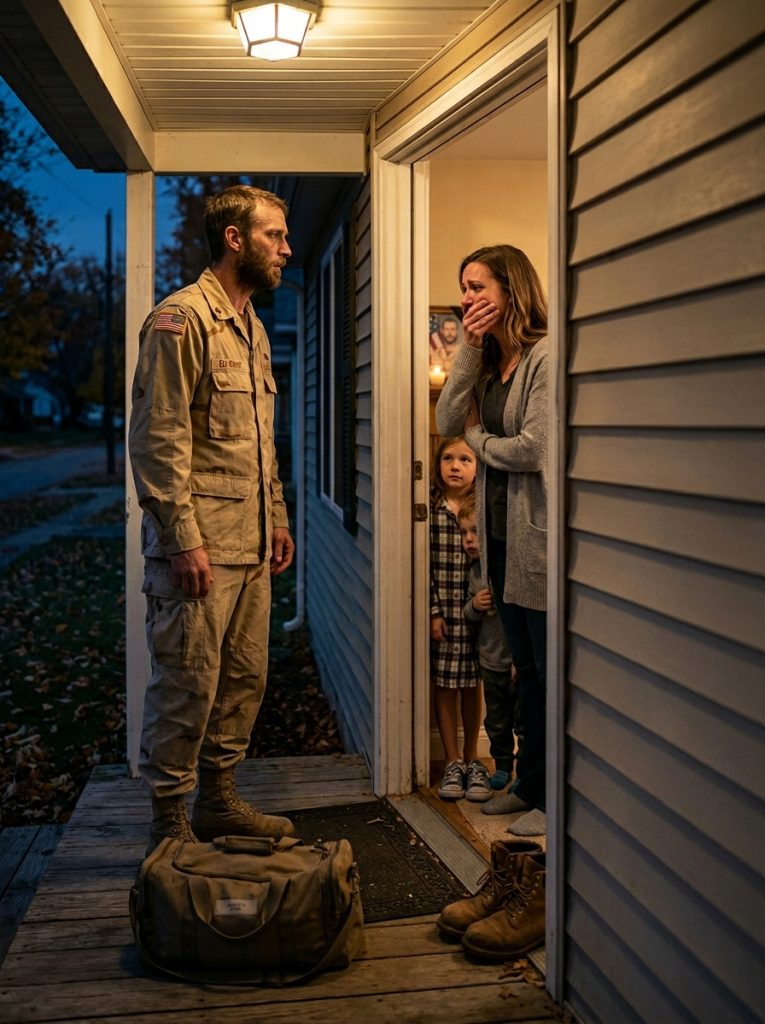
Junie looked at my outstretched hand for a long, long time.
Then she looked at the small scar on my eyebrow — the one from the bike crash when she was three, the one she used to press with her finger and say “ouchie” — and I watched the photograph in her memory line up with the man on the porch.
“Daddy?” she whispered. “Your beard is scratchy now.”
“I know, bug,” I said. “I’ll shave it. I promise. Come here.”
And she crossed that porch and put her arms around my neck, and nineteen months of being dead fell off me all at once. I held my daughter and I shook and I didn’t care who saw.
Rachel was on her knees beside us now, one hand on my face like she needed to confirm I had skin and bone. “How,” she kept saying. “They told us. There was a service. Eli, there was a casket. How are you here?”
I told her the short version, because the long version takes hours. My unit had been hit. In the chaos, I’d been carried out by villagers, badly hurt, no ID, no way to send word, in a place where sending word could get the people who saved me killed. By the time I made it to anyone who could confirm who I was, the Army had already closed the book. The paperwork that brings a dead man back to life is slow. I’d insisted on coming home before the letters caught up, because I couldn’t bear for her to learn it from a form.
What I didn’t tell her on that porch — what I’ve only told a couple of people since — is what kept me alive in the months I was hidden, fevered, half sure I’d never see home again. It was Junie. Specifically, it was a memory of teaching her to ride a bike, the morning I got the scar she’d just touched. I played that morning on a loop in my head, every detail, her wobbling and then catching it and the sound she made when she realized she was doing it alone. I decided in that hole that I had not survived four years of soldiering to die before I saw whether she’d learned to ride without me. That stupid, ordinary memory walked me through every night that should have been my last. I came home, in the end, because a seven-year-old’s laugh refused to let me go.
That’s when I heard the screen door.
A man stepped onto the porch. Flannel shirt, sock feet, a dish towel over his shoulder. He took in the scene — me on my knees, his wife’s hand on my face, two kids — and I watched him understand, all at once, exactly who I was.
This was the man whose boots were by my door.
His name was Tom. And here is the thing I have to tell you, the thing that makes this story the kind that doesn’t have villains.
He didn’t square up. He didn’t get territorial. He went pale, and then he did the bravest, most decent thing I have ever seen a man do. He crouched down to his own stepson, who was clinging to his leg confused, and he said softly, “Hey, buddy. Remember the soldier in the pictures? The one we say goodnight to? That’s Junie’s daddy. He came home. This is a happy thing, okay? This is the happiest thing.”
Then he stood up, and he put out his hand to me — the same hand, I realized later, that had been tucking my daughter in for over a year — and he said, “I’m Tom. She talks about you every day. Junie. Every single day. Welcome home, Sergeant.”
I have shaken a lot of hands in the Army. That one took more courage than most.
The four of us — five, counting little Caleb — sat in my old living room that night under my own photograph with its black ribbon, and we talked until the candle burned out. There was no script for it. We made it up as we went, the way you do.
Here is what I learned, slowly, over that night and the hard weeks after.
Rachel hadn’t moved on because she stopped loving me. She’d moved on because she believed, with a folded flag and a graveside and a chaplain’s hand on her shoulder, that I was gone. Tom had come into her life a year after the funeral. He was steady. He was kind to my daughter. He’d never once tried to make Junie call him Dad — he was careful about that, careful in the way good men are. When Rachel was drowning, he’d been the shore. I could not hate a man for being the shore.
And legally, it was a knot I won’t pretend was simple. A man declared dead doesn’t just snap back into his old life. There were forms and lawyers and a judge who, I think, had never seen a case quite like ours. Rachel and Tom’s marriage, my marriage, the house, the benefits Rachel had received — all of it had to be untangled by people in offices, slowly.
But the part that mattered, the only part that ever really mattered, we settled ourselves, the adults, around a kitchen table after the kids were asleep.
Junie would have her father. All the way. No half measures.
I would not blow up the only stable home my daughter had known to satisfy something in my own chest. Tom would not vanish from Caleb’s life or from Junie’s, because she loved him too, and you don’t take love away from a child to balance the books.
It was not the homecoming I’d dreamed about in a hole on the other side of the world. In that dream, I walked in and everything was exactly as I’d left it. But nothing waits nineteen months without changing, and a real family is not a museum.
Rachel and I are not married anymore. That sentence still lands hard when I write it. We tried, for a few months, to find our way back to what we’d been, and we couldn’t, because grief had already done its work and you cannot un-grieve someone. What we found instead was something I didn’t know existed: a friendship built on having loved the same little girl through the worst thing either of us ever survived.
I live ten minutes away now. I have Junie half the week. Tom and I split the driving for soccer, and on the bad nights — the ones where I wake up still in that hole — he’s actually the one I call, because he’s the only other person whose whole life rearranged itself around the same little girl.
Last month it was Junie’s birthday. Two homes, one party, no weirdness the kids could feel. At one point I looked across the backyard and saw Tom holding the cake steady while Rachel lit the candles while Caleb argued with Junie about whose turn it was to blow them out, and I thought: this is not the family I left.
The next morning I finally did the thing I’d promised on the porch. I shaved the beard. Junie sat on the edge of the bathtub and watched the whole operation like it was surgery, narrating, telling me I was “doing it wrong” and “missing a spot,” bossy as her mother. When I rinsed off and turned around, she went quiet and put her hand on my cheek, on the smooth jaw and the old scar, and she said, “There you are. Now you look like the pictures.” Then she hugged me so hard I had to sit down on the floor. I think that was the moment I actually came home — not the doorway, not the hand on my face, but a kid checking my jaw against a photograph and deciding I matched.
But it’s a family. It’s hers. And she has more people who would lay down their lives for her than she did before that mountain of paperwork said I was dead.
I came home from a war they buried me in, and I found my photograph draped in black and another man’s boots by my door.
I could have torn it all down to feel whole again.
Instead I took the ribbon off my picture, shook the hand of the man who’d kept the porch light on in my place, and learned that coming home isn’t always walking back into your old life.
Sometimes it’s having the grace to step into the new one — and finding your daughter waiting for you in both.
She doesn’t say I’m in heaven anymore.
She says, “My dad came back.” And she’s right.
I did.