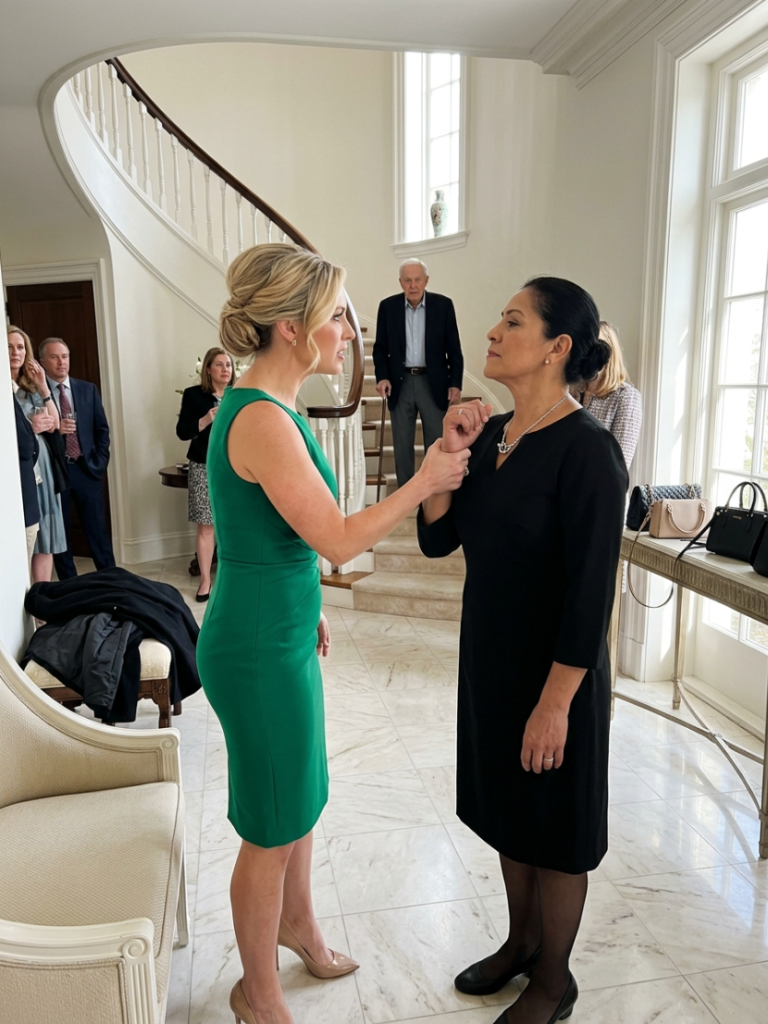
My fingers loosened before my pride allowed them to, and Isabel Reyes did not pull away first — I did.
That should have told me everything. Accusers who are right do not feel their grip go soft when the accused whispers. They tighten. They perform certainty for the foyer, for the arriving guests in cashmere, for the photographers scheduled at two-thirty sharp on the Whitfield marble. I had crossed the foyer in my emerald dress to expose a thief, and Isabel, fifty-two, black uniform, stood with her chin lifted like a woman who had rehearsed this scene longer than I had.
“You are holding the wrong woman,” she said again, quieter.
The silver clasp at her throat caught coastal light through the tall Newport windows — too precise for costume, too familiar for my comfort. I had never seen it in a catalog. I had seen something like it in a framed photograph Henry kept locked in his study, the one he would not discuss: his first wife, Catherine, holding an infant on a sailboat deck the summer before the accident.
Guests froze near the entry table with coats half-off. Perfume and salt air mixed in the hall. From the curved staircase, Henry Whitfield watched without speaking, cane tight in one hand, face unreadable at seventy-eight.
Ten minutes earlier, I had been certain.
The pearl necklace was missing from my dressing room — not the modest strand I wore to board meetings, but the Whitfield heirloom Henry’s mother had worn to every Newport charity season since 1962. I had laid it on the velvet tray at noon before hair and makeup. At one-forty, the tray was empty and Isabel had been the only staff member on the second floor.
It fit the story I wanted. The housekeeper with the quiet eyes and the old-country accent taking what the new Mrs. Whitfield had earned by surviving this family’s moods. Henry’s second marriage had never been fully accepted by the old guard. I had learned to convert their skepticism into authority. Accuse cleanly. Win publicly.
Isabel had flinched when I entered the staff corridor. That flinch felt like guilt.
I grabbed her wrist in the foyer hard enough to make the clasp flash. “Where is it?”
“I am not wearing your pearls,” Isabel said.
“That clasp isn’t yours.”
“No,” she agreed. “It is not.”
Her calm unnerved me more than denial would have. I shook her wrist once, a mistake I felt immediately in the silence of arriving guests. One woman in pearls of her own stepped back as if proximity might stain.
Henry descended one stair at a time. The cane tapped marble with a rhythm I had heard at a thousand galas, but never with this weight.
“Vanessa,” he said. Not a shout. Worse — a name spoken like a door closing.
“Henry, she stole—”
“Show me the clasp.”
Isabel did not resist. She turned her throat slightly, the way witnesses turn toward light. Henry leaned in, spectacles low on his nose, and went still in the particular way men go still when memory returns with engineering detail.
“This mechanism,” he whispered. “I designed this clasp myself. Catherine wanted something a child could not unfasten on a boat deck.”
The foyer temperature seemed to drop. My emerald dress suddenly felt like a costume.
“You designed it for Catherine,” I said, because if I named the first wife aloud I could keep control of the narrative. “Then it should be in the vault, not on—”
“Not on her,” Henry finished. He looked at Isabel. “On our daughter.”
Isabel closed her eyes once. When she opened them, there were tears she did not wipe.
“No,” I heard myself say. “Margaret died in the boating accident. Everyone knows—”
“Everyone knows what I signed after Catherine drowned,” Henry said. “Death certificate for Margaret issued when we never recovered a body. I was grief-mad and persuaded by lawyers who benefited from a clean estate. I have regretted that signature for thirty-one years.”
The photographers had not arrived yet. Thank God for small mercies that were no longer mine.
Isabel’s voice was steady. “My name was Margaret Whitfield until I was twelve. After the storm, a fishing crew pulled me from debris near Block Island with a head injury and no identification. Catherine’s necklace was still on my neck. The clasp held.”
Henry’s hand trembled on the cane. “I searched.”
“You searched the water,” Isabel said. “Not the hospitals that listed me as Jane Doe.”
Guests murmured. I felt each murmur like a verdict I had asked for.
Henry reached toward the clasp but did not touch it without permission. Isabel nodded once. His fingers found the mechanism — a tiny lateral slide he had invented in a workshop, a lock against waves and careless hands. He opened it with muscle memory and closed it again, tears now on his face without shame.
“Margaret,” he said.
“I kept the name Isabel,” she replied. “The nun who raised me in Providence until I was eighteen. I came back to Newport last year when I saw your foundation luncheon listed in the paper. I did not come to take anything. I came to see whether you were still alive to tell.”
The accusation I had made in front of witnesses reassembled itself in my throat as ash.
“The necklace in your dressing room,” Isabel said, looking at me now without victory — worse, with pity. “It is on the east hall table where you left it after trying it with the emerald earrings. I passed it on my way down.”
My assistant, pale near the entry, nodded once, confirming what I had been too angry to verify.
I had not lost pearls. I had lost judgment in public.
Henry turned to the guests with the authority of a man who had built half the harbor. “Luncheon is canceled. Margaret — Isabel — will be staying in the east wing. Vanessa, you will release her wrist, and you will not speak for her again in this house.”
My fingers were already empty. Pride arrived late and useless.
I stepped back. Isabel did not rub the marks my grip had left. She adjusted the clasp instead, the custom mechanism catching light like a small machine built for survival.
In the study an hour later, Henry spread old newspaper clippings across the desk — search boats, memorial service, estate transfers finalized six months after the storm. Second marriage announcements followed. My photograph among them, smiling beside a man who had buried a daughter he never stopped searching for in the wrong records.
“I married again because I was told to heal,” Henry said. “You married me because this house opens doors. Neither fact erases the other. But today you accused my living daughter of theft to protect a status you had not earned.”
The words were quiet. They landed anyway.
Isabel — Margaret — sat in Catherine’s old chair by the window, hands folded, necklace at her throat. She did not ask me to leave. She did not need to. The house had already rearranged itself around her return.
Over the following weeks, the charity board sent polite inquiries. I sent resigned answers. Henry filed amended records with the county and placed Isabel’s name where it should have lived since childhood. The second Mrs. Whitfield’s seat at the harbor gala remained empty by my choice, not his command.
On a Sunday when coastal light lay soft on the marble again, I watched from the library doorway as Henry showed Isabel the sailboat photograph — Catherine laughing, infant Margaret gripping the same clasp now restored to its rightful throat.
Isabel saw me watching. She did not invite me closer. She did not ban me either. She simply turned back to her father, and the clasp caught the window once more — precise, custom, impossible to fake, holding fast through everything that should have broken it.
I closed the library door quietly and left them to a reunion I had almost stolen because I wanted a villain more than I wanted the truth.