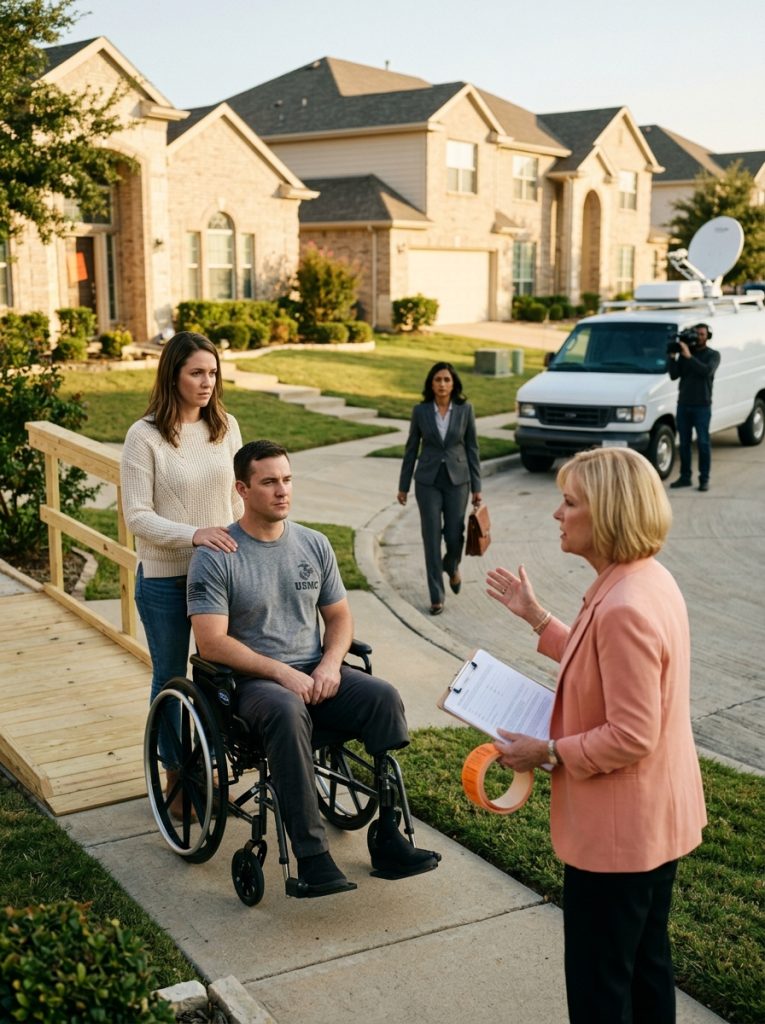
The woman in the charcoal suit reached our walkway first.
She didn’t look at Linda. She looked at Daniel, and she smiled.
“Mr. Hayes? Priya Nandakumar. I’m a disability-rights attorney. Your wife called my office this morning.” She set her briefcase on the step, right beside the orange notice. “I drove down from Dallas. I hope that’s all right.”
Daniel’s hand tightened around mine.
I hadn’t told him. I’d spent a week on the phone after he fell asleep — a veterans’ group, a legal aid line, and finally Priya, who called me back at six that morning and said three words that made me cry into a dish towel. “They broke the law.”
Behind her, the news van doors slid open. A reporter I recognized from the six o’clock broadcast stepped out with a camera operator. A neighbor had tipped them off. Maybe more than one. It turned out the porches that stayed silent had been watching the whole time.
Linda’s smile finally cracked.
“This is a private community matter,” she said, lifting her clipboard like a shield. “The ramp is a code violation. The board voted—”
“Let’s talk about that vote,” Priya said.
She opened the briefcase and drew out a thin stack of paper.
“The Fair Housing Act. Federal law. A homeowners association cannot deny a resident with a disability a reasonable modification needed to access his own home. A wheelchair ramp is the textbook example. Literally — it’s in the training materials.”
“There are aesthetic guidelines,” Linda started.
“Aesthetic guidelines do not override federal law, Ms. Caldwell. The fines you’ve issued aren’t just unenforceable. Issuing them after being told this man is a disabled veteran can be discrimination. That’s the part that gets expensive.”
For the first time, Linda Caldwell had nothing on her clipboard to read from.
That was when Frank walked over.
Frank lives two doors down. Old Army. In all the weeks of notices, he’d never said a word. Now he crossed his lawn in his slippers and held up his phone.
“Six months of these,” he said. “Filmed her taping every one to your door. Figured somebody might want them someday.” He looked at the reporter. “You want them?”
It turned out a lot of people on our street had been keeping receipts.
By the time the camera was rolling, three neighbors had come forward. And then Priya pulled out the page that ended it.
She had spent the morning at the county records office. Linda Caldwell’s own backyard — the pristine pool she fined half the cul-de-sac to “protect property values” around — had been built eight feet over the property line, onto a public drainage easement, with no permit. For nine years.
The woman who ruled the street by quoting the rulebook had been breaking it the entire time.
The segment ran that night. “HOA Fines Disabled Marine for Wheelchair Ramp.” By morning it had been shared past forty thousand times. By noon, two more veterans in two other states had sent us their own stacks of orange notices.
The board called an emergency meeting that week.
They voided every fine against us, in writing. They issued a formal apology, read aloud. And they voted, eleven to one, to remove Linda Caldwell as president. The one vote against removal was Linda’s own.
She put her house up for sale by spring. The county cited the pool the same month. I won’t pretend I felt sorry. I’m not that good a person yet.
But here is the part I keep coming back to.
That reasonable-modification rule Priya quoted — after the story aired, the board didn’t just let our ramp stand. They wrote a new policy: any accessibility modification a resident needs is automatically approved. No application. No fee. No vote. Frank read the new rule out loud at the meeting, still in his slippers, and the whole room clapped.
Daniel didn’t say much through any of it. That isn’t his way.
But the evening the policy passed, I found him out front at sunset, parked at the bottom of the ramp he’d built with his own two hands and every ounce of pride he had left.
He wasn’t looking at the door, or the spot where the orange notice used to flap. He was just looking up the gentle slope of pale wood that led into the house.
“Told you,” he said. “Let people talk long enough, they show you who they are.”
Then he rolled himself up the ramp, slow and steady, and I held the door, and we went home — into a house that was finally, fully, ours to walk into.