The clubhouse smelled like burnt coffee and old carpet, the way it always does. Folding chairs in rows. Gerald Voss up front behind a long table with two other board members who mostly nodded when he told them to. There were more people there than I had ever seen at a meeting. Word travels on a cul-de-sac.
Gerald ran through his agenda like a man who enjoyed the sound of his own gavel. Landscaping. Pool hours. And then, with a little theatrical sigh, “old business — the ongoing situation at the Mercer residence.”
He stood. He actually stood, like a lawyer.
“I know Carol means well,” he said to the room. “But we have a documented fire hazard on Linden Court. Antiquated wiring. Repeated outages. I’ve been more than patient. Tonight I’m formally recommending the board levy the lien and require the display to be removed before someone gets hurt. For everyone’s safety.”
There it was again. For everyone’s safety. The three words he hid behind every single time.
I raised my hand. He gave me the floor with a magnanimous little wave, certain I was going to beg.
“Thank you, Gerald,” I said. “Before the board votes, I’d like to address the wiring concern directly. Because you’re right about one thing — those lights have been going out almost every night. I’d like to show everyone why.”
I’d asked the clubhouse manager to set up the projector ahead of time. He was a good kid; he’d done it without telling Gerald. I walked to the front, plugged in my phone, and the first clip came up on the big pull-down screen, ten feet tall.
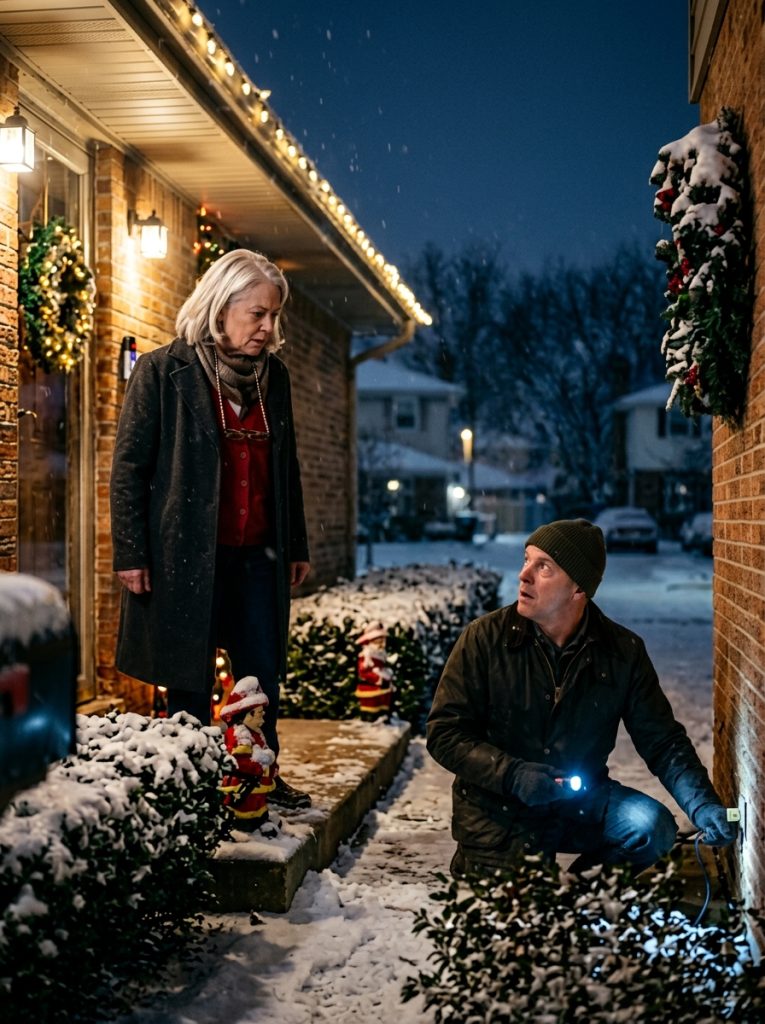
8:46 p.m. The side of my house. Snow falling. And a man in a dark waxed jacket and a knit beanie walking up my side yard with a little flashlight, crouching at the outlet, and switching it off with the ease of long practice.
The room made a sound. Not a gasp, exactly. More like the air going out of it.
“That’s the night before last,” I said. “Here’s three nights ago.”
Same coat. Same beanie. Same crouch.
“Here’s last Thursday, from the Patels’ camera across the street. Different angle. Better light.”
This time, when the figure straightened up and turned, the porch light caught his face full-on. There was no question who it was. There was a man two rows from the front wearing that exact dark waxed jacket, because he hadn’t thought to leave it in the car.
“And this is my favorite,” I said, “because of the irony.”
The last clip was from my own doorbell camera. The one Gerald had stood up at a meeting just like this one and required every household to install. His pet project. His security initiative. In the clip, he reaches for my outlet, then glances up — directly into the lens of the camera he personally mandated — and for half a second looks straight into his own rule.
I turned off the projector.
The clubhouse was dead silent.
Gerald did what men like Gerald always do when the floor gives way. He attacked the floor.
“This is — this is a gross invasion of privacy,” he sputtered. “Recording a person without consent—”
“On my own property,” I said. “With the camera you required me to buy. There’s a clause about it in the bylaws. You wrote it.”
One of the other board members, a retired schoolteacher named Lorraine, slowly slid the binder of bylaws toward herself and started turning pages.
“Carol,” Gerald said, switching tactics, his voice dropping into wounded reason, “I was checking the wiring. For safety. I was worried—”
“You were worried about a fire,” I said, “so your solution was to sneak into a widow’s yard in the dark and cut her power. Every night. For three weeks. While telling the whole neighborhood her late husband’s display was going to burn the street down.”
I hadn’t planned to say “late husband.” It just came out. And it landed in that room like a stone in still water.
Because most of them had known Ray. Half of them had a kid he’d pulled out of a pool, or a kitchen fire he’d talked them through on the phone, or a Christmas Eve when he showed up in his gear to fix a furnace for free because somebody’s heat had died on the coldest night of the year. Ray was the man who climbed the ladder every December and made their children press their faces to the window.
And Gerald Voss had spent three weeks unplugging him.
You could feel the room turn. It wasn’t loud. It was worse than loud. It was the specific quiet of forty people simultaneously rearranging everything they’d believed for a month. Mrs. Okafor, three chairs down from me, put her hand over her mouth. The Brennan boy — grown now, but Ray had coached his Little League team one summer — stood up in the back and said, to no one in particular, “He fixed my grandmother’s furnace on Christmas Eve. For free. In a blizzard.” And then he sat back down, like he’d surprised himself.
A man near the front whose name I never did catch turned around to face Gerald directly. “I voted for you,” he said. “I knocked on doors for you. And you were out there in the dark cutting Carol’s lights.” He shook his head slowly. “My kids waved at that house every night on the way home. I told them it was the firefighter’s house.”
Gerald opened his mouth and shut it again. There was nothing in there. There never had been.
Lorraine looked up from the binder. “Gerald,” she said, in the flat voice of a woman who has corrected a great many lies in her life, “I’m going to ask you to step down from the table while we discuss this. Now, please.”
It wasn’t really a question.
The vote that night did not go the way Gerald had planned. The lien was dead on arrival. Instead, the board voted — unanimously, with one chair conspicuously empty — to censure their president, and Lorraine read aloud a section of the bylaws about removal for cause that I don’t think Gerald ever imagined would be read at him. Within the month there was a special election. He didn’t run. He couldn’t have won a vote for dogcatcher on that street.
But that’s not the part I drove home holding onto.
Two nights later, there was a knock at my door. It was the Patel kids, and the Brennans, and Lorraine, and a dozen others, all bundled up, stamping snow off their boots. Mr. Patel had a ladder over his shoulder.
“We figured,” he said, a little shyly, “that the wiring really is old. So if you’ll tell us where everything goes, we’d like to help you put it up right. All of it. The way Ray had it.”
I stood in my doorway in Ray’s red cardigan and I could not speak.
So I just nodded, and I handed Mr. Patel the diagram Ray kept folded in the garage — the one with his handwriting on it, every strand labeled in his blocky capitals — and for two hours, in the falling snow, my whole street put my husband’s Christmas back together.
When they plugged it in, the whole cul-de-sac lit up gold at once. The wreath. The eaves. The little firefighter figures on the lawn. Children came out in their pajamas. Somebody brought cocoa.
And I stood on my porch under the lights my husband built, surrounded by neighbors who had decided, all at once, exactly whose side they were on.
Ray used to say I was too soft for my own good.
Maybe. But softness kept the receipts. And on the night of the first real snow, the lights came back on for good — and they have not gone dark since.