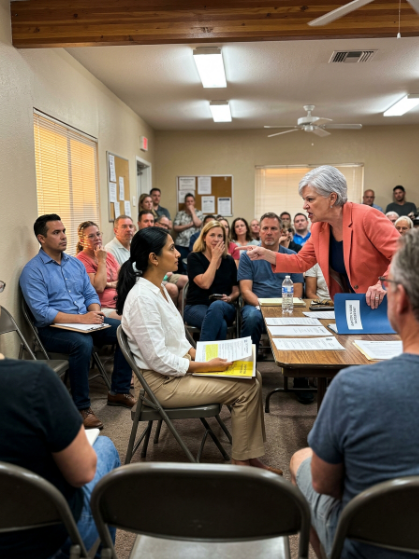
Marlene did not read the vendor name right away.
She looked at me first.
That was how I knew she understood the folder mattered before she understood why.
The clubhouse went quiet in that strange way neighborhood meetings do when everyone senses a rule has shifted but no one knows the new shape of it yet.
Marlene placed one hand on the closed lease folder.
“This agenda item is not relevant to your violation,” she said.
I kept standing.
My fine notice was in my left hand.
My permit packet was in my right.
Both suddenly felt lighter.
“You said community standards matter,” I said. “The next agenda item is a community energy contract. I would like the vendor name read into the minutes before you fine me for an energy improvement that meets city code.”
A man in the second row muttered, “Read it.”
Then someone else said it too.
Marlene’s jaw moved once.
Evan Ruiz, still sitting against the side wall, opened his clipboard without speaking. He did not rescue me. He did not perform outrage. He simply made it clear the city observer was now taking notes.
Marlene opened the folder.
Her eyes dropped to the first page.
For half a second, she looked almost confused.
Then she saw it.
SunBridge Storage.
She did not say the name.
The treasurer, a retired accountant named Mr. Alan Kell, leaned over from the board table and read it upside down.
“It says SunBridge Storage,” he said.
The room turned again.
This time, not toward my roof.
Toward Marlene’s table.
I set the fine notice down on the chair behind me and opened my permit packet to the city approval page.
“SunBridge leases the battery cabinets behind this clubhouse,” I said. “They lower peak demand charges during summer events and keep the cooling system supported during short outages.”
Marlene’s face hardened.
“Are you claiming some special privilege because you work there?”
I shook my head.
“I founded it.”
No one moved.
Even the ceiling fans seemed louder.
Marlene looked back at the contract as if my name might disappear if she stared long enough.
It did not.
The signature page was three tabs back. She flipped too fast, missed it, and had to go back while the entire clubhouse watched. When she found it, the color rose under her makeup.
Priya Desai.
Founder and managing engineer.
My father would have hated that moment.
Not because Marlene was embarrassed.
Because he believed humiliation was a lazy use of power. He had spent his life teaching me that being right was only half the job. The other half was making the room better after the truth arrived.
So I did not smile.
I did not say gotcha.
I did not ask her how ugly she thought the battery cabinets were while they kept her meeting room cool.
I said, “I am not here for special treatment. I am asking the board to replace a personal aesthetic objection with a neutral safety standard.”
Marlene recovered enough to point at my packet.
“This is still about visible panels.”
“Then make a rule about visibility that applies to everyone,” I said. “Panel placement, glare rating, roof load, licensed installation, wiring inspection, city permit. Put it in writing. Apply it evenly. But do not call my project dangerous when the city has approved it and your own clubhouse relies on my company’s equipment.”
That was when Mrs. Alvarez stood up in the back.
She was seventy-one and had lived in Desert Palms longer than the palm trees at the entrance sign.
“My cooling bill was four hundred and eighty dollars last July,” she said.
No one interrupted her.
“If Priya’s panels are ugly, my bill is uglier.”
A few people laughed softly.
Not meanly.
With relief.
The kind of laugh that lets a room breathe again.
Then Mr. Dawson from Palo Verde Court said his garage refrigerator failed during an outage and he had been asking about backup power for two years. A young mother near the aisle said her son’s room hit ninety degrees the week their air conditioner cycled off during peak pricing. One by one, the meeting stopped being about my roof and started being about the real thing Marlene had tried to keep out of the room.
Heat.
Advertisement
Cost.
Control.
Marlene tapped the gavel once.
“We are not rewriting policy tonight.”
Mr. Kell cleared his throat.
“Actually, we can table enforcement pending policy review.”
She looked at him like he had betrayed a family secret.
He adjusted his glasses.
“And we do have the lease renewal tonight. If Ms. Desai’s company is the vendor, I would prefer not to threaten penalties against its founder while asking her to continue servicing the clubhouse.”
There it was.
The full circle.
Ten minutes earlier, Marlene had made me the example.
Now she had to ask whether I was still willing to keep the lights steady in the building where she had displayed my fine.
I looked at the battery lease folder.
Then at the permit packet.
Then at the people fanning themselves with agendas.
“SunBridge will honor the current service agreement no matter what happens to my application,” I said.
Marlene’s shoulders dropped a fraction.
“But renewal is different,” I continued. “A renewal is a future partnership. I will not sign one with a board that uses energy rules as a personal weapon.”
The treasurer looked at Marlene.
The vice president looked at the neighbors.
Evan wrote something down.
I placed three pages on the board table. I had printed them that morning because engineers trust preparation more than luck.
A draft solar review standard.
Not a demand for approval.
A process.
City permit required. Licensed installer required. Non-reflective panels required. Roofline placement reviewed within thirty days. No indefinite fines while an application was under documented review. Same standard for every homeowner.
Marlene picked up the pages like they might stain her fingers.
“You expect us to vote on this tonight?”
“No,” I said. “I expect you to stop fining me tonight. I expect a committee meeting within ten days. And I expect the lease renewal to reflect whether this board wants energy resilience or only energy control.”
That word hit harder than ugly ever had.
Control.
Because everyone in the room knew it was the actual issue.
The board voted first to suspend my fine pending review.
Four to one.
Marlene was the one.
Then they voted to create a solar standards committee with Evan as a city resource and me recused from any vote involving my own application.
Unanimous, after Marlene saw the room.
Then came the lease renewal.
For the first time all evening, Marlene had to ask me a question without sounding like a judge.
“Will SunBridge maintain the current rate during policy review?”
I answered professionally.
“For ninety days. After that, renewal depends on board adoption of a neutral energy standard.”
Mr. Kell smiled into his papers.
The neighbors noticed.
Marlene noticed them noticing.
That was the consequence she hated most.
Not losing a vote.
Losing the room.
The committee met eight days later in the library instead of the clubhouse because Marlene said the clubhouse calendar was full. It was not. I checked. But the library had good air-conditioning and large windows, so I let her have that small piece of control.
Evan brought city code references.
Mr. Kell brought insurance language.
Mrs. Alvarez brought three utility bills in a grocery bag.
Marlene brought a red pen.
To her credit, she used it.
Not kindly.
Not warmly.
But usefully.
She crossed out vague phrases like neighborhood character and replaced them with measurable ones. Glare rating. Setback. Installer license. Review deadline. Appeal process.
I watched her do the work of turning power into procedure.
It looked uncomfortable on her.
It also looked possible.
Thirty-one days after the meeting, my panels went on the roof.
They were not invisible.
Neither was the Arizona sun.
The installer finished near noon, and by three o’clock the monitoring app showed the first clean line of production moving across my phone screen. I stood in the hallway outside my father’s old room and listened to the air conditioner run without that old knot forming under my ribs.
A week later, Marlene walked past my driveway during her evening loop.
She stopped at the sidewalk.
For one second, I thought she might say something about how the panels looked.
Instead she said, “The clubhouse batteries performed well during the outage yesterday.”
I said, “They were designed to.”
She nodded toward my roof.
“And those?”
I looked up at the panels catching the same light that used to scare me.
“Same idea,” I said.
She did not apologize.
But at the next HOA meeting, when a homeowner asked about solar, Marlene opened the new standard and read the process out loud.
No fine notice.
No mugshot.
Just rules everyone could see.
That afternoon, my house stayed cool under the sun that once felt like a threat.