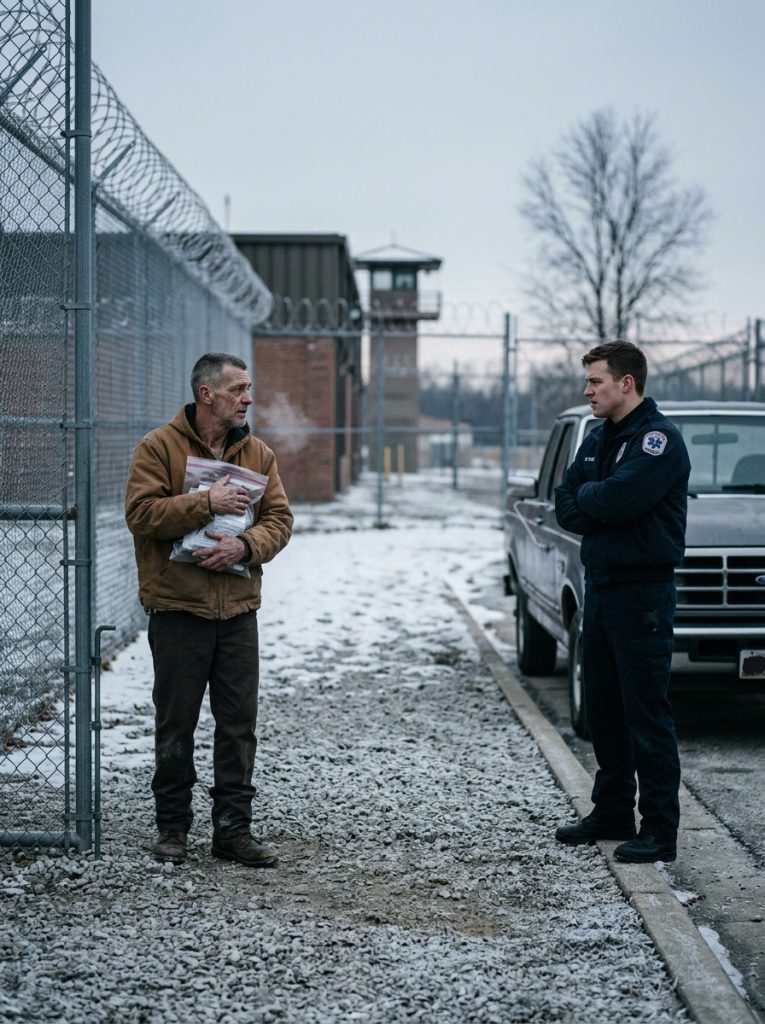
Ada Fenn stopped a few feet from us, the manila folder held against her chest like a shield.
“Raymond,” she said. “He’s a grown man now. He deserves to know what you gave up for him. I’ve kept your secret twelve years. I won’t carry it to my grave too.”
My father’s shoulders dropped. The fight just went out of him, all at once, the way it goes out of a man who’s been holding a door shut against a flood he always knew would win.
“Eli,” he said quietly. “Get in the truck. Please. I’ll tell you. All of it. But not standing here where they can watch.”
So we drove.
I don’t remember choosing to. I just remember the heater rattling and the wipers pushing snow off the glass and my father, small in the passenger seat, holding that plastic property bag in his lap like it was a child.
We parked at the overlook above the reservoir, the one we used to fish before everything fell apart.
And he told me.
“Your mother didn’t get sick the way you remember,” he said. “The cancer came first, yes. But the bills came right behind it. You were fourteen. We had no insurance worth the name. The treatments they wanted ran tens of thousands of dollars, and we didn’t have tens of thousands of dollars. We had a mortgage and a truck payment and a boy who needed shoes.”
I kept my eyes on the gray water.
“Your mother worked the office at Bell Brothers Supply. Bookkeeping. Payroll. She’d been there nine years. They trusted her with everything.” He took a breath. “And one month, when the bill came due and there was nothing left, she moved some money that wasn’t ours. Just to cover a treatment. She told herself she’d put it back.”
“No,” I said. Automatic. “Mom would never—”
“Your mother was dying and terrified and trying to buy herself enough time to see you grow up,” he said, and his voice cracked clean in half. “She wasn’t a thief, Eli. She was a mother. There’s a difference I’ve had twelve years to understand.”
The snow kept falling.
“She couldn’t put it back. The next bill was bigger. Then the next. Over a year, it added up to more than either of us could count. And then Bell Brothers brought in an outside auditor, and your mother came home one night gray as ash and told me they were going to find it within the week.”
He turned the property bag over in his hands.
“She wanted to confess. She was ready to. And I asked her one question.” He looked at me for the first time. “I asked her, ‘If you confess, where do you spend your last months?’ And we both knew the answer. A cell. A prison hospital, if she was lucky. Away from you. And after she was gone, you’d grow up the son of the woman who stole and got caught and died in disgrace.”
My hands had gone numb on the wheel.
“So I went to Ada,” he said. “And I told her I’d done it. That I’d used your mother’s logins, that I’d taken the money, that your mother knew nothing. I had access to the yard accounts, I knew enough to make it stick. I pled guilty to all of it. I wouldn’t name anyone else. I wouldn’t explain. The judge hates a man who won’t cooperate.” A faint, broken smile. “Twelve years.”
Ada’s words came back to me. I’ve kept your secret twelve years.
“Mom let you,” I whispered.
“Mom fought me,” he said. “She fought me until she didn’t have the strength to fight anymore. And then she let me give her the one thing I had left to give. Six months at home. In her own bed. With her son doing his homework at the kitchen table where she could see him.” His eyes filled. “She died thinking you’d remember her as your mother. Not as a headline. That was the deal, Eli. That was the whole deal.”
I sat there and felt twelve years of certainty crack and fall away like ice off a roof.
Every cold thing I’d ever thought about him. Every time I’d told someone he was dead. Every birthday I’d let pass without a card because I couldn’t stand to write his name.
He’d taken all of it. On purpose. And never once corrected me, because correcting me meant telling me the truth about my mother, and he’d rather I hate him than stop loving her.
I thought about the years in between.
After Mom died, I went to live with her sister in Columbus. I was the kid whose father was in prison. I heard it in the teachers’ lounge through a cracked door. I heard it at the lunch table. I stopped saying his name out loud, because every time I did, I watched people rearrange their faces.
I became a paramedic because I wanted to be the one who shows up when everything is falling apart. I told myself it had nothing to do with him.
Maybe that was a lie too.
“Why tell me now?” I managed.
“I wasn’t going to,” he admitted. “Ada’s the one who said you deserved the choice I never gave you. To know. To decide for yourself who to be angry at.” He reached into the property bag, down to the bottom, and drew out an envelope so soft and worn it looked like cloth. My mother’s handwriting on the front. My name.
“She wrote this the last week,” he said. “She made me promise that if you ever came to ask me why — if you ever cared enough to come — I’d give it to you. She said you’d come. I didn’t believe her.” His voice broke again. “You came.”
I took the envelope with shaking hands.
I won’t tell you everything she wrote. Some of it belongs only to me. But I’ll tell you the last line, because it’s the line that undid me, the line I’ll carry the rest of my life.
Be gentle with your father, my sweet boy. He is carrying my sin so that you could keep your mother. There never lived a better man, and I made him promise to let you hate him. Forgive me. And then, when you’re ready, forgive him.
I put my head down on the steering wheel of that old truck and I cried like the fourteen-year-old I’d never let myself be.
My father put his hand on the back of my neck, careful, like he wasn’t sure he was allowed.
“I’ve got you,” he said. “I’ve got you, son.”
It took me a long time to lift my head.
“Why didn’t you write me?” I asked. “Twelve years. You let me believe you were nothing. You could have at least written.”
“I wrote you every week,” he said.
I stared at him.
“I never sent a single one. Every letter, I’d get to the part where I had to explain myself, and I couldn’t do it without telling you about your mother. So I’d fold it up and put it in the bag.” He patted the worn plastic on his lap. “Twelve years of letters I couldn’t send. They’re all in here. You can read them. You can burn them. Your choice.”
I didn’t burn them.
The state never reopened the case. There was no point; the money was long gone into a dead woman’s medical bills, and the man who confessed had served his time. Bell Brothers had folded years before. Ada filed a quiet petition anyway, a letter for the record, so that somewhere in a county file it now says what really happened. It won’t give my father back his twelve years. Nothing will.
But it gave them back to me.
Raymond Cole lives in the spare room of my apartment in Dayton now. He’s slow in the mornings, and he flinches at loud doors, and he keeps his shoes lined up too neatly out of a habit I try not to think about. He comes on ride-alongs sometimes and waits in the truck, and the other medics call him Pop.
Every Sunday we drive out to my mother’s grave together.
He talks to her like she’s just in the next room. He tells her I came. He tells her I know. He tells her she was right about me, like she was right about everything.
And every Sunday, before we leave, my father rests his weathered hand on the cold stone and says the same quiet thing.
“Paid in full, Mar. He’s home. We both are.”