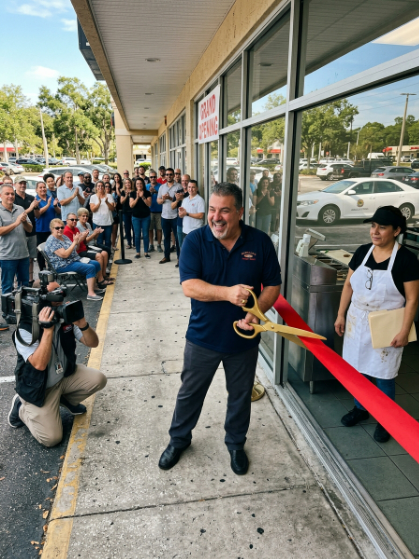
Two people got out of the white sedan with clipboards, and I watched Esperanza set her folder down on the counter and untie her apron strings — not to leave, but the way you straighten up when something you’ve waited a long time for finally walks through the door.
The inspectors didn’t rush. That’s the thing about county health inspectors; they move at the pace of people who know they hold all the cards. They crossed the lot in their plain polos while Vince was still posing with the golden scissors, the red ribbon now in two pieces drifting down on either side of him, the small crowd clapping.
He saw them when they reached the edge of the crowd. I saw the exact moment. His grin didn’t drop right away — guys like Vince have grins that run on momentum — but his eyes did. His eyes went to the clipboards and then to the emblem on the sedan and then, fast, through the window, to Esperanza.
“Mr. Morello?” the lead inspector said. “We’re with the county health department. We need a word about three of your locations.”
“We’re — this is a grand opening,” Vince said, laughing, spreading his arms to the crowd like they’d back him up. “Can we do this Monday? We’ve got press here.”
“No, sir. We can’t.”
They’d come about three stores. This new one, number fifty, and two of the older locations. And the violations they read off that clipboard — I was close enough to hear — were not new. A walk-in cooler failing to hold safe temperature. A reach-in freezer cited for ice buildup and inconsistent cooling. Evidence of pest activity near a dish station. Water intrusion behind a wall. Mold.
Every single one of them was something Esperanza had written down. For three years. On the forms. The forms that went in the trash.
Here’s what I didn’t know until that morning, what came out later: Esperanza hadn’t only filed internal maintenance requests. Two months earlier, a coworker’s little boy had eaten at one of those older stores and ended up in the hospital overnight. Food poisoning. The boy was okay. But something in Esperanza broke loose when she heard, because the cooler that store had been written up for internally was a cooler she’d flagged eleven separate times.
So she did the thing she’d never done in nineteen years. She went outside the family. She filed a formal complaint with the county — and she didn’t just complain, she attached copies. Three years of her own maintenance requests, dated, photographed, organized. She’d kept every single one. The county doesn’t ignore a complaint that arrives with its own evidence binder built by someone on the inside.
That’s what the folder on the counter was. Not the originals — she’s too smart for that. The copies. She’d brought them to the grand opening because she’d been told the inspection might land that day, and she wanted to be standing in the building she’d protected when it did.
Vince’s license to operate food service got suspended. Ninety days, across the cited locations, pending remediation and re-inspection. You can’t run a sandwich shop without it. The grand opening of store number fifty became, by that afternoon, the most photographed closure in the history of Dale Mabry Highway. The local news camera that came to film a ribbon cutting filmed something else entirely.
I’ll be honest with you — I felt sick watching it, and I wasn’t sure why, because Vince had it coming. I think it’s because I kept thinking about old Sal. The father. The man who’d handed Esperanza an apron when she had three words of English and a husband who’d just walked out. Sal built something real. And his son had let it rot from the cooler outward because the cooler doesn’t show up in a photograph.
Esperanza didn’t gloat. I watched her the whole time and she never once looked satisfied. When the inspectors finally came inside to walk the new store, she put her apron back on and walked them through it herself — showed them the equipment, answered every question, pointed out the two things in that brand-new kitchen she’d already flagged on the opening checklist. Even now. Even today. Still protecting the food. Still saying okay, Mr. Sal to a room that had forgotten him.
The part that actually made me put my coffee down came a few weeks later.
The franchise — the larger corporate body that licenses the Morello’s name — does not enjoy watching one of its owners lose a food-service license on the evening news. They launched their own review. And when they pulled the thread, they found the same thing the county found: a paper trail three years deep, every warning documented, every warning ignored. And they found the name of the person who’d written every one of them.
They offered Esperanza a job. Regional food-safety manager. A real title, a real salary, authority over the standards in every store in the region — including the ones that had thrown her reports in the trash. The woman they’d treated as invisible back-of-house labor for nineteen years would now be the person those stores answered to on the one subject she’d been right about all along.
She almost didn’t take it. She told me that, the next time I dropped bread. She said, “I’m a cook. I don’t know about being a manager.” I told her she’d been managing the safety of that food for two decades whether they paid her for it or not, and maybe it was time they paid her for it.
She was quiet for a second and then she told me the thing I’ve thought about ever since. She said that for nineteen years she’d believed if she just did her part right — wrote the reports, kept the copies, made the food safe with whatever broken equipment they gave her — that someone above her would eventually do their part too. That the system would work if she fed it honestly. “I was loyal to a promise nobody else was keeping,” she said. “For a long time I thought that made me a fool.”
It didn’t make her a fool. It made her the only adult in the building. The difference between Esperanza and Vince was never about who worked harder or cared more. It was that she understood the cooler was the company, and he thought the ribbon was. One of those beliefs sends a child to the hospital. The other one keeps a town fed for nineteen years.
She took the job.
She still works the line some mornings, though. Can’t help it. I still see her behind the counter, visor on, apron already losing the fight by eight a.m. But now there’s a different folder — a new one, an official one, with the franchise logo on the front. She keeps it on the prep counter where the old one used to sit.
And the first store she put on a corrective plan, the very first one, was the one with the cooler. The one that sent a coworker’s little boy to the hospital. She fixed it herself, in person, the first week. She told me the boy’s mother cried when she heard who was in charge of it now. They knew each other. Of course they did. Esperanza had trained half the line cooks in three counties.
Nineteen years she gave that name. Loyalty nobody asked for and nobody noticed. It turned out loyalty wasn’t the polo or the ribbon or the grin in front of the camera.
It was the woman behind the glass who never stopped writing it down.