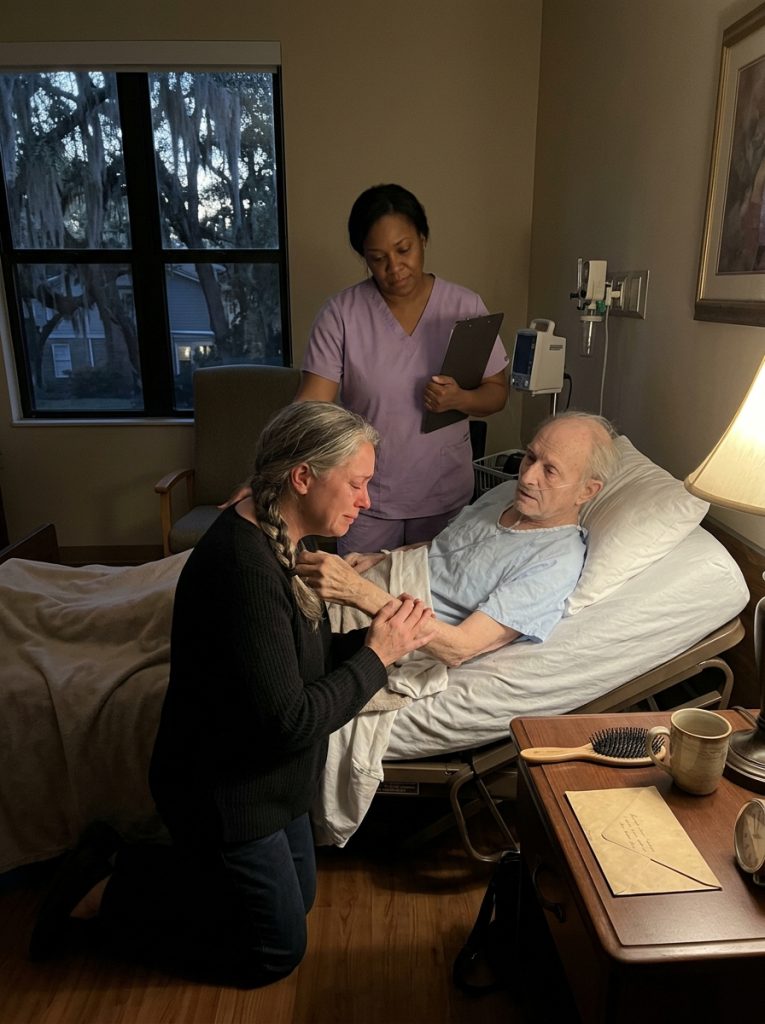
“Daddy,” I said, and my voice came out harder than I meant it to, “you’re dying. Why does it still matter to you whether you were right about me? Can’t you just let it go? For once?”
He shook his head against the pillow, slow and frantic at the same time. He gripped my hand with a strength I didn’t think he had left. His eyes were wet and desperate, and he managed four words that rearranged my entire life.
“Not you,” he rasped. “Me. I lied.”
I went very still.
Joy stepped closer. Earl’s breath was coming in pulls now, and he was racing it, trying to get the words out before it ran all the way down.
“The letter,” he said, eyes flicking to the yellowed envelope on the nightstand. “Read it. After. But the test— I need the test— so they can’t say I wasn’t in my right mind.”
I picked up the letter with a shaking hand. I didn’t open it then. I held it, and I held him, and I told Joy to do whatever he was asking.
She swabbed his cheek. She’d brought a second kit, already labeled, and at Earl’s insistence — a nod, a squeeze of my hand — she swabbed me too. He’d arranged a private lab, the rush kind, the kind that exists for exactly these impossible deadlines. Joy made the call.
Then my father, having spent the last clear strength he owned on getting that swab into a tube, sank back into the pillows and slept.
I sat with him through the night. Sometime in the small hours, with the lamp low and the machines quiet, I opened the letter.
It was dated thirty years ago. His handwriting, strong back then, nothing like the trembling hand on the bed.
It was a confession.
When I was a baby, my father had had an affair. A long one. And in the tangle of those years, there had been a question he never let anyone ask out loud — a question about my brother. About whether my brother, the “real Hamlin blood,” the favored son whose own son Earl had spent thirty years protecting in his will, was actually his.
Earl had suspected, for decades, that my brother was not his biological child. And he had buried that suspicion under the loudest possible accusation aimed in the opposite direction — at me. At my daughter. He called her “the stranger’s child” so ferociously, so publicly, for so long, that no one would ever think to wonder about the stranger in his own son’s parentage.
He’d made my innocent daughter the lightning rod to keep the storm away from the secret he couldn’t bear. Thirty years of cruelty to a little girl, all to protect a lie about himself.
The letter ended: “If you are reading this, I have finally found the courage I never had while I could still look you in the eye. I was a coward, Cleo. I punished your child for my own sin. I rewrote everything to hide it. I am so sorry. Make it right if I cannot.”
I cried in a way I hadn’t cried in years. Not from grief, exactly. From the unbearable waste of it. Thirty years. A grandchild he never held. A word he branded into my daughter. All of it to guard a wound he could have simply confessed.
The results came back the next afternoon. My father was still alive, barely, drifting in and out.
The lab confirmed it twice over. I am his biological daughter — never once in question, no matter what he’d accused. And my brother, the favored heir, the “real blood” Earl had structured the entire estate around, was not Earl’s son at all.
Every document my father had signed to disinherit my daughter had been built on an inversion of the truth. The “stranger’s child” he’d spent a fortune in lawyers keeping out was his own flesh and blood. The heir he’d protected was the child of the affair he’d never confessed.
I knelt by the bed again and told him. Gently. I told him the test was done, that the truth was on paper now, witnessed, with his competency documented by his own careful arrangement so that no one could ever wave it away.
I think he heard me. His hand moved in mine. The corner of his mouth — I’ll swear to this until I die — lifted, just slightly. Relief. The relief of a man who has finally set down a thing he carried for thirty years because he was too proud to ever put it down while he could be seen doing it.
He passed that night, with my hand in his, the letter on the pillow beside him.
I sat with the lab report for a long time before I told anyone outside that room. Part of me — a part I’m not proud of — wanted to walk it into every family gathering where my daughter had ever been called “the stranger’s child” and read it aloud. Thirty years of wanting to be believed does that to a person.
But my father had already done the cruel version of that, to my brother, in reverse, and look what it had cost us all. I wasn’t going to pick up the same weapon that had ruined our family just because it was finally pointed the other way. The truth was on record. It didn’t need a megaphone. It needed handling with more care than my father had ever managed.
What came after wasn’t simple. It never is. My brother — and I do still call him my brother, because biology is not the whole of family — was devastated by the letter in a way that had nothing to do with money. He’d spent his life as the favored one and learned, at fifty, that the favoring was a cover story. We’ve had to find each other again on new and stranger ground. We’re trying. The lie was Earl’s, not his, and I won’t let our father reach out of the grave to break what’s left of us.
The estate, with the truth finally on record, came to me and to my daughter — the granddaughter Earl never held, restored to the family he tried to wall her out of. She didn’t want the house at first. “It only ever held his cruelty,” she said. But we kept it. We’re filling it with new things. Her child runs through those old proud halls now, laughing, the great-grandchild of a man who’d have given anything, in the end, to take back the word he used.
My daughter came to the funeral. She didn’t have to. She stood at the back in a dark coat, and afterward she walked up to the casket of the man who’d spent her whole life pretending she wasn’t his, and she said something to him too quietly for me to hear. When I asked her later, she said, “I told him I forgave him. Because I didn’t want to carry him around the way you carried him around. That’s all.” Forty-nine years old, and it was my daughter who taught me how to set something down.
I keep the letter in a drawer. I don’t read it often. But sometimes, when the old anger tries to come back, I take it out and remember that my father spent his very last strength not on being proven right — but on being honest, finally, when honesty couldn’t buy him anything except a little peace and a little forgiveness from the daughter kneeling at his bed.
It was thirty years too late. He knew that. That’s the part that breaks my heart and the part that, somehow, lets me forgive him.
Her child runs those proud old halls now without the faintest idea they were ever forbidden ground, and that — more than any document — is what undoing a lie actually looks like. Not a courtroom. A great-grandchild laughing where a little girl was once made to feel like a guest.
He used his last breath to make it right.
Most people who wronged you never do.