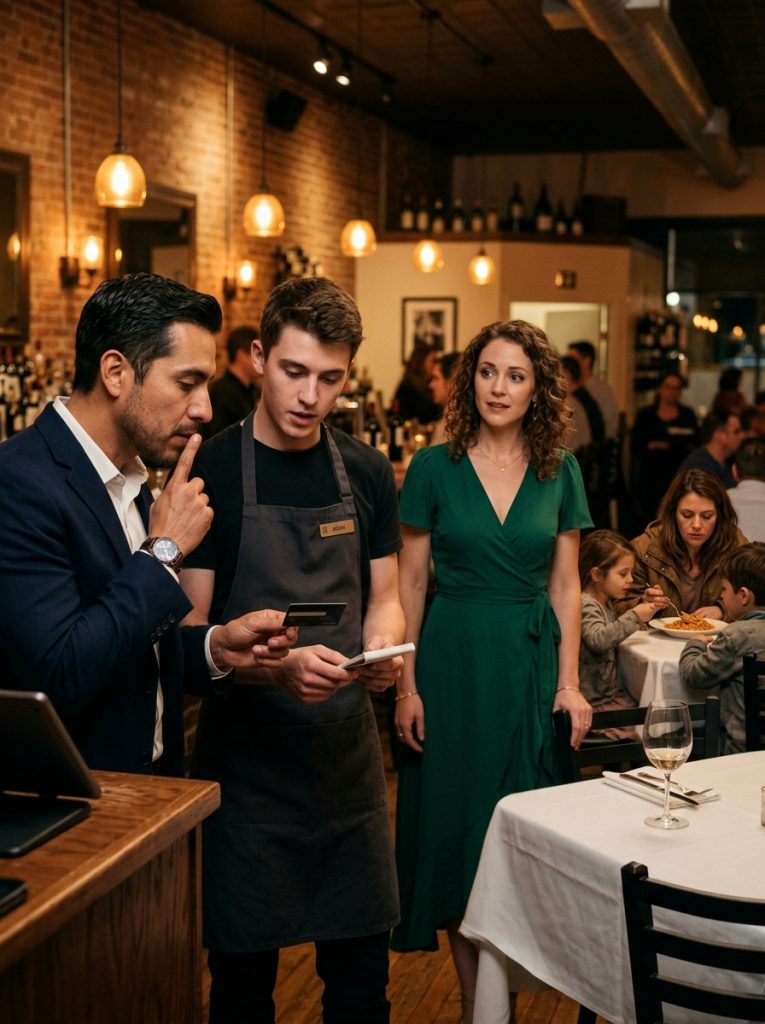
Daniel set down his water glass and looked at me for a second like he was deciding how honest to be.
Then he decided all the way.
“My mom waited tables,” he said. “Thirty years. A diner, then a steakhouse, then back to a diner when her knees went. She raised me on tips and double shifts in a one-bedroom in Pueblo.”
“Okay,” I said. I didn’t know where this was going yet.
“When I was a kid, she dated. Not a lot. She didn’t have time for a lot. But every so often a man would take her out, and I learned to tell the type by how they handled the check.”
He turned his fork a quarter-turn on the table. A small, precise motion.
“There was this one guy. Rick. He took her to the nicest place in town. Ordered the most expensive bottle on the list, loud enough that the next table heard. Tipped the waiter a hundred bucks and made sure everybody saw him do it. My mom came home glowing. She thought she’d finally met a generous man.”
“And?”
“And he’d promised to cover our rent that month. She was short. He knew. That’s part of why she let herself believe in him.” Daniel’s jaw tightened. “He never paid it. He vanished two weeks later. The big spender who tipped a hundred dollars to look good in front of strangers couldn’t be bothered to keep a quiet promise to a woman who actually needed it. We almost lost the apartment.”
He looked up at me.
“I was nine. I watched my mother cry at the kitchen table over a man who’d spent more on one dinner than the rent he didn’t pay. And I figured something out that night that I’ve never been able to un-figure-out.”
“What’s that,” I said quietly.
“Money spent so people will see it isn’t generosity. It’s a costume. Real generosity doesn’t want an audience. It actually kind of hates one.”
The whole restaurant rearranged itself around me.
The penny-splitting. The careful math. I’d read it as a man telling me how little he’d give. It was the exact opposite. It was a man refusing to put on Rick’s costume. Refusing to buy my good opinion with a gesture. Insisting that a first date be honest about money instead of a performance about it.
And then — when he thought no one was watching, when there was no audience, no date to impress, no credit to collect — quietly covering a stranger’s whole table because a tired mother was counting coins.
That was where his real money went. Where no one could see it. Where it actually landed on someone who needed it.
I’d spent my whole twenties building a theory of men out of how they handled checks. A confident theory. Smug, even. And I’d gotten it exactly, perfectly backwards.
The ones who’d grabbed the bill on date one to dazzle me were the same ones who, six weeks later, would “forget” their wallet, or keep a quiet ledger of everything they’d “done for me,” or use one grand gesture to paper over a hundred small unkindnesses.
The man across from me had simply declined to audition.
“I split the bill,” Daniel said, like he could hear me working it out, “because a date shouldn’t be a transaction. The second I pay for you, some part of your brain starts wondering what you owe me. I never want a woman sitting across from me doing that math. So I take it off the table. Literally.”
“And the giving you do when nobody’s looking?”
He shrugged, uncomfortable with the spotlight. “That’s not about being seen. That’s about a kid I used to be, watching his mom get stiffed. If I can keep one tired person from feeling how she felt — I’m going to. Quietly. It’s the only version that feels clean.”
I felt my face go hot.
“Daniel,” I said. “I have to tell you something, and it’s embarrassing.”
He waited.
“When you split the check, I thought you were cheap. I went to the restroom to figure out how to politely never see you again.”
I expected him to flinch. He laughed instead. A real one.
“Yeah,” he said. “I know how it looks. I’ve lost dates over it. The flashy thing works better, honestly. It’s just not true, so I can’t do it.”
“And the family in the corner —”
He looked genuinely alarmed. “You saw that?”
“I saw that.”
He rubbed the back of his neck, actually flustered for the first time all night. “That wasn’t — please don’t make it a thing. I didn’t do it for you. I didn’t know you were looking.”
“I know,” I said. “That’s the whole reason it counts.”
We stayed until they were stacking chairs.
He told me about his mom, who’s doing fine now, who he moved into a little place with good knees-friendly stairs the second he could afford to. I told him about the men I’d dated who threw cards on tables, and how I’d somehow still ended up trusting the gesture I should have distrusted and distrusting the one I should have trusted. We laughed at how backwards people get it.
When the check for that conversation came — coffee, this time, just coffee — he reached for it, then stopped himself, then grinned and slid it to the middle of the table.
“Split it?” he said.
“Split it,” I said. And I meant it like a promise.
He took me to meet his mother two months in.
She still has the diner laugh, the one that cuts clean through a room. She made far too much food, refused to let me lift a finger, and told me three stories about Daniel as a boy that he’d very clearly been dreading.
When he stepped out to take a call, she leaned across the table and took my hand.
“He tell you about Rick?” she asked. I nodded. Her eyes went soft and fierce at the same time. “My boy decided at nine years old that he was never going to make anybody feel the way that man made me feel. Cheap. Like something to be impressed and then forgotten.” She squeezed my fingers. “He splits the bill because he is the most careful man alive about how he makes people feel about money. Don’t you let anybody tell you that’s small.”
“I won’t,” I said. “I almost did. I won’t again.”
I’ve been seeing Daniel for a year now.
Here’s how I knew, really knew. About four months in, we were at a little taco place, nothing fancy, and our server was this frazzled kid clearly working through something hard. When the kid wasn’t looking, Daniel paid out the table behind us — an older couple splitting one plate, the way that corner family had split theirs — and asked the kid not to say who.
He still didn’t know I was watching. He never thinks I’m watching. He just does it. A reflex. The way some people can’t walk past a thing that’s wrong without trying to set it right.
I didn’t say anything that time. I just reached under the table and held his hand.
The thing about loving someone like Daniel is that you start to see the whole hidden economy of it.
The bills he quietly covers. The neighbor’s snowblower he “borrowed” and returned with a full tank and a new spark plug. The way he tips in cash so it can’t be clawed back. The way he never, ever mentions any of it.
I used to think generosity was a performance, because the only generous-looking men I’d ever met were performing.
Daniel taught me the real kind is almost invisible. You have to live beside it to see it at all. And once you can see it, you can’t unsee it, and you’d never want to.
He’d hate that I’m telling you this. He’d say it doesn’t count if you talk about it.
So don’t tell him.
People keep asking how it’s going with the guy who split the bill on our first date.
I tell them the truth.
He’s the most generous man I’ve ever met.
You just have to know where to look. He’ll never show you on purpose.