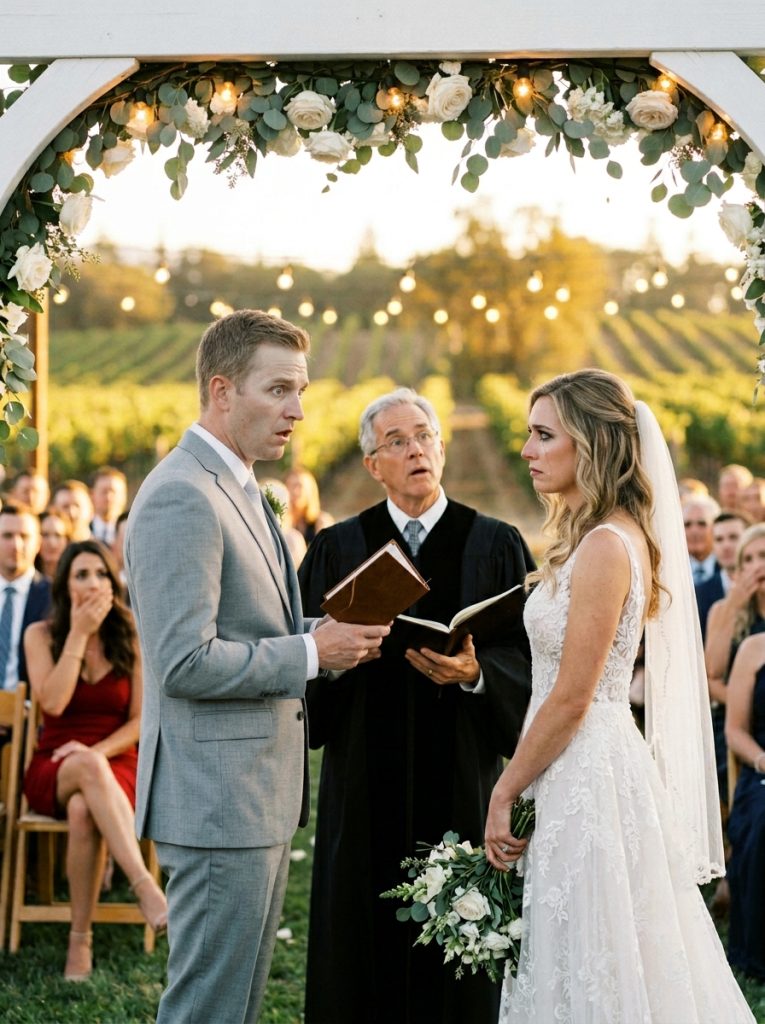
My voice didn’t shake. I’ve thought about that a lot since. I expected it to. It didn’t.
I held his vow book open in both hands, under that perfect arch, in that perfect light, and I read his words out loud to a hundred and forty people.
“From the morning you walked into my office,” I read, “I knew my life had two halves. The one before I knew you. And the one I’ve been trying to build close enough to you to survive.”
A sound moved through the guests. Low. Like wind.
I kept going.
“I tell myself it’s friendship because the other word would cost too much. But I count the hours until Monday. I’ve memorized your coffee order and forgotten my own. You are the reason I know I’m capable of loving someone the way the songs mean it.”
I looked up.
Mason’s face had gone the color of paper.
“This isn’t addressed to me,” I said to him. Quiet. Almost gentle. “There’s a name at the top. Do you want to read it, or should I?”
He couldn’t speak.
So I read it.
“Jenna.”
In the front row, the woman in the red dress made a noise like she’d been struck, and put her face in her hands, and the people on either side of her leaned away as if whatever she had might be catching.
I closed the book.
I want to tell you I planned what came next. I didn’t. It just arrived, clear and calm, the way the right thing sometimes does when you’ve stopped being afraid of the wrong one.
“I’m not going to marry you today,” I told Mason. Not cruel. Just true. “I think you’ve known that for longer than I have. I think that’s why there were two books.”
The officiant quietly closed his own.
Then Mason’s brother, Eli — his best man, standing right behind him — stepped forward. And what Eli did next is the part of this story I’ll be grateful for as long as I live.
“It wasn’t a mistake,” Eli said. To the whole crowd. To me. “The book. It wasn’t a mix-up. I switched them.”
Gasps. Mason turned on him.
“I found both of them last week, looking for the rings,” Eli said, his voice rough. “Two vow books. I read them both. And I begged you, Mason. I begged you for seven days to call this off or come clean. You kept saying you’d handle it. You kept saying it was nothing.” He shook his head. “I wasn’t going to stand up here and watch a good woman say ‘I do’ to a lie because my brother was too much of a coward to be honest. So I put the wrong book in your jacket. I’m sorry, Olivia. I’m not sorry enough to take it back.”
I crossed to him and I kissed him on the cheek, in front of everyone, because someone in that family had decided I was worth the truth, and it wasn’t the man I’d almost married.
Then I picked up my dress in both hands, and I walked back down that aisle alone.
I didn’t run. I want that on the record. I walked. Past my mother, who was already on her feet. Past a hundred faces I’d been so happy to invite that morning. Out from under the arch I’d dreamed about for two years.
It was the longest walk of my life and I did not stumble once.
My mother caught up to me in the vineyard rows. She didn’t say “I’m so sorry.” She said, “Good girl” — which is what she used to say when I was small and did something braver than I felt. Then she took off her own shawl and wrapped it around my shoulders, because I’d started to shake, and she walked me the rest of the way out.
Behind us, I could hear it starting. The rise of a hundred conversations at once. The sound a crowd makes when the thing they’re watching turns out to be bigger than the thing they came for.
I didn’t look back to see Mason’s face. I’d already seen it. And I’ll be honest with you: it wasn’t heartbreak on it. It was the look of a man calculating how to explain. Even then. Even there.
That look did more to heal me than any apology ever could have. Because it showed me, finally and completely, exactly who I’d almost married.
Here’s the part people don’t expect.
I didn’t cancel the reception.
It was paid for. The food, the band, the barn strung with a thousand lights, the open bar — all of it, bought and done. And as I stood in the parking lot shaking, my maid of honor, Dani, grabbed both my hands and said, “Olivia. There is a fully catered party in that barn with your name on it. Are you going to leave it to him?”
I was not going to leave it to him.
I walked into my own reception in my wedding dress and I told the band to play, and a hundred and twenty people who’d come for a wedding stayed for the best non-wedding any of them had ever been to. My grandmother did the twist. My college roommates cried and then danced. Somebody made a toast “to the bride, who dodged a bullet in white satin,” and the barn nearly came down with it.
My father found me by the cake — the cake we’d never cut, three ridiculous beautiful tiers of it.
“Want to cut it anyway?” he asked.
So we did. I put my hand on the knife and my father laid his hand over mine, the way he had at a hundred birthday cakes, and we cut the first slice of a wedding cake at a wedding that didn’t happen, and the room cheered like it was the most natural thing in the world.
I ate it standing up, in my gown, with my fingers. Lemon. Perfect. I’d chosen it myself, back when I thought the day belonged to a future that wasn’t going to exist. Turned out the cake was the one piece of that future I got to keep, and I was not about to let him have a bite.
Dani kept my glass full. The band took requests. At some point I kicked off my shoes, and the grass was cool, and the lights were warm, and I caught myself laughing — really laughing — and the strangest thought arrived and sat down beside me.
I was relieved.
Not brave. Not heartbroken. Relieved. Like I’d set down something I’d been carrying so long I’d stopped feeling the weight of it.
Mason didn’t come in. Mason and Jenna left in separate cars, which tells you everything about how that was always going to end. A grand romance is a thrilling thing to two people in secret. In the daylight, with a barn full of witnesses and both their reputations on the floor, it turned out to be a much smaller thing than the one Mason had thrown away.
They didn’t last the season. I heard it through the grapevine and I felt nothing, which is its own kind of freedom.
Mason texted me three weeks later. A long one. The word “closure” was in it twice. He wanted to “talk through what happened,” which I understood to mean he wanted me to help him feel better about what he’d done.
I didn’t answer. Some books you don’t owe anyone a second reading.
Eli, though — Eli I kept. My almost-brother-in-law. The man who’d rather blow up his own brother’s wedding than watch me marry a lie. He sends me a card every year on the anniversary of the day I didn’t get married. It just says: still the bravest walk I ever saw.
I keep his cards in the same drawer as the one note of Mason’s I never threw away. So I never forget the difference between the two men who stood up front that day.
I kept the dress. I don’t know why. It hangs in a garment bag in the back of my closet, and every so often I see it and instead of grief I feel this strange, fierce pride — for the woman who wore it, who stood under an arch with her heart breaking and read the truth out loud in a steady voice and then went and danced.
People ask if I regret not seeing the signs sooner. I tell them the signs were Mason’s job to show me honestly, not mine to hunt for.
People ask if it was the worst day of my life.
And I tell them the truth, which surprises them.
It was the day I almost made the worst mistake of my life — and didn’t.
The vows he wrote weren’t for me. I’ve made my peace with that.
Because the walk back down that aisle? That one was all mine.
And I have never moved more like a woman who knew exactly where she was going.