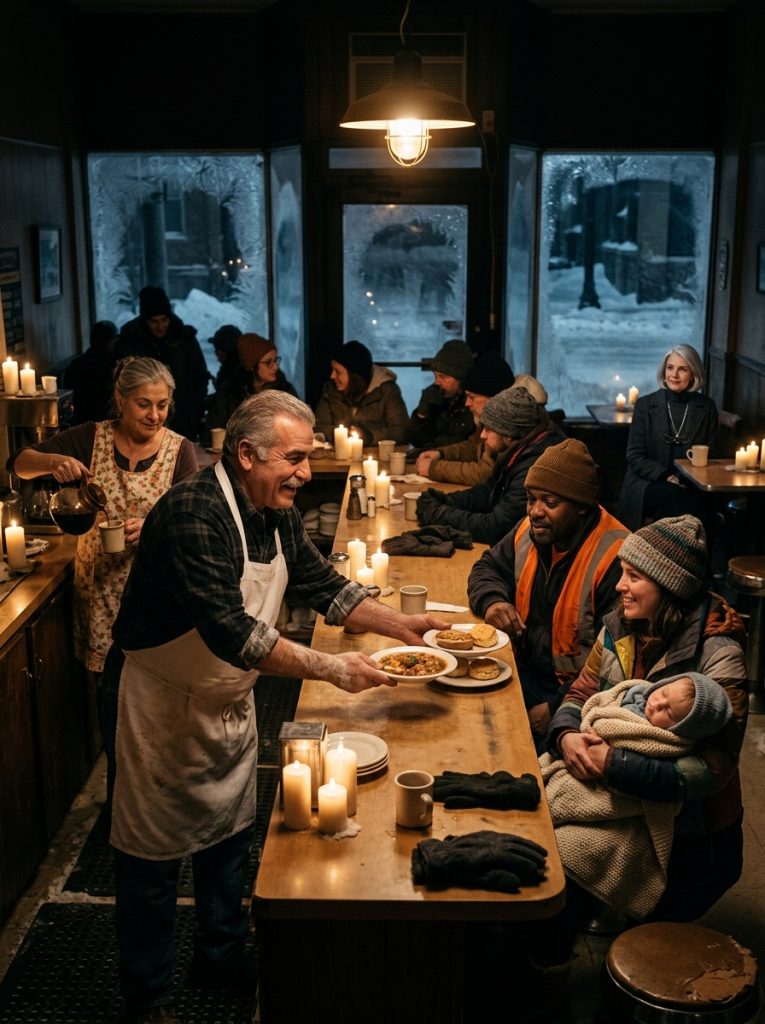
Sal made me wait, which I respected.
“When the rush dies down” meant after the last cold person was fed. After the young mother and her boy had a warm booth to sleep in. After he’d walked a thermos out to the cop in his cruiser. It was nearly two in the morning before he wiped his hands on his apron and slid onto the stool beside mine.
“Okay,” he said. “You’ve been watching me all night like a health inspector. So either I’m in trouble, or you want my hash brown recipe.”
“Neither,” I said. I handed him my card.
He read it twice. The foundation’s name. My title underneath.
“I run a fund that gives grants to the places that hold a neighborhood together,” I said. “I came to Erie this week to evaluate one specific property. Yours.”
His face changed. Not to hope. To worry.
“My landlord called you,” he said slowly. “Didn’t he. He’s trying to get you to take the building when the bank takes me.”
“He did call us,” I admitted. “He pitched it as a ‘community redevelopment opportunity.’ He had a whole slide deck. He never once mentioned the diner had a name. Or that anyone ate here.”
Sal nodded like a man absorbing a blow he’d seen coming for a while.
“I’m three months behind,” he said quietly. “Generator’s older than my marriage. I keep the lights on by not paying myself. I know exactly how it looks on a spreadsheet.”
“I don’t make my decisions off spreadsheets, Sal,” I said. “I make them off nights like this one.”
Here is the thing about my job that I never put in the brochures.
Anyone can perform generosity when there’s a camera or a donor in the room. I have watched men write enormous checks and treat the waiter who brought their coffee like a piece of furniture.
The foundation doesn’t fund the check-writers.
We fund the people who are exactly the same when they believe no one important is watching.
Sal Romano had spent an entire freezing night giving away his last crate of eggs to people who could do nothing for him, and tipping the register into a stranger’s coat pocket when he thought the room wasn’t looking.
He wasn’t trying to pass a test.
He didn’t know there was one.
That, in my experience, is the only kind of person who ever really passes it.
We cleared the back debt that week.
Not a loan. A grant. The Lamplight had quietly been a warming center, a soup kitchen, and a neighborhood anchor for thirty years without ever once calling itself any of those things. That is precisely what the fund exists for.
We bought him a generator that didn’t sound like it was dying. We set up a modest endowment so the diner could keep doing in daylight what I’d watched it do in the dark.
The landlord, when he learned the foundation was funding the tenant instead of buying out the building, was furious. He called to complain that Sal was “not a serious operator.”
I told him the truth: that he’d handed me a deck full of square footage and never once mentioned the people, and that his building was worth far less to us than the man he was trying to evict.
He hung up on me.
The diner is still there. His redevelopment isn’t.
The young mother from that night — her name is Kayla — works the morning shift now. Sal hired her in the spring. Her little boy does his homework in the corner booth, the same one where they slept through the blackout, except now there’s a cup of crayons on the table with his name on it.
I asked Sal once why he’d hire someone with no experience and a toddler in tow.
He looked at me like I’d asked why water is wet.
“She already knew the most important part of the job,” he said. “She knows what it’s like to be cold and counting on a stranger to be decent. You can’t teach that. You can only hire it.”
I went back to the Lamplight a year later, on a clear night this time, just to see.
It was packed. The new generator humming quiet in the back. Rosa working the coffee. A little hand-lettered plaque by the door I hadn’t asked them to put up.
It read: In a blackout, everyone eats. — house rule.
Sal saw me come in and pointed at the last window stool. The same one.
“Your seat,” he called across the room. “Nobody’s allowed to sit there. Bad for business — last person who did cost me a fortune.”
The whole counter laughed.
I sat down in my seat.
And for once in my professional life, I let somebody else pick up the check.
He wouldn’t take my money anyway.
Your money’s no good in here, he said.
And it never was again.