Brett was on his feet before I finished the sentence.
“This is theater,” he said to the room, hands spread, that easy smile working overtime. “She’s grieving. She’s grasping. You can’t just wave an envelope around and—”
“Then you won’t mind if I open it,” I said.
I handed it to Ruth Beasley, the lawyer my father had used for thirty years, the one who’d cried at his funeral. She slit it with a letter opener and read the header out loud so the whole town hall could hear what lab it came from, and the chain of custody, and the names on the samples.
Then she read the result.
“Probability of paternity between the sample labeled ‘Harlan Marsh’ and the sample labeled ‘Brett Calloway,'” she said, “zero percent.”
The room made a sound like wind through a barn.
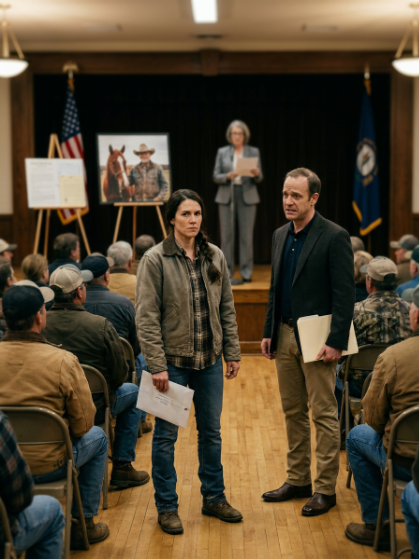
“Zero,” Ruth repeated. “These two men share no biological relationship. Whatever Mr. Calloway is, he is not Harlan Marsh’s son.”
Brett’s smile finally died. “Those samples could be anybody’s. She could’ve swabbed her dog. This is — you can’t admit this, it’s not — I have a birth certificate—”
“You have a birth certificate,” Ruth agreed, “that lists no father at all. We checked. The ‘amendment’ naming Harlan was filed four months ago. By you.” She set down a second folder. “We also pulled the county records clerk who processed it. Donny Pruett. Your old high school friend. He’s agreed to talk to the sheriff about the fee you paid him to backdate the paperwork. I’d imagine he’ll talk quite a lot.”
You could have heard a pin drop on that hardwood floor.
Here’s what Brett never understood about Marsh Hollow.
My father didn’t leave a will that “shut the door all the way,” that’s true. He was a rancher, not a lawyer, and he figured the people who’d worked the land would be the people who got it. He never imagined a stranger driving up with a story.
But he left something better than a tight will. He left thirty-four years of me. My name on the feed accounts. On the vet records. On the loan he and I signed together to save the south barn in ’09. On the breeding registry for every horse in that stable, including Clementine, the chestnut mare he’s photographed beside on that easel — the mare I foaled at two in the morning in a thunderstorm when I was nineteen.
The judge didn’t need a will to see whose farm it was. The DNA just made it impossible for anyone to pretend otherwise.
I should tell you it didn’t all happen in one clean night, because it didn’t. The months before that town hall were the worst of my life. Brett was good — I’ll give him that. He hired a publicist’s worth of charm and worked every diner and church social in the county. He told people I’d “isolated” my father in his last years, that I’d “kept the real family away.” He had an answer for everything, delivered with a wet-eyed catch in his voice.
For a while, people believed him over me. I’d find my truck keyed in the church lot. The bank “needed to review” the operating loan that had run clean for a decade. A man I’d sold hay to for fifteen years crossed the street to avoid me.
What Brett didn’t count on was that a working farm leaves a paper trail a mile deep, and that I’m the kind of stubborn that keeps every receipt. While he was charming the diner, I was in Ruth’s office until midnight, building the file. The samples. The forged amendment. The clerk. I didn’t go to that town hall to make a scene. I went with two years of evidence and one sealed envelope to put a bow on it.
Brett Calloway was charged with attempted fraud and forgery. So was Donny Pruett, the clerk. The “lawyer” who’d cried pie-tears for him at the diner turned out to be a paralegal Brett had met online; he vanished back to wherever he came from before the sheriff could get a statement.
The town turned again, of course. Faster than the first time. The same people who’d called me “the help” suddenly remembered they’d “always had their doubts about that fella.” I let them have it. You don’t run a farm by holding grudges against your whole county. You just remember.
A few didn’t need to remember, because they never wavered. Marcus down at the feed store. Old Ruth, who’d handled my father’s business and now handled mine for free that whole ugly year. The vet who’d known whose hands actually pulled the foals.
The deed is clear now. Marsh Hollow is mine, free of any claim, registered and recorded with my name on every line.
I kept the photo of Dad and Clementine. It hangs in the kitchen where his coffee cup used to sit.
Some mornings I take my own coffee out to the east pasture, to the oak where we buried him, and I tell him the herd’s doing fine.
Clementine threw a colt this spring. Strong little thing, chestnut like his mother, like the mare in that photograph.
I registered him under the Marsh name.
The only name, it turns out, that was ever really his to give.