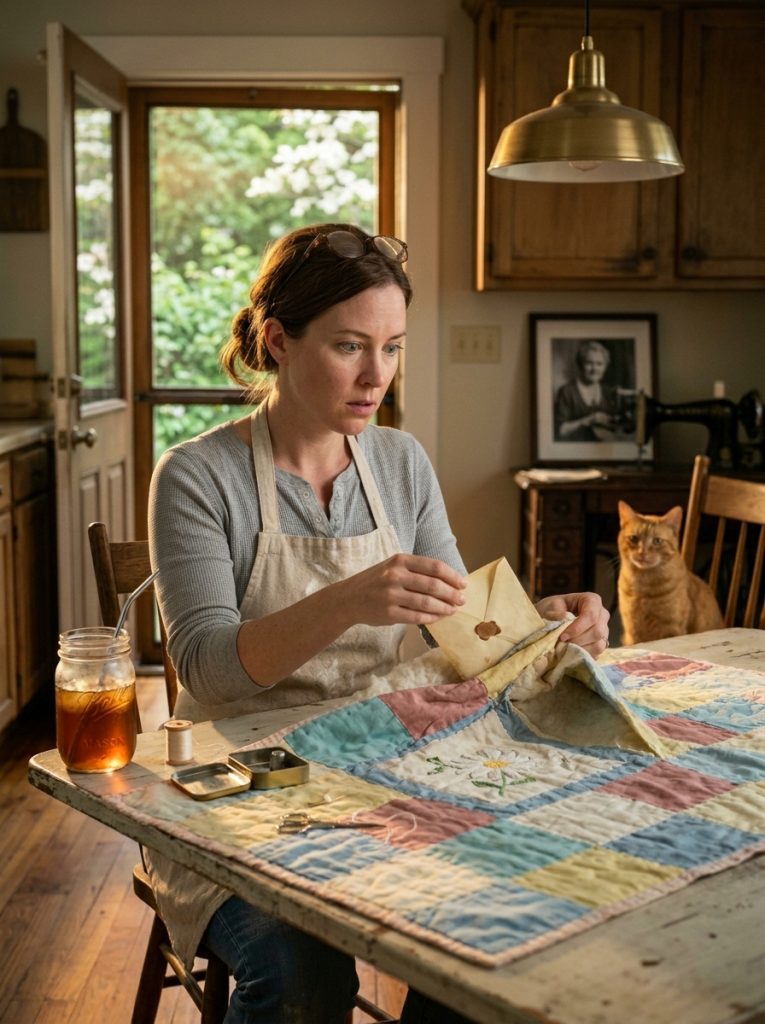
I am an Asheville bookkeeper, not a private investigator.
But I am also the granddaughter of a quiet woman who sewed a confession into a quilt and let three generations sleep under it, and that, it turned out, was preparation enough.
I started with the church.
The 1962 Catholic agency in Knoxville no longer existed under that name, but in 2018 the diocese had rolled up its old adoption records into a regional reunion registry. I called the registry on a Monday and they told me, gently, that they would not give me any names directly, but they would put a flag on a file. If a man matching the demographic information ever called the same registry looking for his birth mother, they would call me.
The match call came in eleven days later.
His name was Jonah Caldwell.
He was sixty-two. He had been searching, off and on, for thirty-seven years. He had been adopted at six days old by a couple in eastern Tennessee. He had grown up Caldwell because his adoptive father was the man who had stood on the other side of the curtain in 1962 and signed for him. James Caldwell, who had not known he was adopting his own son.
I had to read that paragraph from the registry’s letter twice.
Then a third time.
James Caldwell — the man on the envelope — had been told by my grandmother that the baby was being given to “a good family.” He had agreed to step away. He had then, three months later, been approached by a parish priest who said a young couple in his congregation had taken in a baby boy and were quietly looking for a witness who could co-sign the affidavit of awareness for the adoption to be finalized.
The priest had been a friend of my grandmother’s mother.
The priest had known.
The priest had, very deliberately and with what he considered grace, walked James Caldwell into the room where his own son lay in a bassinet, and had asked him to sign him into the family the priest believed could love him better than two scared twenty-two-year-olds could.
James Caldwell had been told the baby was an unrelated infant.
He had taken the baby home.
He had raised him.
He had died in 1989 without ever knowing.
I sat at the kitchen table for a very long time after I read all of that.
Pepper jumped onto my lap.
I called the registry’s case manager. I told her, in as steady a voice as I could find, that I had a letter from the birth mother, dated 1971, addressed to the man named on the file. I asked if she could put me in contact with Jonah.
She called me back the next afternoon.
She said, “Mr. Caldwell would like to meet you. He asks if you’d be willing to come to him. He’s in Maryville. He’s a retired science teacher. He says he doesn’t drive long distances anymore but he’ll meet you anywhere within an hour of his porch.”
I said, “Ma’am, I will drive to his porch.”
I drove to Maryville on a Saturday in late June.
His house was a small brick ranch on a street with old maples. The porch had a swing on it and a stack of birdwatching magazines on a side table. The door opened before I could ring the bell.
He was tall. Salt-and-pepper close-cropped beard. Pressed plaid Western shirt. Jeans. Steel watch. He looked, in the bones of his face, exactly the way I had imagined my grandmother’s father had looked in the one photograph I had ever seen of him.
He had her eyes.
I had not been ready for that.
He said, “Hollis?”
I said, “Yes, sir.”
He held out his hand. I shook it. We stood on his porch for a long second with my grandmother’s eyes on his face and her cheekbones on his cheekbones and a quilt’s worth of unsewn stitches between us.
He said, “You want to come in?”
He had laid out coffee. He had laid out store-bought cookies on a plate his late wife had picked out, he told me later. He had laid out a manila envelope that contained the only six pieces of paper he had ever owned about his own beginning.
I had brought the quilt.
I had brought the letter.
I had brought a Polaroid of my grandmother in her late seventies, holding the same quilt, on the porch of the Asheville bungalow.
I did not know how to start.
He started.
He said, “I had two parents. I had a good father. He worked for the railroad. He was kind. He loved me. I want to get that out of the way first because I don’t want to spend our afternoon making him a stranger.”
I said, “Yes, sir.”
“My mother — my adoptive mother — she was sweet but tired. She died when I was twenty. My father told me at her funeral that I had been adopted. He told me he had not known when he and my mother had brought me home. He said he had only learned a year before, when an old church friend had let it slip at a Christmas dinner. He said he had loved me anyway. He said he hoped I would not look. He said he understood if I did. He died ten years later.”
He looked at the manila envelope.
“I started looking at thirty. I gave up at fifty. I started looking again last year, after my wife passed. The registry called me on a Tuesday.”
He looked at me.
“You’re my niece.”
I said, “Sir. I think I’m — I think you’re my uncle. And my grandmother — was your mother.”
He said, “Tell me about her.”
I told him.
I told him about the Singer on the back porch. About the way she sang under her breath when she ironed. About the dahlias she grew in the front border. About the way she had, every Christmas, looked at the blue square at the center of the quilt for one second and then moved her eyes away.
I told him she had died eight years ago.
I told him that part as gently as I could.
He nodded the way you nod at news you have already braced for.
I read him the letter.
He cried with his hand pressed flat over his mouth, the way men of his generation cry when they do not want to let the sound out.
He said, “She was a coward. That’s what she says here. She wasn’t. She was a kid. She was a kid in 1962 in Tennessee and her mother and her priest told her what to do and she did it. The coward in this room is not her.”
I said, “I know, sir.”
He said, “I forgive her.”
He said it once. Steady.
He said, “Tell her, if you talk to her at the cemetery. Tell her I forgive her. Tell her I had a good father. Tell her I had a wife and we were married thirty-eight years and we had a son and a daughter and four grandchildren. Tell her two of them have her cheekbones and one of them, the youngest, sews. Tell her the family she was afraid she had given to a stranger never stopped being family.”
I said, “Yes, sir.”
Advertisement
I drove him to Asheville two months later for the dahlias. He sat at the kitchen table where I had unsewn the square. He ran his hand along the quilt. He held the unsealed envelope between his thumb and forefinger and then put it back, gently, into the cigar tin where I keep it now.
He met his nieces and nephews. They are my second cousins. They are also his nieces and nephews.
He stood at her grave in Riverside Cemetery in West Asheville on a Saturday in October and read the letter out loud, the whole letter, to a flat granite headstone with my grandmother’s name on it and a small carved daisy at the top.
He left the letter folded under a stone next to the headstone for a night.
He took it back with him in the morning.
He told me on the drive home, “I needed her to know I was here. I think she did know. I think the quilt was her way of leaving the door cracked, the way you crack a door for a cat.”
He laughed at himself for that line.
He kept it anyway.
The bittersweet part is that my grandmother died eight years too early. The bittersweet part is that James Caldwell raised his own son and never got to use the word. The bittersweet part is that there is no scene in any photograph in any drawer of any house I will ever live in where my grandmother and Jonah are sitting at the same table.
The other part, the part I want to say so I do not let only the bittersweet have it:
The quilt is finished now.
I sewed the daisy square back together myself, with white cotton, on the back porch where the Singer used to sit, on a quiet Sunday afternoon, while a sixty-two-year-old retired science teacher who is my uncle drank sweet tea on the porch swing and read his birdwatching magazines and corrected his great-niece on the difference between a chickadee and a Carolina wren.
The blue square is at the center of the quilt where it has always been.
The seam is steady.
There is no longer a letter inside it.
There is no longer a letter inside it because there is no longer a need for one.