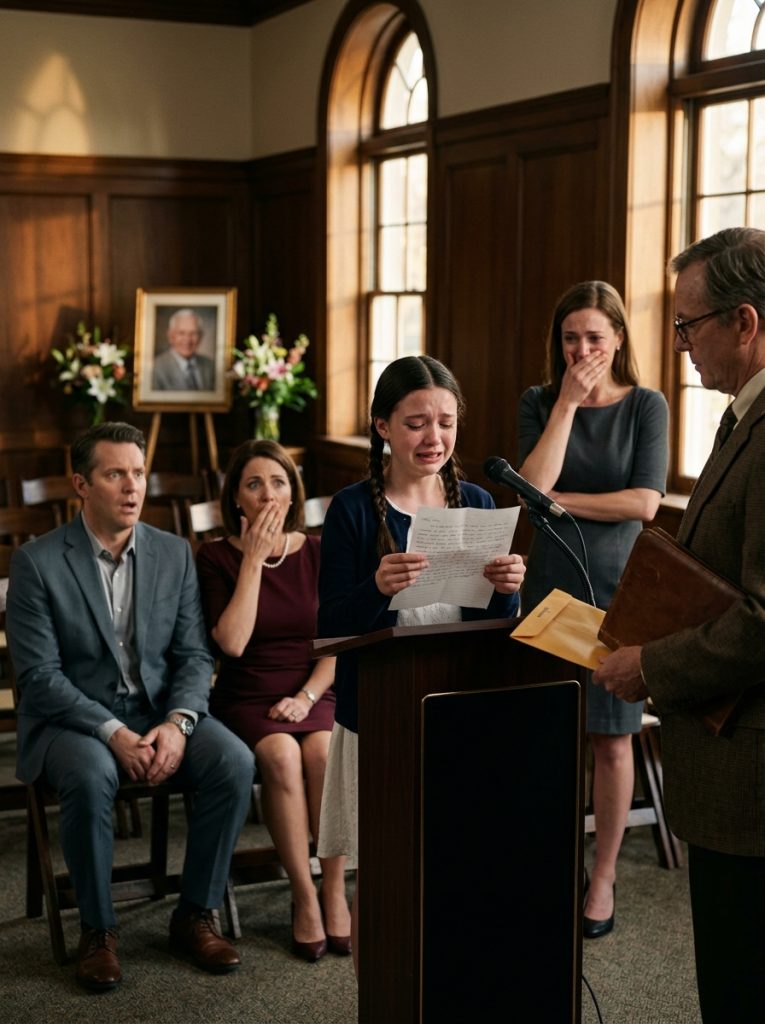
Lily didn’t stop.
She read the next line in a voice that filled the whole room.
“Uncle Greg called the house forty-one times in nine years. I counted in my notebook. Thirty-eight of those times, it was about money.”
Greg shot to his feet. “This is absurd. She’s a child. She doesn’t understand what she’s reading—”
“Sit down, Greg.” It was the first thing I’d said all afternoon, and I didn’t recognize my own voice. “Your father asked her to read it. Let her finish.”
He stared at me like he’d never actually heard me speak before. Maybe he hadn’t. Not in years.
Mr. Abernathy raised one hand. “The instructions were specific,” he said quietly. “Miss Lily reads first. Then I read the will. Mr. Mercer was very clear about the order.”
Greg sat. He sat because forty people were watching, and because the lawyer had said the word “will,” and a man like my brother will always sit down for the word “will.”
Lily kept going.
She read the names of the home nurses who’d cycled through the house. She read about the casseroles the neighbors left on the porch. She read about the night Dad slipped in the bathroom at 2 a.m. and it was an eight-year-old who dialed 911, because her mother was working a double to keep the lights on.
Then she read the part that broke the room.
“Grandpa wrote: I have spent my last year doing the math of my own life. I used to think love was the thing people say about you at the funeral. I was wrong. Love is who is in the room on the ordinary Tuesdays. My daughter Hannah was in the room. My granddaughter Lily was in the room. Everyone else, please stop pretending the door was ever locked.”
Lily folded the paper. She walked back to me and pressed her face into my shoulder.
Nobody clapped. Nobody breathed.
Mr. Abernathy opened the sealed envelope.
“There are two documents,” he said. “The first is the will most of you are expecting — drafted four years ago.” He paused, letting it land. “The second was executed eleven months ago and supersedes the first entirely. I hold the originals, witnessed and notarized.”
Diane’s pearls clicked as she sat up straight.
He read the new one.
The house in Asheville — the one I had scrubbed and cooked in and slept beside a dying man inside of — came to me. Outright.
What remained of the accounts went into a trust for Lily’s education, with Mr. Abernathy as trustee.
And then he held up a worn spiral notebook.
“Mr. Mercer kept this in the kitchen drawer,” he said. “He asked that it be entered into the record. Two hundred and forty-three dated entries. Every visit. Every ride to chemotherapy. Every grocery run and prescription pickup over nine years.” He turned it so the room could see the cramped, careful handwriting. “Every single entry is in his daughter’s name. There are no others.”
Greg’s face had gone the color of paper.
Because the next clause had his name in it.
“To my son Gregory,” Mr. Abernathy read, “who measured his father’s worth by what he stood to inherit, I leave the balance of the loan he secured against this estate in 2022 — which he must now repay to it, with interest, as the estate is no longer his to borrow against.”
The room made a sound I have never heard a room make before. A collective inhale, sharp as a slap.
Diane turned to her husband very slowly. “You did what?”
He didn’t answer her. He couldn’t. He’d borrowed against money that was never going to be his, told a bank a story about an inheritance, and now a twelve-year-old and a tweed-jacketed attorney had unwound the whole thing in under an hour.
He grabbed his coat. He walked out without once looking at the portrait of his father on the easel.
And that, more than any letter, told the room everything.
Here is the part I need you to understand.
I never wanted the house to be a verdict. I didn’t keep those years like receipts. I stayed because my father’s hands shook when he held a coffee cup, and because nobody should have to be afraid of the dark at seventy-six, and because he was mine and I was his.
The inheritance didn’t make any of that worth more. It just stopped other people from pretending it was worth nothing.
We stayed in Asheville.
Lily has the bedroom with the good morning light now. The notebook sits in the kitchen drawer where he kept it, and some evenings I open it just to look at his handwriting — proof, in his own hand, that he saw us the whole time.
Greg sends an email every few months through a lawyer about a payment plan. I read them. I don’t always answer.
On the first warm night of spring, Lily and I sat on the porch he built with his own hands, and she asked me if I thought Grandpa knew she’d be brave enough to stand up and read it.
I told her the truth.
He didn’t just hope she would.
He counted on it.